





 President’s Message
Steel Wire Armored (SWA) Data Cable
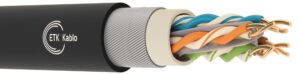
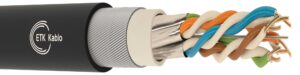
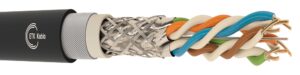
Cat 6A SWA Cable for Mechanically Protected 10 Gigabit Ethernet Networks
Cat 6A SWA Cable combines Category 6A Ethernet transmission with Steel Wire Armor for industrial, infrastructure and physically demanding network routes. ETK Kablo currently manufactures Steel Wire Armored Cat 6A cables in U/UTP, U/FTP and S/FTP architectures, allowing electromagnetic screening and mechanical protection to be specified separately.
The current ETK Kablo Cat 6A SWA range provides Category 6A transmission performance through 500 MHz for 10GBASE-T networks. Each published construction uses solid copper conductors, a halogen-free inner jacket, Steel Wire Armor and a halogen-free outer jacket. Depending on the selected product, the Ethernet core can remain unshielded or include individual pair foils and an overall copper braid.
Steel Wire Armor performs a mechanical function. It should not be confused with Al/PET foil or tinned copper braid used for electromagnetic screening. This distinction becomes particularly important in industrial Ethernet specifications because the same cable can contain several metallic layers that perform completely different engineering functions.
What Is a Cat 6A SWA Cable?
A Cat 6A SWA cable is a Category 6A balanced copper Ethernet cable with a Steel Wire Armor layer around the inner-jacketed data-cable core.
The steel armor adds mechanical protection for fixed network routes where conventional structured cabling can face greater physical exposure.
The underlying Ethernet core retains Category 6A electrical performance through 500 MHz. Therefore, adding SWA changes the mechanical construction without changing the cable into another network category.
What Does SWA Mean?
SWA means Steel Wire Armor.
ETK Kablo places the Steel Wire Armor outside the halogen-free inner jacket and then applies a halogen-free outer jacket around the complete cable.
SWA primarily addresses mechanical protection. It does not define whether the Ethernet pairs use electromagnetic shielding.
A complete project specification should therefore identify both:
- The Ethernet architecture: U/UTP, U/FTP or S/FTP
- The mechanical protection: Steel Wire Armor (SWA)
ETK Kablo Cat 6A SWA Cable Range
| Current Product | Ethernet Screening | Mechanical Protection |
|---|---|---|
| Cat 6A U/UTP LSOH SWA LSOH | No dedicated metallic data screen | Steel Wire Armor |
| Cat 6A U/FTP LSOH SWA LSOH | Individual Al/PET foil around each pair | Steel Wire Armor |
| Cat 6A S/FTP LSOH SWA LSOH | Individual pair foils + overall tinned copper braid | Steel Wire Armor |
The current range therefore provides three different electromagnetic-screening architectures with the same basic Steel Wire Armored mechanical concept.
Cat 6A SWA Cable Construction
The internal construction changes according to the selected Ethernet architecture. However, all three products share the same outer mechanical sequence:
- Cat 6A Ethernet cable core
- UV-resistant halogen-free inner jacket
- Steel Wire Armor
- UV-resistant halogen-free outer jacket
The U/FTP and S/FTP versions add electromagnetic-screening components inside the inner jacket, while the U/UTP version remains electrically unshielded.
Solid Copper Cat 6A SWA Cable
The current ETK Kablo Cat 6A SWA products use electrolytic solid copper conductors.
Solid copper provides stable conductor resistance and predictable electrical characteristics for fixed structured-cabling systems.
The current technical data publishes a maximum conductor resistance of 94 Ω/km at 20°C across the family.
Professional buyers should distinguish solid-copper Ethernet cable from copper-clad alternatives when network performance, Power over Ethernet and project compliance are important.
Why Conductor AWG Is Not Stated Here
The current live Cat 6A SWA product pages identify solid copper conductors but do not publish an AWG value or conductor diameter in the exposed technical tables.
For that reason, this category should not assign an exact AWG value unless the corresponding ETK Kablo datasheet or engineering specification confirms it.
This keeps the category aligned with the currently published technical evidence rather than inferring a conductor size from non-armored Cat 6A products.
Steel Wire Armor for Mechanical Protection
Steel Wire Armor surrounds the inner-jacketed Cat 6A core.
This layer adds mechanical protection for fixed installations where the network cable faces greater physical exposure than conventional LAN cabling.
Potential routes include industrial facilities, infrastructure pathways, technical buildings, utility areas and cable systems where mechanical protection forms part of the project specification.
However, Steel Wire Armor should not automatically be interpreted as qualification for every buried, flooded, chemically exposed or dynamic installation. Those requirements should be evaluated separately.
SWA Is Not the Same as Ethernet Shielding
Steel Wire Armor and electromagnetic screening perform different functions.
| Component | Main Function |
|---|---|
| Individual Al/PET pair foils | Electromagnetic screening around individual twisted pairs |
| Overall tinned copper braid | Overall electromagnetic screening |
| Tinned copper earthing wire | Supports screen continuity and termination |
| Steel Wire Armor | Mechanical protection |
A cable can therefore be mechanically armored while its Ethernet core remains electrically unshielded.
Likewise, a heavily screened Cat 6A cable can contain foil and copper braid without containing Steel Wire Armor.
Cat 6A U/UTP SWA Cable
Cat 6A U/UTP SWA Cable combines an electrically unshielded Category 6A core with Steel Wire Armor mechanical protection.
The current ETK Kablo construction includes:
- Electrolytic solid copper conductors
- Solid polyethylene insulation
- Four twisted pairs
- Star-shaped separator
- Halogen-free inner jacket
- Steel Wire Armor
- Halogen-free outer jacket
No dedicated foil or tinned copper electromagnetic braid surrounds the Ethernet pairs.
This construction clearly demonstrates why the terms armored and shielded should not be used interchangeably.
Cat 6A U/FTP SWA Cable
Cat 6A U/FTP SWA Cable combines individually foil-screened twisted pairs with Steel Wire Armor mechanical protection.
The current construction includes:
- Electrolytic solid copper conductors
- Foamed polyethylene insulation cladded with solid polyethylene
- Four twisted pairs
- Individual Al/PET foil around each pair
- Tinned copper earthing wire between the screened pairs
- Layered overall stranding
- Halogen-free inner jacket
- Steel Wire Armor
- Halogen-free outer jacket
The individual pair foils address electromagnetic performance. The Steel Wire Armor provides separate mechanical protection.
Cat 6A S/FTP SWA Cable
Cat 6A S/FTP SWA Cable combines comprehensive electromagnetic screening with an additional Steel Wire Armor mechanical layer.
The current construction includes:
- Electrolytic solid copper conductors
- Foamed polyethylene insulation cladded with solid polyethylene
- Individual Al/PET foil around each twisted pair
- Tinned copper earthing wire between screened pairs
- Overall tinned copper braid
- Halogen-free inner jacket
- Steel Wire Armor
- Halogen-free outer jacket
The individual pair foils and overall copper braid form the electromagnetic-screening system. Steel Wire Armor remains a separate mechanical-protection layer.
Copper Braid and Steel Armor Perform Different Functions
The S/FTP SWA construction contains several metallic components, so precise terminology matters.
| Metallic Component | Material | Main Purpose |
|---|---|---|
| Individual Pair Screens | Al/PET foil | Pair-level electromagnetic screening |
| Overall Screen | Tinned copper braid | Overall electromagnetic screening |
| Armor | Steel wire | Mechanical protection |
These layers should not be grouped together under a generic term such as shielding.
The foil and copper braid address EMC performance. The steel armor protects the cable mechanically.
U/UTP vs U/FTP vs S/FTP Cat 6A SWA
| Architecture | Individual Pair Foils | Overall Copper Braid | Steel Wire Armor |
|---|---|---|---|
| U/UTP SWA | No | No | Yes |
| U/FTP SWA | Yes | No | Yes |
| S/FTP SWA | Yes | Yes | Yes |
The electromagnetic environment should determine whether the Ethernet core uses U/UTP, U/FTP or S/FTP. The physical route should determine the requirement for Steel Wire Armor.
Why Is There No F/FTP SWA Product in the Current Range?
ETK Kablo's standard Cat 6A portfolio includes an F/FTP category. However, the currently published Cat 6A SWA category contains only U/UTP, U/FTP and S/FTP products.
A project requiring an F/FTP core together with Steel Wire Armor should therefore confirm availability with ETK Kablo rather than assuming that this construction forms part of the standard published range.
500 MHz Cat 6A SWA Performance
The current Cat 6A SWA products publish transmission characteristics through 500 MHz.
Relevant parameters include:
- Insertion loss
- Near-end crosstalk (NEXT)
- Power-sum NEXT
- Equal-level far-end crosstalk
- Power-sum equal-level far-end crosstalk
- Return loss
- Characteristic impedance
- Propagation velocity
The Steel Wire Armor does not increase the Category 6A frequency range. It mechanically protects a 500 MHz Ethernet cable core.
Cat 6A SWA Cable for 10 Gigabit Ethernet
Cat 6A SWA cable can support 10GBASE-T 10 Gigabit Ethernet when the complete installed structured-cabling channel meets the applicable Category 6A requirements.
Potential applications include:
- Industrial Ethernet
- Factory networks
- Industrial automation
- Energy infrastructure
- Utility facilities
- Transport infrastructure
- IP surveillance
- Technical buildings
- Commercial infrastructure
- Mechanically exposed 10 Gigabit Ethernet routes
The armor changes the mechanical construction without increasing the standardized Ethernet bandwidth or transmission distance.
10GBASE-T Channel Length
Category 6A is designed to support 10GBASE-T over a full balanced-copper structured-cabling channel when the complete installed system meets the applicable requirements.
A typical channel can extend to 100 meters, normally including up to 90 meters of permanent-link cable together with patch and equipment cords.
Steel Wire Armor does not extend this standardized Ethernet transmission distance.
Cat 6A SWA Cable for Industrial Ethernet
Industrial facilities can expose network cabling to mechanical stresses, electrical equipment and demanding routing conditions.
Steel Wire Armored Cat 6A cable can add mechanical protection for fixed 10 Gigabit Ethernet routes through factories, technical facilities and infrastructure pathways.
Electromagnetic screening should still be selected separately. U/UTP can suit controlled electromagnetic conditions, while U/FTP and S/FTP provide additional screening where required.
Cat 6A SWA Cable for Industrial Automation
Industrial automation networks increasingly use Ethernet between controllers, switches, machines and supervisory systems.
A mechanically protected Cat 6A construction can be relevant where the network route passes through physically exposed technical areas.
The Steel Wire Armor addresses physical protection, while the U/UTP, U/FTP or S/FTP core determines the electromagnetic-screening architecture.
SWA should not automatically be interpreted as continuous-flex, drag-chain or robotic-motion qualification. Those applications require separate product-design evidence.
Cat 6A SWA Cable for IP CCTV
High-resolution IP surveillance systems can require significant bandwidth together with Power over Ethernet.
Cat 6A SWA can provide additional mechanical protection for network routes serving cameras, switches and other surveillance infrastructure.
The electromagnetic environment should determine whether U/UTP, U/FTP or S/FTP is appropriate, while PoE loading should be evaluated independently from the Steel Wire Armor.
Cat 6A SWA Cable for Cable Trays
Industrial cable trays can carry Ethernet, control, instrumentation and power infrastructure within the same facility.
Where a Cat 6A route faces increased physical exposure, Steel Wire Armor can provide an additional mechanical layer.
U/FTP or S/FTP constructions can also provide electromagnetic screening where the project requires it.
Applicable cable-separation requirements from power circuits should still be followed.
Cat 6A SWA Cable for Infrastructure Routes
The current Cat 6A SWA constructions use UV-resistant halogen-free inner and outer jackets.
This architecture can be relevant to demanding fixed infrastructure routes where mechanical protection forms part of the specification.
However, outdoor, underground and buried installations can introduce moisture, water, chemical and environmental requirements that exist independently from the Steel Wire Armor.
Those route conditions should be defined during cable selection.
Can Cat 6A SWA Cable Be Installed Underground?
Steel Wire Armored Cat 6A can be relevant to underground ducts and infrastructure routes where additional mechanical protection is required.
Underground pathways can also expose cables to moisture, standing water, pulling loads and other environmental conditions.
The complete route should therefore be evaluated rather than treating SWA alone as confirmation of suitability for every underground installation.
Can Cat 6A SWA Cable Be Direct Buried?
Direct-burial suitability depends on the complete cable design and the environmental conditions of the installation.
Steel Wire Armor provides mechanical protection, but buried routes can also require specific moisture, water-blocking, chemical, tensile or environmental characteristics.
Projects requiring direct burial should provide the route conditions during the RFQ so that ETK Kablo can evaluate the appropriate construction.
Cat 6A SWA vs SWB Cable
| Feature | SWA | SWB |
|---|---|---|
| Full Name | Steel Wire Armor | Steel Wire Braid |
| Mechanical Construction | Steel wire armor layer | Braided steel-wire layer |
| Main Function | Mechanical protection | Mechanical protection |
| Category Frequency | 500 MHz | 500 MHz |
| 10GBASE-T | Supported within compliant channel | Supported within compliant channel |
| Current Core Options | U/UTP, U/FTP, S/FTP | U/UTP, U/FTP, S/FTP |
The mechanical conditions of the route should determine whether SWA or SWB is appropriate. Neither construction should automatically be described as universally superior.
Cat 6A SWA vs Standard Cat 6A Cable
| Feature | Cat 6A SWA | Standard Cat 6A |
|---|---|---|
| Frequency | 500 MHz | 500 MHz |
| 10GBASE-T | Supported within compliant channel | Supported within compliant channel |
| Steel Mechanical Protection | Yes | No |
| Electrical Screening | Depends on U/UTP, U/FTP or S/FTP | Depends on selected Cat 6A architecture |
| Main Selection Driver | Mechanical exposure + network requirement | Network and electromagnetic requirements |
Steel Wire Armor is therefore the defining additional feature. It does not create a category above Cat 6A.
Cat 6A SWA vs Cat 6 SWA Cable
| Characteristic | Cat 6 SWA | Cat 6A SWA |
|---|---|---|
| Category Frequency | 250 MHz | 500 MHz |
| Primary Ethernet Positioning | Gigabit Ethernet | 10GBASE-T |
| Mechanical Protection | Steel Wire Armor | Steel Wire Armor |
The SWA mechanical principle can remain similar while the Ethernet core changes substantially according to the required network category.
Cat 6A SWA vs Cat 7 or Cat 7A Armored Cable
Cat 6A operates through 500 MHz and targets 10GBASE-T structured cabling.
Cat 7 and Cat 7A belong to higher standardized channel classes with different frequency and screening architectures.
The presence of Steel Wire Armor does not turn Cat 6A into Cat 7 or Cat 7A. Network category and mechanical protection should remain separate specification items.
Cat 6A SWA vs Aerial Ethernet Cable
Steel Wire Armor and aerial messenger constructions solve different mechanical requirements.
| Construction | Main Purpose |
|---|---|
| Steel Wire Armor | Protects the cable mechanically |
| Aerial Messenger | Supports an overhead cable span |
An SWA cable should not automatically be treated as an aerial cable. Likewise, a messenger-supported Ethernet cable should not automatically be described as armored.
Cat 6A SWA Copper vs Armored Fiber Optic Cable
Steel-armored copper Ethernet and armored fiber optic cable address different network requirements.
Cat 6A copper provides 10GBASE-T connectivity and can form part of compatible Power over Ethernet systems.
Fiber optic cable provides electrical isolation, immunity to electromagnetic interference and substantially longer transmission distances.
For long building-to-building links, industrial infrastructure or electrically complex routes, project engineers should compare copper and fiber architectures before final specification.
LSOH Inner and Outer Jackets
The three current Cat 6A SWA products use halogen-free inner and outer jackets.
The current product pages publish applicable testing for:
- Smoke density
- Single-cable flame retardancy
- Corrosive-gas characteristics
- Halogen content
LSOH or LSZH describes material and reaction-to-fire characteristics. It does not establish fire-resistant circuit integrity such as FE180 or PH120.
Cat 6A SWA Electrical Characteristics
| Parameter | Current Published Value |
|---|---|
| Conductor Resistance at 20°C | Max. 94 Ω/km |
| Insulation Resistance at 20°C | 5000 MΩ/km |
| Mutual Capacitance | Max. 56 nF/km |
| Resistance Unbalance | 2% |
| Propagation Velocity | 78–80% |
| Characteristic Impedance | 100 Ω ±5% |
| Operating Voltage | 125 V DC |
| Test Voltage | 1200 V DC for 1 minute |
Cat 6A SWA Mechanical Characteristics
The current Cat 6A SWA product pages publish:
- Steel Wire Armor
- UV-resistant halogen-free inner jacket
- UV-resistant halogen-free outer jacket
- Minimum bending radius: 8xD
- Operating temperature: -20°C to +60°C
The current public product tables do not expose a complete family-level cable diameter, conductor AWG or packing table. Those values should therefore be confirmed from the exact product documentation during quotation rather than inferred at category level.
Cat 6A SWA Cable Standards
The current ETK Kablo Cat 6A SWA product pages reference:
- ANSI/TIA-568-C.2
- IEC 61156-5
- IEC 11801
The electrical-performance tables extend through 500 MHz.
Project specifications can require different standard editions, CPR classifications or additional approvals, so procurement teams should verify the requirements for the exact supplied construction.
Cat 6A SWA Cable and Power over Ethernet
Cat 6A SWA cable can form part of compatible Power over Ethernet systems.
The Steel Wire Armor does not determine PoE capability. Remote powering depends primarily on the electrical and thermal characteristics of the copper pairs.
Relevant design factors include:
- Conductor resistance
- Resistance unbalance
- Network distance
- Cable bundle size
- Ambient temperature
- Installation pathway
- Required PoE level
Mechanical armor should therefore be evaluated separately from the PoE electrical and thermal design.
How to Specify Cat 6A SWA Cable
A complete RFQ should define network performance, electromagnetic screening and mechanical requirements independently.
| Specification Item | Information to Provide |
|---|---|
| Category | Cat 6A |
| Bandwidth | 500 MHz |
| Network Requirement | 10GBASE-T or applicable Ethernet application |
| Mechanical Protection | Steel Wire Armor (SWA) |
| Ethernet Screening | U/UTP, U/FTP or S/FTP |
| Jacket | Current published range: LSOH inner and outer jackets |
| Installation Environment | Industrial, infrastructure, tray, duct or other mechanically exposed route |
| EMI Environment | Required electromagnetic-screening architecture |
| PoE Requirement | Required PoE application where applicable |
| Underground or Buried Route | Specify moisture and environmental conditions separately |
| Documentation | Datasheet, DoP where applicable and project-specific documentation |
Why Choose ETK Kablo for Cat 6A SWA Cable?
ETK Kablo manufactures Steel Wire Armored Cat 6A Ethernet cables for mechanically demanding 10 Gigabit network infrastructure.
The current range includes U/UTP, U/FTP and S/FTP electrical architectures, allowing electromagnetic screening to be selected independently from the SWA mechanical requirement.
The current products retain Category 6A transmission performance through 500 MHz while using halogen-free inner and outer jackets around the Steel Wire Armor.
ETK Kablo can evaluate SWA construction, Ethernet screening, installation conditions, PoE requirements and project documentation during the quotation process.
Frequently Asked Questions About Cat 6A SWA Cable
What is Cat 6A SWA cable?
Cat 6A SWA cable is a Category 6A Ethernet cable with Steel Wire Armor around the inner-jacketed cable core to provide additional mechanical protection.
What does SWA mean?
SWA means Steel Wire Armor. It describes the steel mechanical-protection layer around the cable.
What frequency is Cat 6A SWA cable?
The current ETK Kablo Cat 6A SWA products provide Category 6A transmission performance through 500 MHz.
Does Cat 6A SWA support 10 Gigabit Ethernet?
Yes. Cat 6A SWA cable can support 10GBASE-T when the complete installed structured-cabling channel meets the applicable Category 6A requirements.
Is SWA the same as Ethernet shielding?
No. Steel Wire Armor provides mechanical protection. Ethernet screening uses components such as Al/PET foil and tinned copper braid inside the data-cable core.
Can Cat 6A SWA cable be U/UTP?
Yes. ETK Kablo currently manufactures a U/UTP SWA construction with Steel Wire Armor but no dedicated metallic electromagnetic screen around the Ethernet pairs.
Does ETK Kablo manufacture U/FTP SWA Cat 6A?
Yes. The current U/FTP SWA product uses individual Al/PET foil screens around the twisted pairs together with a separate Steel Wire Armor mechanical layer.
Does ETK Kablo manufacture S/FTP SWA Cat 6A?
Yes. The current S/FTP SWA construction combines individual pair foils, an overall tinned copper braid and a separate Steel Wire Armor layer.
Does ETK Kablo manufacture F/FTP SWA Cat 6A?
An F/FTP product is not currently listed in the published Cat 6A SWA category. Projects requiring this configuration should confirm availability with ETK Kablo.
What is the difference between Cat 6A SWA and SWB?
SWA uses a steel wire armor construction, while SWB uses a braided steel-wire layer. Both provide mechanical protection through different physical constructions.
Is Cat 6A SWA cable LSZH?
The three currently published Cat 6A SWA products use halogen-free inner and outer jackets.
Is Cat 6A SWA cable fire resistant?
Not automatically. Halogen-free and flame-retardant material characteristics do not establish defined fire-resistant circuit integrity.
Can Cat 6A SWA cable be installed underground?
It can be relevant where an underground route requires additional mechanical protection, but moisture, water exposure and other environmental conditions should be evaluated separately.
Can Cat 6A SWA cable be directly buried?
Direct-burial suitability depends on the complete cable construction and installation conditions. Steel Wire Armor alone should not be treated as universal confirmation of direct-burial suitability.
Can Cat 6A SWA cable support PoE?
Cat 6A SWA cable can form part of compatible PoE systems. Conductor resistance, network distance, bundle conditions, ambient temperature and the required PoE level should form part of the system design.
What information should I provide when requesting a quotation?
Provide the Cat 6A requirement, SWA construction, U/UTP/U/FTP/S/FTP architecture, installation environment, underground or outdoor conditions where applicable, PoE requirement, quantity and required project documentation.


