





 President’s Message
Braid Screened
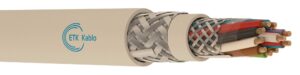
LI2YCHSWBH Signal Control Cable
SKU:
LI2YCHSWBH
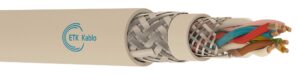
LI2YCHSWBH-TP/TT Signal Control Cable
SKU:
LI2YCHSWBH-TP/TT
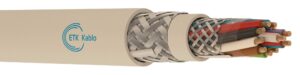
LIHCHSWBH Signal Control Cable
SKU:
LIHCHSWBH
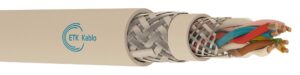
LIHCHSWBH-TP/TT Signal Control Cable
SKU:
LIHCHSWBH-TP/TT
LSZH Braid Screened SWB Signal Control Cables
Braid screened SWB cable constructions from ETK Kablo combine a tinned copper braid for electromagnetic screening with galvanized steel wire braiding for additional mechanical protection. This LSZH signal control cable category includes LIHCHSWBH and LI2YCHSWBH families in standard and TP/TT constructions.
All four products use IEC 60228 Class 5 stranded copper conductors, an overall tinned copper braid electrical screen, halogen-free inner and outer jackets and galvanized steel wire braiding. LIHCHSWBH uses halogen-free conductor insulation, while LI2YCHSWBH uses solid polyethylene insulation.
The two braided metallic layers perform different functions. The tinned copper braid is the dedicated electrical screen around the signal core, while the galvanized steel wire braid forms the outer mechanical-protection layer.
What Is a Braid Screened SWB Cable?
A braid screened SWB cable combines electromagnetic screening and mechanical protection within one signal-control construction.
First, a tinned copper braid surrounds the assembled signal core and provides the dedicated electrical screen. A halogen-free inner jacket then separates this screen from the galvanized steel wire braid applied outside it.
The galvanized SWB layer provides additional mechanical protection before the final halogen-free outer jacket is applied.
This distinction is important because the copper braid and steel braid should not be treated as interchangeable layers.
ETK Kablo Braid Screened SWB Cable Range
| Product | Conductor Insulation | Conductor Arrangement | Electrical Screen | Mechanical Protection |
|---|---|---|---|---|
| LIHCHSWBH Signal Control Cable | Halogen-free | Conductors stranded in layers | Tinned copper braid | Galvanized steel wire braid |
| LIHCHSWBH-TP/TT Signal Control Cable | Halogen-free | Twisted pairs or triads | Tinned copper braid | Galvanized steel wire braid |
| LI2YCHSWBH Signal Control Cable | Solid polyethylene | Conductors stranded in layers | Tinned copper braid | Galvanized steel wire braid |
| LI2YCHSWBH-TP/TT Signal Control Cable | Solid polyethylene | Twisted pairs or triads | Tinned copper braid | Galvanized steel wire braid |
How Is a Braid Screened SWB Cable Constructed?
The construction begins with IEC 60228 Class 5 stranded electrolytic copper conductors. The conductor-insulation material depends on the cable family.
LIHCHSWBH uses halogen-free conductor insulation. LI2YCHSWBH instead uses solid polyethylene insulation.
The assembled conductors are wrapped with polyester tape and surrounded by an overall tinned copper braid. This braid provides electromagnetic screening for the signal circuits.
A UV-resistant halogen-free inner jacket is then applied. Galvanized steel wire braiding surrounds this inner jacket to provide additional mechanical protection. Finally, a UV-resistant halogen-free outer jacket completes the cable.
LIHCHSWBH vs LI2YCHSWBH
| Feature | LIHCHSWBH | LI2YCHSWBH |
|---|---|---|
| Conductor | IEC 60228 Class 5 stranded copper | IEC 60228 Class 5 stranded copper |
| Conductor Insulation | Halogen-free | Solid polyethylene |
| Electrical Screen | Tinned copper braid | Tinned copper braid |
| Inner Jacket | Halogen-free | Halogen-free |
| Mechanical Protection | Galvanized steel wire braid | Galvanized steel wire braid |
| Outer Jacket | Halogen-free | Halogen-free |
The main difference between the two families is the conductor-insulation material. LIHCHSWBH uses halogen-free insulation, while LI2YCHSWBH uses solid polyethylene insulation.
This difference also affects insulation resistance. ETK Kablo publishes higher insulation-resistance values for the polyethylene-insulated LI2YCHSWBH family.
Standard vs TP/TT Construction
| Construction | Conductor Arrangement | Individual Pair/Triad Screen | Overall Copper Braid | SWB Protection |
|---|---|---|---|---|
| Standard | Conductors stranded in layers | No | Yes | Yes |
| TP/TT | Twisted pairs or triads | No | Yes | Yes |
Standard LIHCHSWBH and LI2YCHSWBH use a conventional layered conductor arrangement.
TP/TT versions first organize the insulated conductors into twisted pairs or triads. These groups are then stranded together before the overall tinned copper braid is applied.
TP/TT therefore describes conductor grouping. It does not mean that each pair or triad has its own metallic screen.
What Do TP and TT Mean?
TP refers to twisted pairs, while TT refers to twisted triads.
These arrangements keep related conductors together within the cable core. They can be useful in signal, measurement and control circuits that use paired or three-conductor circuit organization.
However, both LIHCHSWBH-TP/TT and LI2YCHSWBH-TP/TT use one overall tinned copper braid around the complete cable core. They do not contain separate metallic screens around individual pairs or triads.
Why Are There Two Different Braid Layers?
| Layer | Material | Main Function |
|---|---|---|
| Electrical Screen | Tinned copper braid | Electromagnetic screening |
| Inner Jacket | Halogen-free compound | Separates electrical screen from mechanical layer |
| SWB Layer | Galvanized steel wire braid | Mechanical protection |
The copper braid is electrically conductive and specifically forms the signal-screening layer.
The galvanized steel braid is installed outside the inner jacket and primarily addresses mechanical protection. Therefore, the word “braid” can refer to two completely different functions within the same cable construction.
Braid Screened SWB vs Foil Screened SWB Cable
The wider LSZH steel wire braided signal control cable range also includes foil-screened constructions.
In a foil screened SWB cable, the dedicated electrical screen is an Al/PET foil with a tinned copper earthing wire.
In the products on this page, the electrical screen is instead a tinned copper braid. Both constructions retain a separate galvanized steel wire braid for mechanical protection.
| Feature | Foil Screened SWB | Braid Screened SWB |
|---|---|---|
| Electrical Screen | Al/PET foil | Tinned copper braid |
| Mechanical Layer | Galvanized steel wire braid | Galvanized steel wire braid |
| Inner Jacket | Halogen-free | Halogen-free |
| Outer Jacket | Halogen-free | Halogen-free |
Braid Screened vs Foil and Braid Screened SWB Cable
ETK Kablo also offers foil and braid screened SWB signal control cables.
Those constructions use both an Al/PET foil and a tinned copper braid as the electrical-screening system. The products on this page use only the tinned copper braid as their dedicated electrical screen.
Both ranges subsequently add a halogen-free inner jacket, galvanized steel wire braid and halogen-free outer jacket.
Additional screening layers should be selected according to the electromagnetic environment and project specification rather than simply assuming that more metallic layers always provide the best solution.
SWB vs SWA Braid Screened Signal Cable
The comparable braid screened SWA signal control cable range uses steel wire armor instead of galvanized steel wire braiding as the mechanical layer.
| Feature | SWB | SWA |
|---|---|---|
| Electrical Screen | Tinned copper braid | Tinned copper braid |
| Mechanical Protection | Galvanized steel wire braid | Galvanized steel wire armor |
| Primary Difference | Braided steel mechanical construction | Steel-wire armor construction |
The required mechanical construction should follow route conditions and the project specification. SWA or SWB should not automatically be treated as universally superior to the other.
Electrical Characteristics
Electrical ratings vary according to conductor cross-section and conductor-insulation material.
| Conductor Cross-Section | Operating Voltage | Test Voltage | LIHCH Insulation Resistance | LI2YCH Insulation Resistance |
|---|---|---|---|---|
| 0.22–0.34 mm² | 250 V DC | 1200 V DC / 1 min | 200 MΩ/km | 5000 MΩ/km |
| 0.50–2.50 mm² | 300/500 V | 2000 V DC / 1 min | 20 MΩ/km | 5000 MΩ/km |
The published maximum conductor resistance ranges from 85.0 Ω/km for 0.22 mm² to 7.98 Ω/km for 2.50 mm² at 20°C.
Because electrical values vary by conductor size and insulation system, project specifications should refer to the technical data of the selected cable rather than applying one value to the complete family.
Operating Temperature and Bending Radius
ETK Kablo currently publishes an operating temperature range of -30°C to +70°C for the products in this category.
The published minimum bending radius is 7.5 × D, where D is the actual outer diameter of the selected cable.
IEC 60228 Class 5 stranded conductors provide installation flexibility. However, Class 5 construction alone does not qualify these cables for drag chains, robotics or continuous-flex applications.
LSZH and Fire Behavior
Current ETK Kablo documentation lists IEC 61034-2 for smoke density, IEC 60754-1 and IEC 60754-2 for halogen and corrosive-gas behavior, IEC 60332-3-24 for flame propagation and IEC 60332-1-2 for flame retardancy.
These characteristics describe smoke, halogen and flame-related behavior. They do not mean that the cable maintains circuit integrity during fire.
LSZH and flame-retardant performance should therefore not be interpreted as FE180, PH120, E30, E60 or E90 performance unless the specific construction has been designed and tested for the relevant requirement.
LSZH Is Not the Same as CPR
LSZH and CPR describe different fire-related characteristics.
LSZH relates to material, smoke and halogen behavior. CPR concerns reaction-to-fire classification for an applicable cable construction.
A specific B2ca, Cca, Dca or other Euroclass should be confirmed from the applicable Declaration of Performance rather than inferred from the term LSZH.
Can Braid Screened SWB Cable Be Directly Buried?
Galvanized steel wire braiding alone should not be treated as proof of direct-burial suitability.
Underground installations can expose cables to moisture, standing water, chemicals and mechanical installation loads. The complete cable construction and route conditions must therefore be considered separately.
Where Are Braid Screened SWB Signal Cables Used?
These cables can be considered for fixed low-voltage signal, automation, monitoring and control circuits where the project requires both copper-braid electromagnetic screening and additional mechanical protection.
Typical applications can include industrial automation, manufacturing facilities, process control, control panels, building-management systems, HVAC controls, sensors, actuators and fixed signal routes exposed to increased mechanical stress.
Final cable selection should consider signal sensitivity, interference sources, conductor grouping, mechanical conditions, circuit voltage and fire-related requirements.
How to Select a Braid Screened SWB Cable
First, select the conductor-insulation system. LIHCHSWBH uses halogen-free conductor insulation, while LI2YCHSWBH uses solid polyethylene insulation.
Next, define the conductor arrangement. Standard versions use conductors stranded in layers, while TP/TT versions organize conductors into twisted pairs or triads.
Then define conductor cross-section, conductor or pair/triad count, operating voltage and total cable length.
Finally, confirm mechanical route conditions, LSZH requirements, CPR classification where applicable, bending radius, marking, packing and required project documentation.
What Should an RFQ Include?
A clear RFQ should identify LIHCHSWBH or LI2YCHSWBH, conductor cross-section, conductor or pair/triad count and whether standard or TP/TT construction is required.
The request should also state total cable length and any required CPR classification, test documentation, cable marking and packing requirements.
ETK Kablo as a Braid Screened SWB Cable Manufacturer
ETK Kablo manufactures braid-screened steel wire braided signal control cables at its production facility in Istanbul, Türkiye.
The range combines tinned copper braid electromagnetic screening with galvanized steel wire braid mechanical protection and includes LIHCHSWBH and LI2YCHSWBH constructions for distributors, automation contractors, system integrators, OEMs and industrial projects.
What Determines Braid Screened SWB Cable Price?
Braid screened SWB cable price depends on conductor cross-section, conductor or pair count, copper content, conductor-insulation material, copper-braid content, galvanized steel wire braid content, cable diameter, order quantity and required documentation.
The cable contains both a copper screening braid and a separate galvanized steel mechanical braid. Therefore, changes in diameter and braid requirements can materially affect total metallic content and cable cost.
Commercial comparisons should use equivalent conductor sizes, conductor arrangements, screening systems, mechanical protection, fire requirements and documentation scope.
Frequently Asked Questions
What is a braid screened SWB cable?
It is a signal or control cable that uses a tinned copper braid for electromagnetic screening together with galvanized steel wire braiding for additional mechanical protection.
What is LIHCHSWBH cable?
LIHCHSWBH uses Class 5 stranded copper conductors, halogen-free conductor insulation, an overall tinned copper braid, halogen-free inner and outer jackets and galvanized steel wire braiding.
What is LI2YCHSWBH cable?
LI2YCHSWBH uses Class 5 stranded copper conductors with solid polyethylene insulation, an overall tinned copper braid, halogen-free inner and outer jackets and galvanized steel wire braiding.
What is the difference between the copper braid and SWB?
The tinned copper braid provides electromagnetic screening. The galvanized steel wire braid provides additional mechanical protection.
What do TP and TT mean?
TP refers to twisted pairs and TT refers to twisted triads. They describe conductor grouping rather than individual electrical screening.
Does this category include PiMF/TiMF cables?
No. The current ETK Kablo braid-screened SWB category contains standard and TP/TT constructions. PiMF/TiMF products are not listed in this branch.
Is an LSZH SWB cable fire resistant?
Not automatically. LSZH and flame-retardant characteristics do not provide FE180, PH120 or another circuit-integrity rating unless the selected cable has been specifically designed and tested for that requirement.
Can an SWB cable be directly buried?
The presence of galvanized steel wire braiding alone does not establish direct-burial suitability. The complete cable construction and environmental conditions must be evaluated.
What is the operating temperature?
ETK Kablo currently publishes an operating temperature range of -30°C to +70°C for these products.
What is the minimum bending radius?
The current technical data specifies 7.5 × D, where D is the actual outer diameter of the selected cable.
What determines braid screened SWB cable price?
Important factors include conductor size, conductor or pair count, copper content, electrical-screen braid, steel-wire-braid content, cable diameter, order quantity and required technical documentation.


