





 President’s Message
Unscreened Signal Control Cable
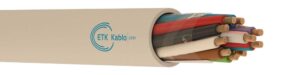
LIHH Signal Control Cable
SKU:
LIHH
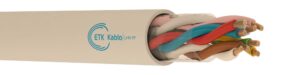
LIHH-TP/TT Signal Control Cable
SKU:
LIHH-TP/TT
LSZH Unscreened Signal Control Cables | LIHH & LIHH-TP/TT
LSZH unscreened signal cable is designed for low-voltage signal and control circuits that require halogen-free materials but do not require a dedicated metallic electromagnetic screen. ETK Kablo manufactures this category in LIHH and LIHH-TP/TT constructions for automation, monitoring, building control and industrial signal applications.
Both products use IEC 60228 Class 5 stranded electrolytic copper conductors, halogen-free insulation, polyester tape and a UV-resistant halogen-free outer jacket. Standard LIHH arranges the insulated conductors in layers, while LIHH-TP/TT organizes them into twisted pairs or triads before the groups are stranded together.
Neither construction contains an overall Al/PET foil, tinned copper braid or individual metallic pair screen. Therefore, these cables are suitable for projects that require LSZH materials and where the electromagnetic environment does not call for additional metallic screening.
What Is an LSZH Unscreened Signal Cable?
An LSZH unscreened signal cable combines a halogen-free material system with an unscreened electrical construction. In the current ETK Kablo LIHH range, both the conductor insulation and the outer jacket use halogen-free materials.
The term unscreened means that the cable does not include a dedicated metallic electromagnetic screen such as an Al/PET foil or tinned copper braid around the cable core.
These two characteristics describe different functions. LSZH relates to smoke and halogen behavior, while unscreened describes the electromagnetic screening configuration. A cable can therefore be LSZH and unscreened, or LSZH and screened.
ETK Kablo LSZH Unscreened Signal Cable Range
| Product | Conductor Arrangement | Metallic Screen | Outer Jacket |
|---|---|---|---|
| LIHH Signal Control Cable | Conductors stranded in layers | None | Halogen-free |
| LIHH-TP/TT Signal Control Cable | Conductors arranged in twisted pairs or triads | None | Halogen-free |
The principal difference between LIHH and LIHH-TP/TT is the internal conductor arrangement. Both cables remain unscreened.
What Is LIHH Cable?
LIHH is ETK Kablo's standard unscreened halogen-free signal control cable.
The current construction uses IEC 60228 Class 5 stranded copper conductors with halogen-free insulation. The insulated conductors are stranded together in layers, wrapped with polyester tape and completed with a UV-resistant halogen-free outer jacket.
Because the construction does not contain a dedicated metallic screen, LIHH can suit low-voltage signal and control circuits where the project requires halogen-free materials and the electromagnetic environment allows an unscreened cable.
What Is LIHH-TP/TT Cable?
LIHH-TP/TT uses the same basic halogen-free material concept but changes the conductor arrangement.
In the TP construction, insulated conductors are twisted into pairs. In the TT construction, they are arranged into triads. The resulting pairs or triads are then stranded together to form the cable core.
This configuration allows designers to keep conductors that belong to the same signal or control circuit together. However, TP and TT describe conductor grouping; they do not indicate metallic screening.
LIHH vs LIHH-TP/TT
| Feature | LIHH | LIHH-TP/TT |
|---|---|---|
| Conductor | IEC 60228 Class 5 copper | IEC 60228 Class 5 copper |
| Insulation | Halogen-free | Halogen-free |
| Conductor Arrangement | Stranded in layers | Twisted pairs or triads |
| Overall Metallic Screen | None | None |
| Individual Group Screen | None | None |
| Outer Jacket | Halogen-free | Halogen-free |
Standard LIHH suits applications where a conventional multicore arrangement meets the circuit design. By contrast, LIHH-TP/TT can be selected when the project requires conductors to remain organized as pairs or triads.
What Do TP and TT Mean?
TP refers to a twisted-pair arrangement, while TT refers to a twisted-triad arrangement.
A twisted pair groups two insulated conductors together. A twisted triad groups three conductors. This organization can help maintain the intended relationship between conductors that belong to the same measurement, sensor or control circuit.
However, twisting does not turn LIHH-TP/TT into a screened cable. There is no Al/PET foil or conductive copper braid around the pairs, triads or overall cable core.
LIHH Cable Construction
| Construction Element | LIHH / LIHH-TP/TT |
|---|---|
| Conductor | Stranded electrolytic copper, Class 5 |
| Conductor Standard | IEC 60228 / EN 60228 / DIN VDE 0295 |
| Insulation | Halogen-free |
| Conductor Arrangement | LIHH: stranded in layers; LIHH-TP/TT: twisted pairs or triads |
| Wrapping | Polyester tape |
| Metallic Screen | None |
| Outer Jacket | UV-resistant halogen-free, RAL 7035 grey |
When Should an Unscreened Signal Cable Be Used?
An unscreened signal cable can be appropriate when the route has limited electromagnetic interference and the project specification does not require a dedicated metallic screen.
Typical applications can include control cabinets, building automation systems, sensors, actuators, electronic control equipment, measurement systems and process-monitoring circuits.
However, route conditions remain important. Motors, variable-frequency drives, switching equipment and nearby power cables can create electromagnetic interference. In such environments, designers should evaluate whether a screened construction provides a better solution.
Unscreened vs Screened LSZH Signal Cable
LIHH provides the simplest electromagnetic configuration within ETK Kablo's LSZH signal control cable range because it does not contain a dedicated metallic screen.
| Construction | Electrical Screen | Main Selection Consideration |
|---|---|---|
| Unscreened | None | Routes where additional metallic screening is not required |
| Foil Screened | Overall Al/PET foil | Overall electromagnetic screening |
| Braid Screened | Tinned copper braid | Flexible overall electromagnetic screening |
| Foil + Braid Screened | Overall foil and copper braid | Combined screening structure |
If the project requires an overall foil screen, consider the LSZH foil screened signal control cable range.
Where the specification calls for a tinned copper braid, ETK Kablo also offers LSZH braid screened signal control cables. For projects that require both screening methods, the LSZH foil and braid screened range combines both structures.
What Does LSZH Mean?
LSZH means Low Smoke Zero Halogen. It describes a material system designed to limit smoke and halogen-related gas emissions under fire conditions.
The current ETK Kablo LIHH products use halogen-free conductor insulation and a halogen-free outer jacket. Their published documentation lists IEC 61034-2 for smoke density, IEC 60754-1 for halogen-free behavior and IEC 60754-2 for corrosive gas behavior.
These characteristics can become particularly relevant in buildings, technical rooms and infrastructure projects where the specification requires low-smoke and halogen-free materials.
Is LSZH Cable Fire Resistant?
No. LSZH does not mean that the cable maintains circuit integrity during a fire.
ETK Kablo's current LIHH documentation lists IEC 60332-1-2 and IEC 60332-3-24 flame-related tests. However, these characteristics are different from circuit-integrity requirements such as FE180, PH120, E30, E60 or E90.
Therefore, projects that require signal continuity during fire conditions should specify the required fire-resistance performance separately.
Is LSZH the Same as CPR?
No. LSZH material characteristics and CPR reaction-to-fire classification describe different requirements.
A halogen-free cable does not automatically belong to a specific B2ca, Cca, Dca or other Euroclass. If a project requires a particular CPR classification, the relevant Declaration of Performance and product documentation should be checked for the selected cable.
LIHH vs PVC LIYY Cable
LIHH and LIYY can serve similar unscreened signal and control functions, but their material systems differ.
| Feature | LIHH | LIYY |
|---|---|---|
| Conductor | Class 5 stranded copper | Class 5 stranded copper |
| Conductor Insulation | Halogen-free | PVC |
| Metallic Screen | None | None |
| Outer Jacket | Halogen-free | PVC |
When the project requires low-smoke and halogen-free materials, LIHH provides the relevant material concept. Where PVC materials are acceptable, the PVC unscreened signal control cable range offers LIYY alternatives.
LIHH Electrical Characteristics
ETK Kablo's current LIHH technical data shows that electrical values change with conductor cross-section. Therefore, the complete LIHH family should not be described with one single operating voltage.
| Cross-Section | Max. Conductor Resistance at 20°C | Insulation Resistance at 20°C | Operating Voltage | Test Voltage |
|---|---|---|---|---|
| 0.22 mm² | 85.0 Ω/km | 200 MΩ/km | 250 V DC | 1200 V DC / 1 min |
| 0.25 mm² | 77.8 Ω/km | 200 MΩ/km | 250 V DC | 1200 V DC / 1 min |
| 0.34 mm² | 56.0 Ω/km | 200 MΩ/km | 250 V DC | 1200 V DC / 1 min |
| 0.50 mm² | 39.0 Ω/km | 20 MΩ/km | 300/500 V | 2000 V DC / 1 min |
| 0.75 mm² | 26.0 Ω/km | 20 MΩ/km | 300/500 V | 2000 V DC / 1 min |
| 1.00 mm² | 19.5 Ω/km | 20 MΩ/km | 300/500 V | 2000 V DC / 1 min |
| 1.50 mm² | 13.3 Ω/km | 20 MΩ/km | 300/500 V | 2000 V DC / 1 min |
| 2.50 mm² | 7.98 Ω/km | 20 MΩ/km | 300/500 V | 2000 V DC / 1 min |
Operating Temperature and Minimum Bending Radius
ETK Kablo's current LIHH and LIHH-TP/TT documentation specifies an operating temperature range of -30°C to +70°C.
The published minimum bending radius is 7.5 × D, where D represents the actual outer diameter of the selected cable.
Because cable diameter changes with conductor cross-section and conductor or pair count, installers should calculate the minimum bend using the diameter of the selected product.
Does Class 5 Mean Continuous Flex?
No. IEC 60228 Class 5 stranded copper provides installation flexibility compared with a comparable solid conductor. However, Class 5 construction alone does not qualify the cable for drag chains, robotics or continuously repeated flexing.
Applications involving continuous movement should use a cable specifically designed and documented for the required bending cycles, speed, acceleration and torsional conditions.
Where Are LIHH Cables Used?
LIHH and LIHH-TP/TT can be considered for automation, monitoring, measurement and low-voltage control circuits where the project requires halogen-free materials and an unscreened cable remains suitable for the electromagnetic environment.
Typical applications include control panels, building automation, sensors, actuators, electronic control equipment, measurement devices, HVAC control systems and process-monitoring circuits.
Final cable selection should always consider the signal type, circuit voltage, route, electromagnetic environment, fire requirements and other project conditions.
How to Select an LSZH Unscreened Signal Cable
First, define the conductor arrangement. Standard LIHH suits conventional multicore circuits, while LIHH-TP/TT provides pair or triad grouping.
Next, select the conductor cross-section and conductor, pair or triad count. Because conductor resistance and operating voltage vary by cross-section, the technical data for the selected size should be checked.
Then evaluate the electromagnetic environment. If the route requires a metallic screen, move to an appropriate foil, copper braid or combined-screen LSZH cable instead of using an unscreened construction.
Finally, confirm operating temperature, bending radius, required LSZH tests, CPR classification where applicable and project documentation.
What Should an RFQ Include?
A clear quotation request should identify the required cable construction rather than stating only “halogen-free signal cable.”
Specify LIHH or LIHH-TP/TT, conductor cross-section, conductor or pair/triad count, required operating voltage and total cable length. For TP/TT constructions, also define the required pair or triad configuration.
If the project requires a specific CPR class or fire-related performance, state the required classification and documentation. Packing length, printing, marking, test reports and other commercial requirements can also be included in the RFQ.
ETK Kablo as an LSZH Unscreened Signal Cable Manufacturer
ETK Kablo manufactures LIHH and LIHH-TP/TT signal control cables at its production facility in Istanbul, Türkiye.
The range gives automation contractors, system integrators, distributors and industrial projects a choice between standard multicore organization and twisted pair or triad configurations while maintaining an unscreened halogen-free construction.
What Determines LSZH Unscreened Signal Cable Price?
LSZH unscreened signal cable price depends on conductor cross-section, conductor or pair count, copper content, halogen-free material quantity, cable diameter, order length and required technical documentation.
For example, a small two-core LIHH and a larger multicore LIHH do not contain the same amount of copper or insulation material. Likewise, pair or triad count affects the construction and total material requirement of LIHH-TP/TT.
Therefore, cable quotations should be compared using the same construction, conductor size, conductor or pair count, fire-related requirements and documentation scope rather than only comparing price per meter.
Frequently Asked Questions About LSZH Unscreened Signal Cable
What is LIHH cable?
LIHH is an unscreened signal control cable that uses Class 5 stranded copper conductors, halogen-free insulation and a halogen-free outer jacket.
Is LIHH screened?
No. Standard LIHH does not contain a dedicated Al/PET foil or tinned copper braid electromagnetic screen.
What is the difference between LIHH and LIHH-TP/TT?
LIHH arranges the insulated conductors in layers. LIHH-TP/TT arranges them into twisted pairs or triads. Both constructions remain unscreened.
What do TP and TT mean?
TP refers to twisted pairs, while TT refers to twisted triads. The terms describe conductor grouping rather than metallic screening.
Is LIHH an LSZH cable?
Yes. ETK Kablo's current LIHH construction uses halogen-free insulation and a halogen-free outer jacket.
Is LIHH fire resistant?
LSZH and flame-retardant characteristics do not by themselves provide fire circuit integrity. FE180, PH120 and similar requirements need dedicated fire-resistant constructions and relevant test evidence.
What is the difference between LIHH and LIHCH?
LIHH is unscreened. LIHCH adds an overall tinned copper braid for electromagnetic screening. Both families use halogen-free material systems.
What is the LIHH operating temperature?
ETK Kablo's current LIHH documentation gives an operating temperature range of -30°C to +70°C.
What is the LIHH minimum bending radius?
The current product documentation specifies 7.5 × D, where D is the outer diameter of the selected cable.
Is LIHH suitable for continuous movement?
Class 5 stranded conductors provide installation flexibility, but they do not automatically qualify LIHH for continuous-flex, robotics or drag-chain applications.
Does LSZH automatically mean a specific CPR class?
No. LSZH and CPR describe different fire-related characteristics. The required Euroclass and Declaration of Performance should be confirmed for the selected product.
What determines LIHH cable price?
Key factors include conductor cross-section, conductor or pair count, copper content, halogen-free material quantity, order length and required project documentation.


