





 President’s Message
Solar Cables
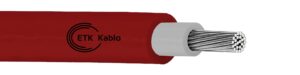
H1Z2Z2-K Solar Cable
SKU:
H1Z2Z2-K
Solar Cable Manufacturer for Photovoltaic PV Systems
Solar Cable provides the DC electrical connection between photovoltaic modules, string circuits, combiner boxes and inverters in solar-energy systems. ETK Kablo manufactures H1Z2Z2-K photovoltaic cable with flexible tinned copper conductors, cross-linked halogen-free insulation and a cross-linked halogen-free outer jacket for demanding PV installations.
The ETK Kablo Solar Cable range includes the H1Z2Z2-K construction in conductor cross-sections from 1.5 mm² to 35 mm². Black and red outer-jacket options support polarity identification in photovoltaic DC circuits.
Solar cable must withstand more than normal electrical loading. Outdoor PV installations can expose cables to heat, sunlight, temperature cycling and long-term environmental stress. Therefore, cable selection should consider conductor size, DC voltage, current, voltage drop, temperature, installation method and the applicable photovoltaic cable standard.
What Is a Solar Cable?
A solar cable is a single-core flexible power cable designed for the direct-current side of photovoltaic systems.
Typical connections include:
- PV module to PV module
- PV string to combiner box
- Combiner box to inverter
- PV array to DC distribution equipment
- Solar generation equipment within applicable DC circuits
Photovoltaic cables differ from conventional building wires because PV systems can expose the cable to sustained outdoor conditions, elevated conductor temperatures and high DC system voltages over long operating periods.
H1Z2Z2-K Solar Cable
H1Z2Z2-K is the principal solar cable construction in the ETK Kablo photovoltaic portfolio.
The ETK Kablo construction uses a Class 5 stranded tinned copper conductor together with cross-linked halogen-free insulation and a cross-linked halogen-free outer jacket.
This flexible single-core architecture is intended for photovoltaic DC connections where electrical performance and long-term material stability are important.
H1Z2Z2-K Cable Construction
| Component | ETK Kablo Construction |
|---|---|
| Conductor | Class 5 stranded tinned copper |
| Insulation | Cross-linked halogen-free compound |
| Outer Jacket | Cross-linked halogen-free compound |
| Standard Colors | Black RAL 9005 or Red RAL 3000 |
| Construction | Flexible single-core photovoltaic cable |
Why Solar Cable Uses Tinned Copper
ETK Kablo uses stranded tinned copper conductors in its H1Z2Z2-K solar cable.
Tinning places a metallic coating around the copper strands. This helps protect the conductor surface and is widely used in photovoltaic cable constructions exposed to long-term environmental conditions.
The Class 5 stranded structure also provides flexibility during installation around module frames, cable trays, inverter areas and other PV-system routes.
Solar Cable Sizes
The ETK Kablo H1Z2Z2-K range includes conductor cross-sections from 1.5 mm² to 35 mm².
| Conductor Size | Conductor Resistance at 20°C |
|---|---|
| 1.5 mm² | 13.70 Ω/km |
| 2.5 mm² | 8.21 Ω/km |
| 4 mm² | 5.09 Ω/km |
| 6 mm² | 3.39 Ω/km |
| 10 mm² | 1.95 Ω/km |
| 16 mm² | 1.24 Ω/km |
| 25 mm² | 0.795 Ω/km |
| 35 mm² | 0.565 Ω/km |
The correct conductor cross-section depends on current, cable length, allowable voltage drop, ambient temperature, grouping conditions and the electrical design of the photovoltaic system.
4 mm² Solar Cable
4 mm² solar cable is a commonly specified conductor size for photovoltaic string connections.
ETK Kablo's H1Z2Z2-K range includes a 4 mm² tinned copper construction with a conductor resistance of 5.09 Ω/km at 20°C.
However, conductor size should never be chosen solely because 4 mm² is common in the market. The project engineer should calculate current-carrying capacity and voltage drop for the actual string length and operating conditions.
6 mm² Solar Cable
6 mm² solar cable provides a larger conductor cross-section for PV circuits requiring lower conductor resistance or greater current capability.
ETK Kablo specifies a conductor resistance of 3.39 Ω/km at 20°C for the 6 mm² H1Z2Z2-K size.
Longer PV string routes or installations with stricter voltage-drop targets can make larger conductor sizes relevant.
10 mm² and 16 mm² Solar Cable
ETK Kablo also manufactures 10 mm² and 16 mm² H1Z2Z2-K solar cable for higher-current or longer-distance DC circuits.
Larger cross-sections reduce conductor resistance, but they also increase cable diameter, material usage and installation requirements.
The complete electrical calculation should therefore determine the appropriate cross-section.
25 mm² and 35 mm² Solar Cable
The ETK Kablo H1Z2Z2-K range extends to 25 mm² and 35 mm² conductor sizes.
These larger solar-cable cross-sections can become relevant where PV system design requires greater current capacity or reduced voltage drop across longer DC routes.
The exact application should always follow system engineering and applicable installation standards.
Red and Black Solar Cable
ETK Kablo offers two outer-jacket colors for H1Z2Z2-K:
- Black – RAL 9005
- Red – RAL 3000
Red and black cable colors are commonly used to help installers identify polarity within photovoltaic DC circuits.
Color identification should still follow the electrical design and applicable national installation requirements.
Solar Cable for 1500 V DC PV Systems
Modern utility-scale photovoltaic installations increasingly use DC system voltages up to 1500 V.
EN 50618 and IEC 62930 define photovoltaic cable requirements for single-core cross-linked cables used on the DC side of PV systems up to 1.5 kV DC.
Project teams should verify that the exact ETK Kablo product documentation and certification correspond to the required system voltage before specifying or installing the cable.
EN 50618 Solar Cable
EN 50618 is the European standard associated with H1Z2Z2-K photovoltaic cable.
It addresses flexible single-core cables with cross-linked insulation and sheath for the DC side of photovoltaic systems.
The standard covers important electrical, thermal and material requirements for cables expected to operate over long periods in demanding solar installations.
IEC 62930 Photovoltaic Cable
IEC 62930 is the international photovoltaic cable standard for single-core cross-linked cables used on the DC side of PV systems with rated voltages up to 1.5 kV DC.
The standard addresses cable construction, electrical performance and long-term operating conditions for photovoltaic applications.
Project specifications can reference EN 50618, IEC 62930 or other applicable requirements depending on market and approval needs.
Solar Cable Temperature Performance
ETK Kablo specifies an operating-temperature range of -40°C to +90°C for H1Z2Z2-K.
Photovoltaic cable standards also distinguish normal continuous conductor temperature from limited high-temperature operation.
Temperature selection should consider:
- Ambient air temperature
- Solar radiation
- Rooftop temperature
- Cable grouping
- Conductor loading
- Installation in trays or conduits
- Thermal conditions around modules and inverters
The actual conductor temperature can exceed ambient temperature, so the complete thermal design remains important.
Solar Cable for Outdoor PV Installations
Photovoltaic systems frequently place cables outdoors for most of their operating life.
Typical installation environments include:
- Utility-scale ground-mounted solar farms
- Commercial rooftop PV systems
- Residential rooftop solar arrays
- Industrial solar installations
- Solar carports
- Building-integrated photovoltaics
- Off-grid solar systems
The cable construction must match the actual environmental exposure, routing method and mechanical protection provided by the installation.
Solar Cable for Utility-Scale Solar Farms
Large solar plants can contain extensive DC cable networks connecting modules, strings, combiner equipment and inverters.
These projects place particular emphasis on conductor losses, cable routing, installation speed and long-term outdoor performance.
Different circuit lengths and current levels can require several conductor cross-sections within the same solar plant.
ETK Kablo can manufacture H1Z2Z2-K cable across a broad range of conductor sizes for project-specific PV requirements.
Solar Cable for Rooftop PV Systems
Rooftop solar systems expose cable to heat, sunlight and repeated temperature cycling.
Cables can run beneath modules, along roof structures, through cable trays and toward inverter equipment.
Correct support, bend radius, connector compatibility and routing help maintain the mechanical and electrical integrity of the installation.
Solar Cable for Commercial and Industrial PV
Commercial and industrial solar projects can combine long string routes with substantial system power.
Electrical designers should therefore evaluate conductor size according to circuit current and voltage drop rather than using one standard cross-section throughout the complete project.
Larger ETK Kablo H1Z2Z2-K conductor sizes can provide additional options for higher-current or longer-distance DC connections.
Solar Cable for Residential PV Systems
Residential photovoltaic systems commonly use flexible solar cable between rooftop modules and inverter equipment.
Although residential installations may use lower total power than utility-scale projects, the cable still operates under outdoor thermal and environmental conditions.
The required conductor size, polarity identification and cable route should follow the system designer's electrical calculations.
Solar Cable for BESS and Hybrid PV Systems
Photovoltaic projects can also operate together with battery energy storage systems.
Solar cable can form part of PV-side DC circuits within hybrid solar installations, but battery interconnection circuits can have different current, voltage and cable requirements.
A photovoltaic cable should therefore not automatically be treated as the correct battery cable for every BESS connection.
The exact circuit specification should determine the required cable construction.
Solar Cable vs Standard Electrical Cable
| Characteristic | Solar Cable | General Electrical Cable |
|---|---|---|
| Main Application | DC side of photovoltaic systems | General electrical distribution according to cable type |
| Typical Construction | Flexible single-core, cross-linked insulation and sheath | Varies widely by product |
| Conductor | Tinned flexible copper in ETK Kablo H1Z2Z2-K | Depends on cable construction |
| Outdoor PV Use | Designed specifically for photovoltaic environments | Should not be assumed unless explicitly suitable |
| PV Standard | EN 50618 / applicable PV requirements | Depends on exact cable family |
A conventional electrical cable should not automatically replace a dedicated photovoltaic cable simply because conductor size and nominal voltage appear similar.
H1Z2Z2-K vs PV1-F Solar Cable
PV1-F appears in older photovoltaic project specifications, while H1Z2Z2-K is the designation associated with the later EN 50618 photovoltaic cable framework.
For new European projects, procurement teams commonly specify H1Z2Z2-K when EN 50618 compliance is required.
Existing projects should still follow their approved specification rather than substituting cable designations without technical review.
Halogen-Free Solar Cable
ETK Kablo's H1Z2Z2-K construction uses cross-linked HFFR insulation and outer-jacket materials.
ETK Kablo H1Z2Z2-K documentation includes tests such as:
- IEC 61034-2 for smoke density
- IEC 60754-1 for halogen content
- IEC 60754-2 for corrosive-gas characteristics
- IEC 60332-1-2 for flame retardancy
- IEC 60332-3-24 for flame propagation
The exact product documentation should remain the basis for project fire-performance and material-compliance requirements.
Solar Cable Does Not Mean Fire Resistant Cable
Halogen-free and flame-retardant characteristics should not be confused with fire-resistant circuit integrity.
A photovoltaic cable can limit flame propagation and meet specified smoke or halogen tests without maintaining electrical continuity during prolonged fire exposure.
Projects requiring dedicated circuit-integrity performance should specify and verify that requirement separately.
Solar Cable Bending Radius
ETK Kablo specifies a minimum bending radius of 8xD for H1Z2Z2-K, where D represents the cable's outer diameter.
Respecting the required bending radius helps avoid excessive mechanical stress on the conductor, insulation and outer jacket during installation.
Installers should also avoid sharp edges and unnecessary mechanical tension along PV cable routes.
How to Select Solar Cable Size
Solar cable cross-section should follow an electrical calculation rather than a generic rule.
Important factors include:
- Maximum operating current
- Short-circuit current
- String length
- Allowable voltage drop
- Ambient temperature
- Conductor operating temperature
- Number of grouped cables
- Installation method
- System DC voltage
- Applicable project standard
Longer routes or higher currents generally increase the conductor cross-section required to control voltage drop and thermal loading.
Why Voltage Drop Matters in PV Cable
Every conductor has electrical resistance, so part of the generated energy is lost as heat while current travels through the cable.
Reducing cable resistance can reduce voltage drop and resistive losses, but larger conductor sizes also increase material cost.
PV cable sizing therefore requires a balance between electrical efficiency, installation requirements and project economics.
Solar Cable for Positive and Negative DC Connections
Photovoltaic arrays use DC circuits with defined polarity.
Red and black outer-jacket options can assist installation teams in differentiating positive and negative conductors.
Polarity identification should remain consistent throughout the complete PV system and follow the applicable electrical design and installation rules.
How to Specify an H1Z2Z2-K Solar Cable
A complete solar-cable RFQ should define both the electrical requirements and the project environment.
| Specification Item | Information to Provide |
|---|---|
| Cable Type | H1Z2Z2-K |
| Application | Photovoltaic DC system |
| Conductor | Class 5 stranded tinned copper |
| Cross-Section | Required mm² size |
| System Voltage | Required PV DC voltage |
| Outer Jacket Color | Black, red or project requirement |
| Temperature | Required operating and installation conditions |
| Installation Environment | Rooftop, utility-scale plant, industrial or other PV route |
| Standard | EN 50618, IEC 62930 or project-specific requirement |
| Documentation | Datasheet, test reports, approvals and project certificates |
| Packing | Required coil or drum length |
Why Choose ETK Kablo for Solar Cable?
ETK Kablo manufactures H1Z2Z2-K photovoltaic cable with flexible tinned copper conductors and cross-linked halogen-free materials for solar-energy applications.
The product range covers conductor cross-sections from 1.5 mm² to 35 mm² together with red and black jacket options.
This range allows solar EPC companies, PV distributors, installers and renewable-energy projects to select conductor size according to system current, route length and voltage-drop requirements.
ETK Kablo can evaluate conductor cross-section, color, packing requirements, project standards and documentation during the quotation process.
Frequently Asked Questions About Solar Cable
What is solar cable?
Solar cable is a flexible single-core electrical cable designed for DC power connections on the photovoltaic side of solar-energy systems.
What is H1Z2Z2-K cable?
H1Z2Z2-K is a photovoltaic cable designation associated with EN 50618 and used for flexible single-core DC wiring in solar installations.
What is the difference between solar cable and normal electrical cable?
Solar cable is specifically designed around photovoltaic DC operation and long-term environmental exposure. A general electrical cable should not automatically be used as a substitute unless its exact technical specification permits the application.
What conductor does ETK Kablo solar cable use?
ETK Kablo's H1Z2Z2-K construction uses Class 5 stranded tinned copper conductors.
What solar cable sizes does ETK Kablo manufacture?
ETK Kablo's H1Z2Z2-K range includes 1.5, 2.5, 4, 6, 10, 16, 25 and 35 mm² conductor sizes.
Is 4 mm² or 6 mm² solar cable better?
Neither size is universally better. The correct cross-section depends on current, cable length, allowable voltage drop, temperature and installation conditions.
What colors are available?
ETK Kablo offers black RAL 9005 and red RAL 3000 outer-jacket options.
What is the operating temperature of ETK Kablo H1Z2Z2-K cable?
ETK Kablo specifies an operating-temperature range of -40°C to +90°C.
Can H1Z2Z2-K be used in 1500 V DC solar systems?
EN 50618 and IEC 62930 cover photovoltaic cable applications up to 1.5 kV DC. The exact supplied ETK Kablo product voltage rating and project approval should be verified from the product datasheet before specification.
Is solar cable LSZH?
ETK Kablo's H1Z2Z2-K product uses cross-linked HFFR insulation and outer-jacket compounds, and its documentation includes smoke-density, halogen-content and corrosive-gas tests.
Is solar cable fire resistant?
Not automatically. Flame retardancy, low-smoke behavior and halogen-free construction do not by themselves establish fire-resistant circuit integrity.
What information should I provide when requesting a quotation?
Provide the H1Z2Z2-K requirement, conductor cross-section, system DC voltage, required color, quantity, packing length, applicable standards and required project documentation.


