





 President’s Message
Blog
YSLY vs YSLCY vs YSLYCY Control Cables: What Is the Difference?
Reading Time: 15 minutes
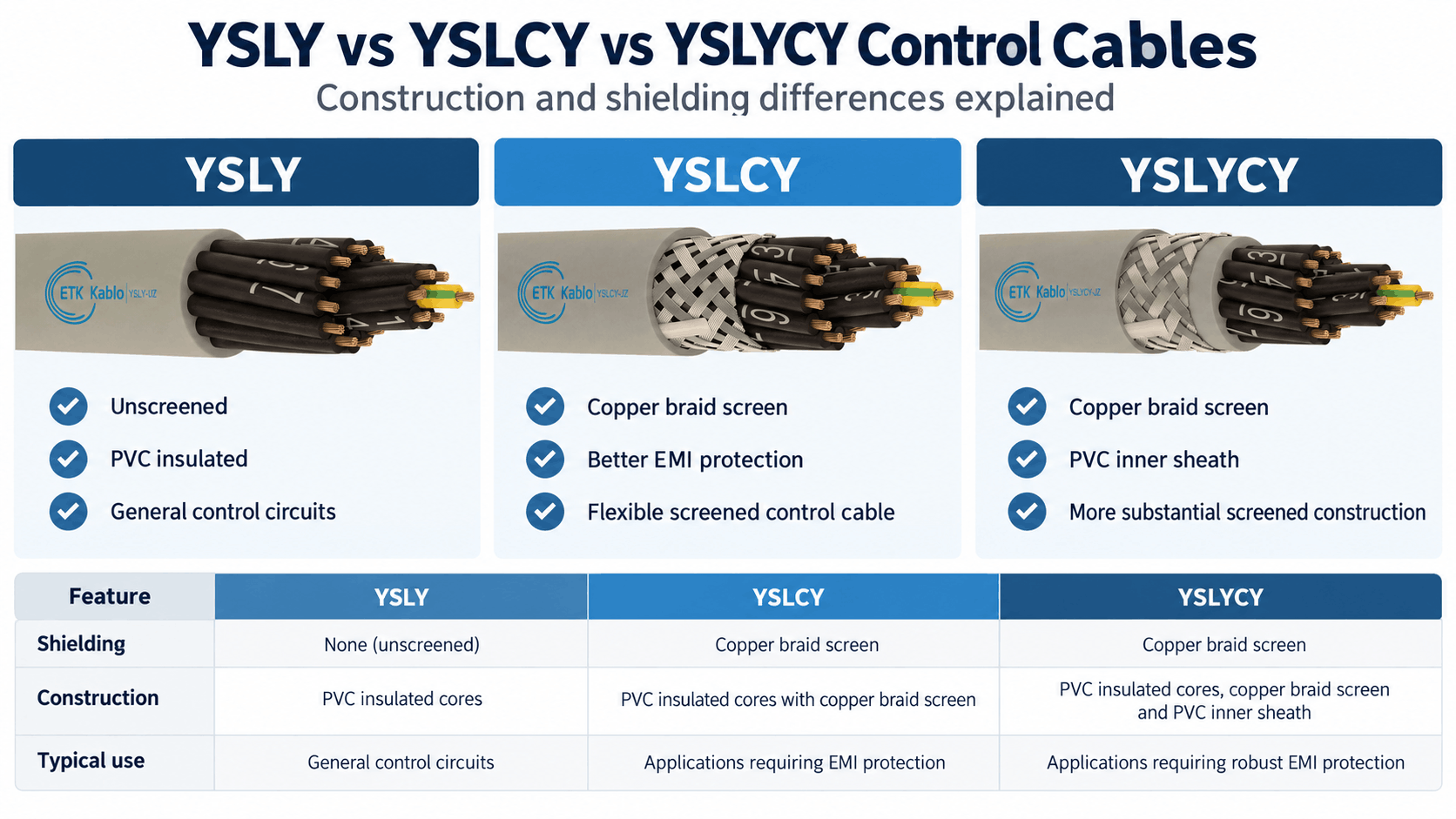
Choosing between YSLY vs YSLCY control cable and the heavier YSLYCY construction requires more than checking whether a cable is flexible or screened. All three belong to the flexible PVC control-cable family, but their internal constructions differ significantly.
YSLY is the simplest of the three. It uses flexible Class 5 copper conductors, PVC insulation and a PVC outer sheath without a metallic screen. By contrast, YSLCY adds a tinned copper braid around the assembled cable core to improve electromagnetic compatibility. YSLYCY goes one step further by placing a PVC inner sheath beneath the copper braid before applying the final PVC outer sheath.
Therefore, the selection should follow the actual electrical and mechanical environment. YSLY is efficient where electromagnetic interference is limited. YSLCY provides screened signal and control transmission while keeping the construction relatively compact. Meanwhile, YSLYCY adds another structural layer around the cable core, making it useful where a screened control cable with a more substantial inner-sheath construction is preferred.
Quick answer: Choose YSLY for flexible control circuits in relatively low-EMI environments. Choose YSLCY when the same type of control circuit requires a tinned-copper braid screen. Choose YSLYCY when screening is required together with an additional PVC inner sheath beneath the braid. However, cable voltage, core count, conductor size, movement, fire requirements and environmental exposure should still be specified separately.
YSLY vs YSLCY vs YSLYCY at a Glance
| Characteristic | YSLY | YSLCY | YSLYCY |
|---|---|---|---|
| Conductor | Class 5 flexible copper | Class 5 flexible copper | Class 5 flexible copper |
| Insulation | PVC | PVC | PVC |
| Core assembly | Layer stranded | Layer stranded | Layer stranded |
| Separator | Not required in standard construction | Polyester tape | Inner sheath performs the underlying structural function |
| Inner sheath | No | No extruded inner sheath in ETK standard construction | PVC inner sheath |
| Screen | No | Tinned copper braid | Tinned copper braid |
| Outer sheath | PVC | PVC | PVC |
| EMI protection | Limited by unshielded construction | Yes | Yes |
| Relative construction | Simplest | Screened and compact | Screened with additional inner sheath |
| Typical selection logic | Low-EMI control circuits | Screened industrial control | Screened control with more substantial layered construction |
The most important point is that YSLCY and YSLYCY are both screened.
Consequently, the difference between them is not simply “screened versus unshielded.” The additional PVC inner sheath in YSLYCY is the key structural distinction.
What Is YSLY Control Cable?
YSLY control cable is a flexible multicore PVC cable used for industrial control, signal and low-voltage auxiliary circuits.
A typical YSLY construction contains:
- Class 5 stranded copper conductors
- PVC conductor insulation
- Layer-stranded cable core
- PVC outer sheath
Because there is no metallic screen, the design remains relatively simple, compact and economical.
Therefore, YSLY can be particularly effective where the control circuit does not require additional protection against electromagnetic interference.
What Is YSLCY Control Cable?
YSLCY control cable takes the basic flexible PVC control-cable architecture and adds a metallic braid screen.
In ETK’s standard YSLCY construction, the sequence includes:
- Class 5 stranded copper conductors
- PVC insulation
- Layer stranding
- Polyester separating tape
- Tinned copper wire braid
- PVC outer sheath
The tinned copper braid surrounds the complete assembled core. As a result, YSLCY provides additional protection against electromagnetic interference from nearby industrial equipment.
However, ETK’s standard YSLCY does not use an extruded PVC inner sheath beneath the braid.
What Is YSLYCY Control Cable?
YSLYCY control cable is also a flexible, copper-braid-screened PVC control cable.
However, its internal architecture differs from YSLCY.
ETK’s YSLYCY construction includes:
- Class 5 stranded copper conductors
- PVC insulation
- Layer-stranded cable core
- PVC inner sheath
- Tinned copper wire braid
- PVC outer sheath
Therefore, the braid sits over an extruded inner jacket rather than directly over a polyester-separated core.
This extra layer changes the cable’s construction, diameter, weight and mechanical architecture.
What Is the Main Difference Between YSLY, YSLCY and YSLYCY?
The comparison can be reduced to two questions:
Does the circuit need electromagnetic screening?
If screened, does the required cable construction include an inner sheath beneath the braid?
YSLY answers the first question with no screen.
YSLCY adds a tinned-copper braid around a polyester-separated cable core.
Meanwhile, YSLYCY introduces a PVC inner sheath before the tinned-copper braid.
Therefore:
YSLY = unshielded.
YSLCY = screened, without an extruded PVC inner sheath in the standard ETK design.
YSLYCY = screened, with an additional PVC inner sheath.
YSLY vs YSLCY Control Cable: The Importance of Screening
The clearest comparison is between YSLY and YSLCY.
Both use flexible copper conductors, PVC insulation and a PVC outer sheath. However, YSLCY adds a tinned-copper braid screen.
This screen becomes valuable where control circuits run near sources of electromagnetic interference such as:
- Variable-frequency drives
- Motors
- Contactors
- Power cables
- Transformers
- Switchgear
- Industrial power electronics
Consequently, YSLCY is often preferred when control-signal reliability requires additional EMC protection.
YSLCY vs YSLYCY: What Does the Inner Sheath Change?
Both YSLCY and YSLYCY use a tinned-copper braid.
Therefore, comparing them only by asking which cable is screened misses the actual distinction.
In YSLCY, a polyester tape separates the assembled insulated cores from the braid.
By contrast, YSLYCY uses an extruded PVC inner sheath beneath the braid.
This inner sheath creates a defined cable core before screening.
As a result, it can provide:
- A stable bedding beneath the braid
- Greater separation between insulated cores and metallic screen
- A more substantial layered construction
- Additional mechanical structure around the assembled core
However, the additional material also increases cable diameter and weight.
YSLCY vs YSLYCY Control Cable: What Does the Inner Sheath Change?
Not automatically.
Both constructions use a tinned-copper braid screen.
Therefore, engineers should not assume that the presence of an additional inner sheath alone makes YSLYCY electrically superior.
Actual screening performance can depend on factors such as:
- Braid coverage
- Wire diameter
- Braid geometry
- Electrical continuity
- Frequency of interference
- Screen termination
- Complete cable construction
Consequently, the actual product datasheet and project EMC requirements should govern the comparison.
Does YSLYCY Provide More Mechanical Protection?
In addition, the inner sheath creates a more substantial internal cable structure.
However, YSLYCY should not be confused with a mechanically armored cable.
The PVC inner sheath provides bedding and separation, but it is not equivalent to:
- Steel Wire Armour
- Steel Wire Braid
- Steel tape armour
- Heavy mechanical reinforcement
Therefore, if the route faces significant crushing, impact or other mechanical hazards, engineers should select a cable specifically designed for that level of protection.
YSLY vs YSLCY vs YSLYCY: Diameter and Weight
Adding screening and additional layers naturally changes cable geometry.
ETK’s 4 × 1.5 mm² standard constructions provide a useful example:
| ETK Construction | Approx. Diameter | Approx. Cable Weight |
|---|---|---|
| YSLY 4 × 1.5 mm² | 7.5 mm | 104 kg/km |
| YSLCY 4 × 1.5 mm² | 7.8 mm | 121 kg/km |
| YSLYCY 4 × 1.5 mm² | 9.3 mm | 163 kg/km |
The progression is logical.
First, YSLCY adds the copper braid to the basic YSLY architecture.
Then, YSLYCY adds both the screened construction and an additional PVC inner sheath.
Therefore, the heavier construction should be justified by the project rather than selected automatically.
Why Cable Diameter Matters in Control Panels
Control installations can contain dozens or hundreds of multicore cables.
Consequently, even relatively small diameter differences can affect:
- Cable tray fill
- Panel entry space
- Gland dimensions
- Routing through conduits
- Minimum bending space
- Overall installation density
For this reason, YSLCY can be attractive where screening is required but engineers also want to keep the control cable relatively compact.
Why Cable Weight Matters
Additional copper and PVC increase cable weight.
This can influence:
- Drum handling
- Transport
- Cable tray loading
- Long pulling routes
- Installation labour
Therefore, the most heavily constructed cable is not automatically the most efficient solution.
What Does the Copper Braid Do?
The copper braid provides a conductive screen around the cable core.
In industrial environments, this screen helps reduce the influence of electromagnetic interference on the internal control circuits.
Potential interference sources include:
- VFDs
- Servo drives
- Motors
- Switching equipment
- Power converters
- Adjacent power cables
Therefore, a screened CY-type control cable becomes particularly valuable where signal integrity matters.
Why Use Tinned Copper for the Screen?
Tinning applies a thin protective metallic layer to the copper braid wires.
As a result, the screen can provide useful corrosion resistance compared with exposed bare copper in suitable industrial environments.
However, the cable’s overall environmental resistance still depends mainly on the complete sheath and construction.
Therefore, tinned braid should not be interpreted as making a generic control cable suitable for every corrosive or outdoor environment.
Does Screening Replace Proper Cable Routing?
No.
A screened control cable forms one part of an EMC strategy.
Signal performance can also depend on:
- Distance from power cables
- Industrial equipment layout
- Screen continuity
- Grounding philosophy
- Frequency content
- Equipment interfaces
Consequently, specifying YSLCY or YSLYCY does not eliminate every EMC consideration in the control system.
YSLY for Industrial Automation
YSLY provides an efficient solution for general-purpose automation circuits where electromagnetic interference remains controlled.
Common applications can include:
- Machine control
- Control panels
- Conveyor systems
- Production machinery
- HVAC control
- Assembly lines
- Auxiliary circuits
Because the cable lacks metallic screening, it can also offer lower diameter, weight and material cost than comparable screened constructions.
YSLCY for Industrial Automation
YSLCY is particularly useful where flexible control wiring operates in an electrically noisier industrial environment.
For example, it can connect:
- Control panels
- Machinery
- Automation equipment
- Actuators
- Industrial sensors
- Drive-associated control circuits
The copper braid provides electromagnetic screening while the absence of an extruded inner sheath helps maintain a relatively compact architecture.
YSLYCY for Industrial Automation
YSLYCY serves similar screened control applications but uses the additional PVC inner sheath beneath the braid.
Therefore, it can be considered when a project specification prefers a more layered screened control-cable construction.
Potential applications include:
- Machine tools
- Production lines
- Process equipment
- Control systems
- Industrial automation
- Manufacturing plants
However, its larger diameter and higher weight should be considered during pathway design.
YSLY vs YSLCY for VFD Environments
Variable-frequency drives can generate substantial electromagnetic noise.
Therefore, control circuits close to VFD equipment can benefit from screened cable construction.
Between YSLY and YSLCY, YSLCY provides the clear advantage of a tinned-copper braid.
However, the exact cable used for a drive system depends on what the cable is carrying.
A low-level control circuit, encoder circuit and motor-power output can require very different cable constructions.
Consequently, a screened control cable should not automatically replace a purpose-designed motor or feedback cable.
YSLY vs YSLCY vs YSLYCY for PLC Systems
PLC installations can contain both noise-sensitive inputs and relatively robust control outputs.
Therefore, one project can legitimately use all three cable types.
For example:
- Low-EMI digital control circuits → YSLY may be sufficient
- Sensitive screened control circuits → YSLCY may be preferred
- Screened circuits requiring the additional inner-sheath construction → YSLYCY may be selected
The best cable should follow the electrical signal and route rather than a single plant-wide preference.
YSLY vs YSLCY vs YSLYCY for Machine Building
Machine builders frequently prioritize flexibility, compact routing and reliable termination.
Therefore, cable selection should balance:
- EMI exposure
- Available panel space
- Core count
- Conductor size
- Mechanical movement
- Installation radius
YSLY offers the simplest construction.
Meanwhile, YSLCY adds screening with relatively limited increase in diameter.
YSLYCY adds another structural layer where the project calls for an inner-sheathed screened design.
Flexible Does Not Automatically Mean Continuous Flex
YSLY, YSLCY and YSLYCY use fine-stranded Class 5 conductors, which improves flexibility during routing and installation.
However, “flexible cable” should not automatically be interpreted as “continuous-flex cable.”
Applications such as:
- Drag chains
- Robotic arms
- Continuous reciprocating machinery
- High-cycle automated movement
can require cables specifically designed and tested for repeated dynamic flexing.
Therefore, conductor class alone should not determine drag-chain suitability.
Fixed Installation vs Occasional Movement
Industrial control cables can require flexibility during installation even when they remain stationary afterward.
This is different from continuous dynamic operation.
For example, Class 5 conductors can make it easier to:
- Route cable inside panels
- Navigate bends
- Connect machine equipment
- Terminate densely packed cabinets
Consequently, flexible control cable can still primarily serve fixed or limited-movement applications.
JZ vs OZ: What Is the Difference?
The JZ and OZ suffixes describe core identification rather than screening.
JZ commonly identifies black numbered conductors together with a green-yellow protective conductor.
OZ generally uses numbered conductors without the green-yellow protective conductor.
Therefore, engineers should treat YSLY/YSLCY/YSLYCY and JZ/OZ as separate decisions.
For example:
- YSLY-JZ
- YSLY-OZ
- YSLCY-JZ
- YSLCY-OZ
- YSLYCY-JZ
- YSLYCY-OZ
can represent different combinations of cable architecture and conductor identification.
Does JZ Mean the Cable Is Grounded?
No.
JZ identifies the presence of a green-yellow protective conductor within the core arrangement.
It does not define how a copper braid screen should be terminated or how the complete system should be bonded.
Therefore, protective-earth conductors and EMC screen connections should not be treated as identical functions.
300/500 V Control Cable
ETK’s standard YSLY, YSLCY and YSLYCY families are available as 300/500 V control constructions.
This rating suits many industrial control, auxiliary and automation circuits.
However, voltage requirements should always come from the actual system rather than from the cable family name alone.
450/750 V Control Cable Variants
ETK also manufactures higher-voltage variants within the control-cable range.
For example, separate 0.45/0.75 kV YSLY and YSLCY constructions are available.
Therefore, engineers should not assume that every cable carrying a similar trade designation has the same voltage rating.
The specific product code and datasheet should govern.
Does YSLY Mean PVC?
YSLY is associated with the conventional flexible PVC control-cable family.
In ETK’s standard construction, both the conductor insulation and outer sheath use PVC materials.
Similarly, YSLCY and YSLYCY retain PVC insulation and PVC outer sheaths while adding different screening and inner-layer arrangements.
Therefore, projects requiring halogen-free materials should consider a different cable family rather than assuming a screened YSL cable is automatically LSZH.
YSLY vs HSLH
YSLY and HSLH solve different fire-material requirements.
YSLY uses PVC insulation and sheath materials.
By contrast, HSLH belongs to the halogen-free flexible control-cable family.
Therefore, an enclosed public building, tunnel or other project with strict smoke and halogen requirements may favour an HSLH-family cable instead of standard YSLY.
YSLCY vs HSLCH
A similar distinction applies to screened control cables.
YSLCY uses PVC materials with a tinned-copper screen.
Meanwhile, HSLCH provides a screened halogen-free alternative for projects with different fire-material requirements.
Consequently, shielding and halogen-free performance should remain separate selection criteria.
Does PVC Mean the Cable Is Fire Resistant?
No.
Standard PVC control cables can provide flame-retardant performance when the complete construction meets the relevant flame-propagation test.
However, flame retardancy and fire resistance are different concepts.
A fire-resistant cable must maintain a defined circuit function during fire according to the specified test regime.
Therefore, YSLY, YSLCY or YSLYCY should not be described as fire resistant simply because the cable passes a flame test.
YSLY vs YSLCY vs YSLYCY and Flame Retardancy
ETK’s standard constructions list flame-retardancy testing according to IEC 60332-1-2.
This test addresses vertical flame propagation on a single cable.
However, project requirements can demand different or additional fire classifications.
Therefore, buyers should specify the required fire performance rather than relying only on the cable designation.
Can YSLY, YSLCY and YSLYCY Be Used Outdoors?
Outdoor suitability should come from the actual product construction and manufacturer data.
ETK specifies UV-resistant PVC outer jackets on its relevant YSLY, YSLCY and YSLYCY constructions.
However, the trade designation alone does not guarantee suitability for every outdoor condition.
Projects should also consider:
- Sunlight exposure
- Water
- Temperature
- Mechanical protection
- Chemical exposure
- Installation method
Consequently, the complete datasheet should govern outdoor selection.
Can These Control Cables Be Directly Buried?
The presence of a PVC outer sheath does not automatically establish direct-burial suitability.
Direct burial can require additional:
- Crush resistance
- Impact protection
- Rodent protection
- Water resistance
- Mechanical reinforcement
Therefore, projects requiring direct burial should use a construction specifically intended for the underground environment.
Can YSLCY or YSLYCY Replace an Armored Control Cable?
Usually not when true mechanical armour is required.
The copper braid in these cables primarily serves an electromagnetic-screening function.
It should not be confused with heavy mechanical protection such as:
- SWA
- SWB mechanical reinforcement
- Steel tape armour
Therefore, a screened cable and an armored cable solve different engineering problems.
Screened vs Armored Control Cable
| Feature | Copper-Braid Screen | Mechanical Armour |
|---|---|---|
| Main purpose | EMC / signal protection | Mechanical protection |
| Typical material | Tinned copper braid | Steel wires or other reinforcing system |
| Protects against EMI | Yes | Not its primary purpose |
| Protects against heavy impact | Limited | Yes when appropriately designed |
| Typical ETK examples | YSLCY / YSLYCY | SWA or SWB cable families |
YSLY vs YSLCY vs YSLYCY for Analog Signals
Analogue control signals can be more sensitive to electromagnetic interference than robust switching circuits.
Therefore, screened YSLCY or YSLYCY may be preferable when:
- Signal levels are low
- Routes are long
- Power equipment is nearby
- Industrial electrical noise is significant
However, highly sensitive instrumentation circuits can require dedicated instrumentation cable rather than a general-purpose multicore control cable.
Control Cable vs Instrumentation Cable
The two categories overlap in some applications but should not be treated as identical.
Control cables commonly handle command, auxiliary and machine-control circuits.
Instrumentation cables, meanwhile, often place greater emphasis on:
- Pairs or triads
- Individual screening
- Capacitance
- Low-level analogue signals
- Process instrumentation
Therefore, a YSLCY control cable should not automatically replace a PiMF instrumentation cable simply because both are screened.
YSLY vs LIYY
YSLY and LIYY can both use flexible copper conductors and PVC materials, but they belong to different cable families and can target different signal and control applications.
Therefore, buyers should not substitute them based solely on the presence of PVC and flexible conductors.
Voltage, conductor identification, electrical characteristics and intended application should be compared from the relevant datasheets.
YSLCY or YSLYCY vs LIYCY
All can contain a copper braid screen, but that does not make them equivalent.
LIYCY belongs primarily to the flexible signal/data-control cable family, while YSLCY and YSLYCY serve industrial control applications with their own conductor and voltage constructions.
Consequently, selection should follow:
- Operating voltage
- Core identification
- Conductor size
- Signal type
- Required electrical characteristics
- Application standard
Which Control Cable Should You Choose?
| Project Condition | Cable to Consider | Reason |
|---|---|---|
| Low electromagnetic interference | YSLY | Simple unshielded construction |
| EMI protection required | YSLCY | Tinned copper braid screen |
| Screening + PVC inner sheath required | YSLYCY | Inner sheath beneath copper braid |
| Very limited panel space | Compare YSLY or YSLCY first | Generally more compact construction |
| VFD-adjacent control wiring | Screened construction | Additional EMC protection |
| Halogen-free project | HSLH / HSLCH family | Different fire-material strategy |
| Heavy mechanical exposure | Dedicated armored construction | Copper braid is not heavy armour |
| Continuous drag-chain movement | Dedicated continuous-flex cable | Class 5 alone does not establish high-cycle suitability |
| Sensitive process instrumentation | Instrumentation cable | May require pairs, triads and specific electrical parameters |
Common Mistakes When Comparing YSLY, YSLCY and YSLYCY
1. Assuming YSLCY Is Unscreened
YSLCY already includes a tinned-copper braid screen.
2. Assuming YSLYCY Is Simply Another Name for YSLCY
In ETK’s constructions, YSLYCY includes a PVC inner sheath beneath the braid, while YSLCY uses a polyester separator without an extruded inner sheath.
3. Assuming YSLYCY Has Better EMI Performance Just Because It Is Larger
Screen performance depends on the actual braid and complete EMC design, not cable size alone.
4. Assuming YSLY Is Always the Wrong Choice
Unscreened cable can be perfectly appropriate where electromagnetic interference is limited.
5. Specifying Screened Cable for Every Control Circuit
Additional screening increases copper content, diameter, weight and cost.
6. Treating the Copper Braid as Mechanical Armour
The braid primarily provides electromagnetic screening rather than heavy mechanical protection.
7. Assuming Flexible Means Drag-Chain Rated
Class 5 conductors improve flexibility but do not automatically qualify the cable for continuous high-cycle movement.
8. Ignoring Cable Diameter
The YSLYCY inner sheath can materially increase outside diameter in high-core-count installations.
9. Ignoring Cable Weight
Additional PVC and copper can significantly increase drum and pathway loading.
10. Assuming PVC Means Fire Resistant
Flame retardancy and circuit integrity during fire are separate characteristics.
11. Assuming JZ Defines the Screening System
JZ relates to conductor identification and the protective-earth conductor, not the presence of a copper braid.
12. Assuming All Similar Product Names Have the Same Voltage Rating
Different product variants can use different voltage classes.
13. Assuming UV-Resistant PVC Means Unlimited Outdoor Use
The full environmental specification should determine outdoor suitability.
14. Using YSLCY Instead of a Dedicated Instrumentation Cable Without Reviewing Signal Requirements
Sensitive analogue systems can require specific capacitance, pairing or individual-screening characteristics.
15. Selecting by Cable Code Without Reading the Datasheet
Legacy and trade cable designations can vary between manufacturers. The actual construction should always govern procurement.
Why Manufacturer Datasheets Matter with YSL Cable Names
YSLY, YSLCY and YSLYCY are widely recognized industrial cable designations.
However, exact material sequences and interpretations can vary between manufacturers and markets.
Therefore, buyers should confirm:
- Conductor class
- Insulation
- Separator
- Inner sheath
- Screen material
- Braid coverage where specified
- Outer sheath
- Voltage rating
- Temperature range
- Fire performance
This prevents procurement decisions based only on a familiar product abbreviation.
What Should Buyers Include in a Control Cable RFQ?
An RFQ that states only “YSLYCY cable” can still leave several project requirements unclear.
A useful request should define:
- Required cable type: YSLY, YSLCY or YSLYCY
- JZ, OZ or other core identification
- Number of conductors
- Conductor cross-section
- Operating voltage
- Conductor class
- Screen requirement
- Inner-sheath requirement where relevant
- Minimum copper-braid coverage if project-specified
- Outer sheath material
- Sheath colour
- UV resistance
- Oil resistance where required
- Chemical resistance where required
- Operating temperature
- Installation temperature
- Minimum bending radius
- Fixed or moving application
- Continuous-flex requirement where applicable
- Flame-retardancy requirement
- CPR requirement where applicable
- Applicable IEC, EN or customer specification
- Cable marking
- Packing length
- Test reports and certificates
Consequently, the manufacturer can quote the required construction without relying on assumptions about the cable designation.
ETK Kablo YSLY, YSLCY and YSLYCY Control Cables
ETK Kablo manufactures YSLY, YSLCY and YSLYCY control cables for industrial automation, machinery, production lines, control panels, HVAC, manufacturing and related control applications.
YSLY provides the basic flexible PVC construction using Class 5 stranded copper conductors, PVC insulation and a PVC outer sheath.
Meanwhile, YSLCY adds a polyester separator and tinned-copper braid screen before the PVC outer sheath. This construction provides additional electromagnetic protection while retaining a relatively compact design.
YSLYCY uses a different screened architecture. After the insulated cores are assembled, ETK applies a PVC inner sheath, followed by tinned-copper braid and a PVC outer sheath.
Therefore, ETK offers three distinct construction levels within the same flexible control-cable family rather than treating the product names as interchangeable.
Standard variants support multiple conductor counts and cross-sections for project-specific automation requirements. JZ and other conductor-identification arrangements can also be selected according to the wiring philosophy.
For projects requiring different fire-material performance, ETK’s broader control-cable portfolio also includes halogen-free HSLH and screened HSLCH constructions.
The appropriate ETK cable should therefore be selected by combining the circuit’s EMI sensitivity with conductor count, voltage, installation space, mechanical environment and fire requirements.
Frequently Asked Questions
What is the difference between YSLY, YSLCY and YSLYCY?
YSLY is an unshielded flexible PVC control cable. YSLCY adds a polyester separator and tinned-copper braid screen. YSLYCY also uses a tinned-copper braid but includes an additional PVC inner sheath beneath the screen.
Is YSLY screened?
No. Standard YSLY does not contain a metallic screen.
Is YSLCY screened?
Yes. ETK’s YSLCY construction uses a tinned-copper braid around the assembled cable core.
Is YSLYCY screened?
Yes. YSLYCY also uses a tinned-copper braid screen.
What is the difference between YSLCY and YSLYCY?
In ETK’s standard construction, YSLCY uses polyester tape beneath the copper braid, while YSLYCY uses an extruded PVC inner sheath beneath the braid.
Why does YSLYCY have an inner sheath?
The inner sheath creates a defined bedding layer around the assembled cable core before the metallic braid is applied.
Is YSLYCY better than YSLCY?
Not universally. YSLYCY provides an additional inner-sheath construction, while YSLCY can offer a more compact screened design. The better option depends on the project.
Which cable is better for EMI protection?
YSLCY and YSLYCY both provide copper-braid screening. Actual EMI performance depends on the screen construction, system design and installation requirements.
Which cable is the lightest?
For equivalent conductor counts and cross-sections, YSLY is generally the lightest because it has no copper-braid screen.
Which cable is generally the largest?
YSLYCY is generally larger than comparable YSLY and YSLCY constructions because it includes both the screen and an additional PVC inner sheath.
What is YSLY used for?
YSLY is commonly used for industrial machine control, automation panels, conveyor systems and auxiliary circuits where significant electromagnetic screening is not required.
What is YSLCY used for?
YSLCY is used for screened industrial control and signal circuits where electromagnetic interference can affect system reliability.
What is YSLYCY used for?
YSLYCY serves screened industrial control applications where the specified cable architecture also requires a PVC inner sheath beneath the braid.
Can YSLY be used near motors?
It depends on the electromagnetic environment and circuit sensitivity. Where significant interference exists, a screened construction such as YSLCY or YSLYCY may be more appropriate.
Is YSLCY suitable near VFDs?
The copper-braid screen can help protect control circuits in electrically noisy environments. However, the specific VFD signal or power connection must still use the cable type required by the equipment and system design.
Is YSLYCY armored?
No. The standard YSLYCY copper braid functions primarily as an electromagnetic screen rather than heavy mechanical armour.
What does JZ mean in YSLY-JZ?
JZ commonly identifies black numbered cores together with a green-yellow protective conductor.
What does OZ mean?
OZ generally identifies numbered conductors without a green-yellow protective conductor.
Are YSLY, YSLCY and YSLYCY LSZH?
The standard constructions use PVC materials. For halogen-free control-cable requirements, a suitable HSLH or HSLCH-family construction should be considered.
Are YSLY cables suitable for drag chains?
Standard flexible Class 5 construction should not automatically be considered suitable for continuous high-cycle drag-chain use. A dedicated continuous-flex product should be specified where required.
What voltage is YSLY cable?
ETK’s standard YSLY family is available in 300/500 V construction, while separate higher-voltage variants are also available.
What voltage are YSLCY and YSLYCY cables?
ETK’s standard YSLCY and YSLYCY constructions are available at 300/500 V. Specific higher-voltage product variants should be checked separately.
Which should I choose: YSLY, YSLCY or YSLYCY?
Choose YSLY where screening is unnecessary, YSLCY where copper-braid screening is required in a relatively compact construction, and YSLYCY where the screened design should also include a PVC inner sheath beneath the braid.
Conclusion
Understanding YSLY vs YSLCY control cable and YSLYCY begins with the cable layers rather than the product name alone.
YSLY provides the simplest architecture: flexible Class 5 copper conductors, PVC insulation and a PVC outer sheath without metallic screening.
YSLCY adds a tinned-copper braid screen around a polyester-separated cable core. Therefore, it provides additional electromagnetic protection while maintaining a relatively compact construction.
YSLYCY also uses a copper-braid screen. However, it adds a PVC inner sheath beneath that braid, creating a more substantial layered structure and generally increasing cable diameter and weight.
Consequently, YSLYCY should not automatically be considered superior, nor should YSLCY and YSLYCY be treated as identical. Each construction solves a slightly different project requirement.
Screening should also remain separate from mechanical armour, fire performance and continuous-flex capability. A copper braid primarily addresses electromagnetic interference, while heavy mechanical protection, LSZH materials and high-cycle movement require separate cable features.
For engineers and purchasing teams, the most effective approach is therefore to determine whether screening is required first, decide whether the screened cable also needs an inner-sheath construction second, and then specify conductor count, voltage, fire performance and environmental requirements according to the actual industrial application.


