





 President’s Message
Blog
LIYCY vs LIYY vs LIHCH vs LIHH: Signal Control Cable Comparison
Reading Time: 15 minutes
Choosing between LIYCY vs LIYY cable and the halogen-free LIHCH and LIHH alternatives becomes much easier once the specification is divided into two decisions: electromagnetic screening and cable material.
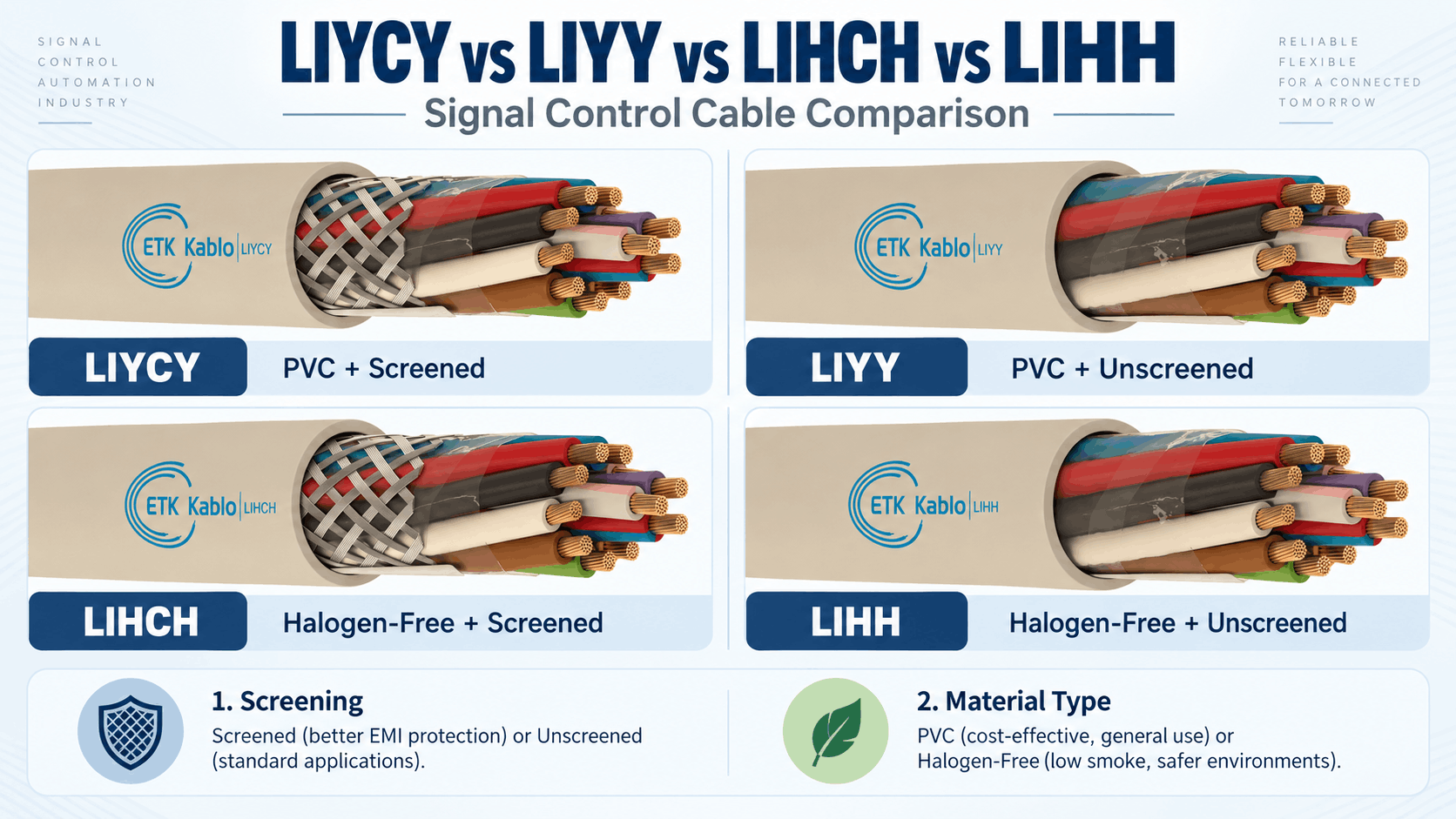
LIYY is an unscreened PVC signal and control cable. LIYCY uses a similar PVC-based construction but adds a tinned-copper braid screen for improved electromagnetic compatibility. Meanwhile, LIHH replaces the PVC insulation and sheath system with halogen-free materials while remaining unscreened. LIHCH combines both requirements by using halogen-free materials together with a tinned-copper braid screen.
Therefore, none of the four cables should automatically be considered the “best” option. The correct construction depends on the electrical-noise environment, fire and smoke requirements, installation location, signal sensitivity and project specification.
Quick answer: Choose LIYY for general signal and control circuits where EMI exposure is low and PVC is acceptable. Choose LIYCY where the same type of signal requires copper-braid screening. Select LIHH when the project requires halogen-free, low-smoke materials but does not need a metallic screen. Finally, choose LIHCH when both electromagnetic screening and halogen-free construction are required.
LIYCY vs LIYY vs LIHCH vs LIHH at a Glance
| Characteristic | LIYY | LIYCY | LIHH | LIHCH |
|---|---|---|---|---|
| Conductor | Class 5 flexible copper | Class 5 flexible copper | Class 5 flexible copper | Class 5 flexible copper |
| Insulation | PVC | PVC | Halogen-free | Halogen-free |
| Screen | No | Tinned copper braid | No | Tinned copper braid |
| Outer sheath | PVC | PVC | Halogen-free | Halogen-free |
| EMI protection | Limited by unscreened construction | Yes | Limited by unscreened construction | Yes |
| Halogen-free | No | No | Yes | Yes |
| Typical selection logic | General low-noise signal circuits | EMI-sensitive signal circuits | Low-smoke halogen-free environments | EMI-sensitive + halogen-free environments |
This creates a simple selection matrix.
LIYY = PVC + no screen.
LIYCY = PVC + copper-braid screen.
LIHH = halogen-free + no screen.
LIHCH = halogen-free + copper-braid screen.
Consequently, screening and fire-material strategy can be selected independently rather than treating all four product codes as unrelated cables.
What Is LIYY Signal Control Cable?
LIYY is a flexible multicore signal and control cable using PVC insulation and a PVC outer sheath without a metallic screen.
A typical construction includes:
- Class 5 stranded copper conductors
- PVC conductor insulation
- Layer-stranded cable core
- PVC outer sheath
Because LIYY does not include a metallic braid, the cable remains relatively simple, flexible and economical.
Therefore, LIYY can be an efficient choice for:
- Control cabinets
- Electronic equipment
- Monitoring systems
- Industrial automation
- Low-frequency signal circuits
- Indoor communication equipment
However, engineers should avoid using an unscreened construction where strong electromagnetic interference can disturb sensitive signals.
What Is LIYCY Signal Control Cable?
LIYCY is the screened PVC version within this signal-control family.
ETK’s standard LIYCY construction includes:
- Class 5 stranded electrolytic copper conductors
- PVC insulation
- Layer stranding
- Polyester wrapping
- Tinned-copper braid screen
- UV-resistant PVC outer sheath
The tinned-copper braid surrounds the complete assembled cable core.
As a result, LIYCY provides additional protection against electromagnetic interference while retaining the familiar PVC insulation and sheath architecture.
LIYCY vs LIYY Cable: What Is the Main Difference?
The main difference in a LIYCY vs LIYY cable comparison is the metallic screen.
Both belong to flexible PVC signal-control cable families.
However:
LIYY is unscreened.
LIYCY uses tinned-copper braid screening.
Therefore, LIYCY becomes particularly useful where nearby electrical equipment can introduce unwanted interference into sensitive circuits.
When Should You Choose LIYCY Instead of LIYY?
Choose LIYCY when the cable route passes near significant sources of electrical noise.
Examples include:
- Variable-frequency drives
- Motors
- Servo drives
- Power cables
- Contactors
- Transformers
- Switchgear
- Industrial power electronics
In these environments, the braid can help reduce electromagnetic interference entering the signal conductors.
Consequently, LIYCY can offer greater signal stability than LIYY where EMI conditions are demanding.
When Is LIYY the Better Choice?
Screening should not be specified automatically.
Where EMI exposure is low, LIYY can provide several practical advantages:
- Simpler construction
- Lower copper content
- Lower weight
- Smaller diameter in comparable designs
- Easier termination
- Lower material cost
Therefore, using LIYCY for every low-voltage signal circuit can create unnecessary complexity.
In practice, LIYY remains a strong choice for protected control cabinets and low-noise electronic environments.
What Is LIHH Signal Control Cable?
LIHH provides the halogen-free, unscreened alternative within the same general signal-control family.
Instead of PVC insulation and sheath materials, the cable uses halogen-free compounds.
A typical LIHH construction includes:
- Class 5 stranded copper conductors
- Halogen-free conductor insulation
- Layer or pair stranding depending on the product version
- Polyester wrapping where required
- Halogen-free outer sheath
Because LIHH contains no metallic braid, it solves a different problem from LIYCY.
Its main advantage is not electromagnetic shielding. Instead, it addresses smoke, corrosive gases and halogen-related fire considerations.
What Is LIHCH Signal Control Cable?
LIHCH combines halogen-free materials with tinned-copper braid screening.
ETK’s standard construction includes:
- Class 5 stranded electrolytic copper conductors
- Halogen-free insulation
- Layer-stranded cable core
- Polyester tape
- Tinned-copper braid screen
- Halogen-free outer sheath
Therefore, LIHCH addresses two separate project requirements at the same time:
- Electromagnetic compatibility
- Halogen-free fire-material performance
This combination can be particularly useful in sensitive industrial and building-control applications where both signal integrity and fire-safety material requirements matter.
LIHCH vs LIHH: What Is the Difference?
The LIHCH versus LIHH comparison mirrors the LIYCY vs LIYY cable comparison.
Both LIHH and LIHCH use halogen-free insulation and sheath materials.
However:
LIHH is unscreened.
LIHCH includes a tinned-copper braid screen.
Therefore, LIHCH is the natural choice when a halogen-free signal cable also requires additional EMI protection.
Two Decisions Explain All Four Cables
The simplest selection method is to answer two questions.
Question 1: Does the circuit need electromagnetic screening?
If the answer is no, consider:
- LIYY
- LIHH
If the answer is yes, consider:
- LIYCY
- LIHCH
Question 2: Does the project require halogen-free materials?
If PVC is acceptable, consider:
- LIYY
- LIYCY
If halogen-free construction is required, consider:
- LIHH
- LIHCH
As a result, the correct cable can often be identified before comparing detailed conductor sizes and electrical parameters.
LIYCY vs LIYY Cable: PVC Signal Cable Selection
For conventional industrial environments where PVC remains acceptable, the primary decision becomes screening.
LIYY provides the basic unscreened architecture.
Meanwhile, LIYCY adds tinned-copper braid protection.
Therefore, a LIYCY vs LIYY cable decision should primarily follow the electromagnetic environment rather than assuming that the screened construction is always superior.
LIHCH vs LIHH: Halogen-Free Signal Cable Selection
For projects requiring halogen-free materials, the same logic applies.
LIHH works well where additional EMI shielding is unnecessary.
By contrast, LIHCH adds copper-braid screening for circuits operating in electrically noisy environments.
Consequently, the project can maintain a halogen-free cable strategy without giving up electromagnetic screening where the signal demands it.
PVC vs Halogen-Free Signal Control Cable
The difference between PVC and halogen-free cable materials becomes particularly important during fire.
Conventional PVC can release dense smoke and halogen-containing combustion products.
Halogen-free materials are designed to reduce corrosive halogen gases and, in suitable low-smoke constructions, reduce smoke generation.
Therefore, halogen-free signal cables are commonly considered for:
- Hospitals
- Airports
- Railway stations
- Tunnels
- Data centers
- Public buildings
- Control rooms
- Transportation infrastructure
However, halogen-free does not automatically mean fire resistant.
Halogen-Free vs Fire Resistant
This distinction is essential.
Halogen-free describes the chemical behaviour of cable materials during combustion.
Fire resistant describes the ability of a cable to maintain required circuit integrity during fire for a defined test period.
Therefore, LIHH or LIHCH should not automatically be described as fire-resistant cables simply because they use halogen-free materials.
If circuit continuity during fire is required, the project must specify a dedicated fire-resistant construction and applicable test standard.
Does LSZH Mean Flame Retardant?
LSZH and flame retardancy also describe different characteristics.
A low-smoke halogen-free material strategy addresses smoke and halogen emissions.
Meanwhile, flame-retardancy testing evaluates flame propagation.
ETK’s halogen-free signal-control constructions can combine these characteristics through appropriate materials and tested cable designs.
However, purchasing specifications should still state the required standards explicitly.
Why Does Copper-Braid Screening Matter?
A copper braid forms a conductive enclosure around the cable core.
This screen can help reduce electromagnetic coupling between the signal cable and its surrounding environment.
Therefore, screened cables such as LIYCY and LIHCH can be valuable around:
- Motors
- VFDs
- Industrial drives
- Power distribution
- Switching equipment
- High-density cable trays
In addition, braid screening provides a mechanically robust screen architecture compared with very lightweight foil-only designs.
Does the Copper Braid Eliminate EMI?
No.
Screening improves electromagnetic compatibility, but cable selection forms only one part of the EMC design.
Signal integrity can also depend on:
- Cable routing
- Distance from power cables
- Grounding
- Screen termination
- Equipment interfaces
- Frequency of interference
- Signal level
Consequently, LIYCY or LIHCH should complement good EMC practice rather than replace it.
Why Is the Copper Braid Tinned?
Tinning applies a protective metallic coating to the copper braid wires.
As a result, the braid gains improved resistance to surface oxidation and corrosion in suitable environments.
However, the cable’s complete environmental resistance still depends on its outer sheath and the installation conditions.
Therefore, tinned copper should not be interpreted as universal chemical protection.
LIYCY vs LIYY Cable for Industrial Automation
Industrial automation represents one of the most common applications for both cable families.
A low-noise cabinet installation may use LIYY efficiently.
However, routes near drives, motors or high-current circuits can justify LIYCY.
For example, signal and control cables can connect:
- PLCs
- Sensors
- Actuators
- Monitoring equipment
- Control panels
- Automation cabinets
- Data acquisition equipment
Therefore, a LIYCY vs LIYY cable comparison for automation should begin with the expected EMI level.
LIHCH vs LIHH for Building Automation
Building automation can add another requirement: fire and evacuation performance.
For example, BMS systems can run through:
- Hospitals
- Hotels
- Office complexes
- Transport buildings
- Public facilities
If electromagnetic noise remains low, LIHH can provide an efficient halogen-free option.
Meanwhile, LIHCH adds screening where the same network passes through electrically demanding environments.
Signal Cable for HVAC and BMS Systems
HVAC and building-management systems combine sensors, controllers, actuators and monitoring devices.
Therefore, different sections of one building can justify different cable constructions.
For example:
- Protected low-noise control route → LIYY
- Noisy equipment room → LIYCY
- Public escape-sensitive area → LIHH
- Escape-sensitive + EMI-exposed area → LIHCH
This illustrates why a single cable type does not need to serve every circuit in a large project.
LIYCY vs LIYY Cable Near Variable-Frequency Drives
VFDs can generate substantial electromagnetic noise because of rapid switching waveforms.
Therefore, nearby low-level signal circuits often benefit from screening.
In a direct LIYCY vs LIYY cable comparison, LIYCY provides the clear screening advantage because of its tinned-copper braid.
However, the exact cable connected directly to a VFD depends on the function.
A motor-output cable, feedback cable, encoder cable and general control cable can require different electrical constructions.
Consequently, LIYCY should not automatically replace a dedicated VFD motor cable.
LIYCY and LIHCH for Instrumentation
LIYCY and LIHCH can both serve selected instrumentation and measurement applications.
The copper braid can help protect low-level signals from electromagnetic interference.
However, highly demanding process instrumentation can require additional characteristics such as:
- Twisted pairs or triads
- Individual PiMF or TiMF screens
- Specific capacitance
- Defined conductor resistance
- Intrinsic-safety parameters
Therefore, a general braid-screened signal cable should not automatically replace a dedicated instrumentation cable.
Signal Control Cable vs Instrumentation Cable
The two categories can overlap, but their design priorities can differ.
Signal-control cables often provide flexible multicore connections for electronic control and monitoring systems.
Instrumentation cables frequently place greater emphasis on:
- Pair and triad geometry
- Individual shielding
- Capacitance
- Analogue measurement accuracy
- Long process-control routes
Consequently, engineers should compare the actual electrical parameters before substituting one family for another.
LIYCY vs LIYY Cable for Sensors
Sensor wiring can carry relatively low-level electrical signals.
Therefore, the electromagnetic environment can strongly influence cable selection.
For sensors inside protected equipment, LIYY may provide sufficient performance.
By contrast, an industrial sensor positioned close to motors or drive systems can benefit from LIYCY screening.
As a result, the sensor output type and cable route should both influence the final choice.
LIHCH vs LIHH for Public Buildings
Public buildings often place greater emphasis on smoke and corrosive combustion products.
For this reason, halogen-free cables can become preferable to conventional PVC constructions.
LIHH provides the simplest halogen-free option where EMI exposure remains low.
Meanwhile, LIHCH combines the same fire-material philosophy with copper-braid screening.
LIHCH for Transportation Infrastructure
Transportation environments can combine public occupancy with significant electrical equipment.
Examples include:
- Railway stations
- Metro systems
- Airports
- Transport terminals
- Tunnels
Consequently, LIHCH can become attractive where the project needs both a halogen-free construction and EMI protection.
Nevertheless, railway, metro or tunnel projects can impose additional approvals and fire classifications beyond the generic LIHCH designation.
LIHH for Low-Noise Public Infrastructure
Not every halogen-free circuit requires metallic shielding.
For example, low-noise signal routes within protected building areas can use LIHH without adding copper braid.
This can reduce:
- Cable weight
- Diameter
- Material content
- Termination complexity
Therefore, LIHH can provide a more efficient solution where the principal requirement is halogen-free material behaviour rather than EMI protection.
LIYCY vs LIYY Cable and Cable Diameter
Adding a copper-braid screen increases material content.
Consequently, a screened cable will generally have a somewhat larger diameter and greater weight than an otherwise comparable unscreened construction.
This difference can affect:
- Cable tray fill
- Panel entries
- Gland dimensions
- Conduit capacity
- Routing space
Therefore, screening should be specified where it delivers an actual electrical benefit.
Copper Weight and Cable Cost
LIYCY and LIHCH contain additional copper in the braid.
As a result, screened cables can cost more than comparable unscreened cables.
However, cable price should not be considered in isolation.
Electrical noise can create far greater costs through:
- False readings
- Communication errors
- Intermittent faults
- Commissioning delays
- Plant downtime
Consequently, the most economical cable is the least complex construction that still provides reliable long-term performance.
Flexible Does Not Mean Continuous Flex
All four cable families use fine-stranded Class 5 conductors in ETK’s standard constructions.
This provides useful flexibility during installation and routing.
However, Class 5 construction alone does not automatically qualify the cable for:
- Drag chains
- Robotics
- Continuous reciprocating movement
- High-cycle dynamic bending
Therefore, continuous-flex applications should use a cable specifically designed and tested for that movement profile.
LIYCY vs LIYY Cable for Fixed Installations
Both families work well in fixed signal and control installations where their environmental requirements are satisfied.
For example, Class 5 conductors simplify routing through:
- Control cabinets
- Equipment enclosures
- Machine panels
- Junction boxes
- Tight cable pathways
In practice, the LIYCY vs LIYY cable decision remains primarily an EMI question rather than a flexibility question.
Can LIYCY, LIYY, LIHCH and LIHH Be Used Outdoors?
Outdoor suitability should come from the actual product datasheet.
ETK uses UV-resistant outer jackets in relevant standard constructions.
However, UV resistance alone does not establish suitability for every outdoor route.
Projects should also consider:
- Water exposure
- Temperature range
- Mechanical stress
- Chemical exposure
- Direct sunlight
- Installation method
Therefore, the complete environmental requirement should govern the final selection.
Can These Signal Cables Be Directly Buried?
Not simply because they have an outer sheath.
Direct burial can require dedicated:
- Crush protection
- Impact resistance
- Rodent protection
- Water resistance
- Mechanical reinforcement
Consequently, buyers should use a construction specifically designed for underground burial where the project requires it.
Is Copper Braid the Same as Armour?
No.
This is another important distinction.
The copper braid in LIYCY and LIHCH primarily performs an electromagnetic-screening function.
Mechanical armour, meanwhile, protects the cable against physical damage.
| Characteristic | Copper Braid Screen | Mechanical Armour |
|---|---|---|
| Main purpose | EMI protection | Mechanical protection |
| Typical material | Tinned copper | Steel wires, tape or other reinforcement |
| Signal shielding | Yes | Not primary purpose |
| Heavy impact protection | Limited | Yes when designed accordingly |
Therefore, screened signal cable should not automatically replace an armored cable in mechanically demanding routes.
Screen Grounding and Termination
The copper braid can only perform effectively when the complete EMC installation is properly designed.
Screen termination can depend on:
- Signal type
- Frequency
- Equipment manufacturer
- Grounding topology
- Potential differences between locations
- Project EMC philosophy
Therefore, cable manufacturers should not prescribe one universal screen-grounding method for every LIYCY or LIHCH installation.
Installers should follow the approved system design.
Does Screened Cable Always Need Grounding?
The screen normally requires an intentional termination strategy to provide the expected EMC performance.
However, one-end grounding, both-end bonding and other arrangements can behave differently depending on the electrical system.
Consequently, installation practice should follow the specific project’s EMC requirements rather than a generic rule.
Operating Voltage and Conductor Size
LIYCY, LIYY, LIHCH and LIHH are available across multiple conductor cross-sections.
For example, ETK’s LIYCY and LIHCH families include small signal sizes such as 0.22 mm² as well as larger 0.50, 0.75, 1.00, 1.50 and 2.50 mm² options.
Smaller cross-sections can operate at lower signal-control voltage ratings, while larger standard versions can be available in 300/500 V designs.
Therefore, the product designation alone does not establish the exact voltage rating.
The specified cross-section and product datasheet should govern.
Why Mutual Capacitance Matters
Signal circuits can be sensitive to cable capacitance, particularly over long routes.
Capacitance can influence:
- Signal rise time
- Analogue circuit behaviour
- Digital transmission
- Intrinsic-safety calculations
Therefore, engineers should review actual capacitance values when the application requires them rather than selecting only by PVC, halogen-free or screening designation.
LIYCY and LIHCH in Intrinsically Safe Systems
A screened signal cable can form part of an intrinsically safe installation.
However, neither LIYCY nor LIHCH automatically proves intrinsic-safety compliance.
The complete loop can require evaluation of:
- Cable capacitance
- Cable inductance
- Loop resistance
- Route length
- Barrier or isolator parameters
- Field-device parameters
Consequently, hazardous-area engineering should consider the actual cable electrical data.
DIN VDE 0812 and Signal Control Cables
ETK references DIN VDE 0812 for these signal and control cable families.
In addition, conductor construction follows IEC 60228 / EN 60228 Class 5 requirements in the relevant products.
However, a standard reference does not determine:
- Screening requirement
- PVC vs halogen-free materials
- Conductor count
- Cross-section
- Fire strategy
- Environmental exposure
Therefore, the project still needs a complete cable specification.
Fire Tests for LIYCY and LIYY
PVC signal-control cables can use flame-retardant constructions tested according to relevant IEC flame-propagation requirements.
For example, ETK’s standard LIYCY lists IEC 60332-1-2 flame-retardancy testing.
Nevertheless, that classification should not be confused with halogen-free or fire-resistant performance.
Fire and Smoke Performance for LIHH and LIHCH
Halogen-free constructions add additional fire-material performance.
ETK’s halogen-free signal-control families can incorporate requirements relating to:
- Flame propagation
- Smoke density
- Halogen content
- Corrosive combustion gases
For example, relevant ETK LIHH/LIHCH constructions reference tests from the IEC 60332, IEC 60754 and IEC 61034 families.
Therefore, they can be more suitable where smoke and corrosive gas behaviour matters.
Which Signal Control Cable Should You Choose?
| Project Requirement | Cable to Consider | Main Reason |
|---|---|---|
| Low EMI + PVC acceptable | LIYY | Simple unscreened PVC construction |
| Higher EMI + PVC acceptable | LIYCY | Tinned-copper braid screen |
| Low EMI + halogen-free required | LIHH | Halogen-free unscreened construction |
| Higher EMI + halogen-free required | LIHCH | Halogen-free + braid screening |
| Protected control cabinet | LIYY or LIHH | Screen may be unnecessary |
| Near VFDs or motors | LIYCY or LIHCH | Additional EMI protection |
| Public building | LIHH or LIHCH | Halogen-free material strategy |
| Public building + electrical noise | LIHCH | Combines both requirements |
| Heavy mechanical exposure | Dedicated reinforced cable | Copper braid is not armour |
| Continuous movement | Dedicated continuous-flex cable | Class 5 alone is insufficient |
| Complex process instrumentation | Dedicated instrumentation cable | May require pairs, triads and individual screens |
Common Mistakes When Comparing LIYCY, LIYY, LIHCH and LIHH
1. Assuming LIYCY Is Always Better Than LIYY
LIYCY adds screening, but that extra construction can be unnecessary in low-noise environments.
2. Assuming LIHCH Is Always Better Than LIHH
LIHCH is useful where screening is required. LIHH can be more efficient when the environment does not need a metallic screen.
3. Assuming LIHH Is the Halogen-Free Version of LIYCY
LIHH is unscreened. The closer halogen-free equivalent to screened LIYCY is LIHCH.
4. Assuming LIHCH Is Simply an LSZH LIYY
LIHCH also contains a tinned-copper braid screen, while LIYY is unscreened.
5. Treating PVC vs Halogen-Free and Screened vs Unscreened as One Decision
They are separate design choices.
6. Assuming Copper Braid Is Mechanical Armour
The braid primarily provides electromagnetic screening.
7. Assuming Halogen-Free Means Fire Resistant
Fire resistance requires dedicated circuit-integrity construction and testing.
8. Assuming Screened Cable Eliminates EMC Installation Rules
Routing, grounding and screen termination still matter.
9. Assuming Class 5 Means Drag-Chain Rated
Fine-stranded conductors improve flexibility but do not automatically provide continuous-flex capability.
10. Using LIYCY Instead of Dedicated Instrumentation Cable Without Checking Electrical Data
Process instrumentation can require specific capacitance, pair geometry and individual screens.
11. Ignoring Cable Diameter
Screening adds material and can increase outside diameter.
12. Ignoring Fire-Material Requirements
PVC may not satisfy projects requiring halogen-free construction.
13. Assuming Every Halogen-Free Cable Needs Screening
LIHH demonstrates that fire-material requirements and EMI protection remain independent.
14. Choosing LIHCH Only Because It Has the Most Features
Additional materials add weight, diameter and cost. They should solve actual project risks.
15. Selecting Only by Product Code
The actual datasheet should confirm electrical values, temperature, fire tests and environmental suitability.
What Should Buyers Include in a Signal Control Cable RFQ?
An RFQ that simply states “LIYCY cable” or “LIHCH cable” can leave several project requirements undefined.
A useful specification should include:
- Required cable family
- LIYY, LIYCY, LIHH or LIHCH
- Number of conductors
- Pair arrangement where required
- Conductor cross-section
- Conductor class
- Operating voltage
- Screening requirement
- Minimum braid coverage where project-specified
- PVC or halogen-free construction
- Core identification
- Outer sheath colour
- UV resistance
- Indoor or outdoor application
- Operating temperature
- Installation temperature
- Minimum bending radius
- Mutual capacitance where relevant
- Inductance where relevant
- Conductor resistance
- Intrinsic-safety parameters where relevant
- Flame-retardancy requirement
- Smoke-density requirement
- Halogen and corrosive-gas requirements
- CPR classification where applicable
- Continuous-flex requirement where applicable
- Mechanical protection requirement
- Applicable IEC, EN, DIN or customer specification
- Cable marking
- Packing length
- Certificates and test reports
As a result, the manufacturer can quote the required signal-control construction without assuming that every application with similar conductor counts needs the same cable.
ETK Kablo LIYCY, LIYY, LIHCH and LIHH Solutions
ETK Kablo manufactures LIYCY, LIYY, LIHCH and LIHH signal control cables for industrial automation, building control, HVAC, instrumentation, monitoring, communication and electronic-control systems.
LIYY provides the unscreened PVC option for general signal circuits in relatively low-noise environments.
Meanwhile, LIYCY adds a tinned-copper braid around the cable core. Therefore, it can provide additional electromagnetic protection in industrial environments containing motors, drives and other interference sources.
LIHH uses halogen-free insulation and outer-sheath materials without adding a metallic screen. As a result, it provides a suitable architecture where smoke and halogen-related fire considerations are important but additional EMI screening is unnecessary.
LIHCH combines both characteristics by using halogen-free materials together with tinned-copper braid screening.
ETK’s relevant signal-control cable constructions use Class 5 flexible copper conductors and are available across multiple conductor counts and cross-sections. Depending on the specific size, operating-voltage options include low-voltage signal ratings and 300/500 V constructions.
Therefore, the appropriate ETK cable should be selected by defining the electrical-noise environment first, the fire-material requirement second, and then conductor size, voltage, electrical parameters and installation conditions.
Frequently Asked Questions
What is the difference between LIYCY, LIYY, LIHCH and LIHH?
LIYY is unscreened and PVC-based. LIYCY is PVC-based with a tinned-copper braid screen. LIHH is unscreened and halogen-free. LIHCH combines halogen-free materials with a tinned-copper braid screen.
What is the difference between LIYCY and LIYY?
The main LIYCY vs LIYY cable difference is screening. LIYCY includes a tinned-copper braid, while LIYY is unscreened.
What is the difference between LIHCH and LIHH?
Both are halogen-free, but LIHCH includes a tinned-copper braid screen while LIHH remains unscreened.
Which cable is the halogen-free equivalent of LIYCY?
LIHCH is the closest equivalent because it combines halogen-free materials with copper-braid screening.
Which cable is the halogen-free equivalent of LIYY?
LIHH provides the closest equivalent because both are unscreened, while LIHH replaces PVC materials with halogen-free compounds.
Is LIYCY screened?
Yes. LIYCY uses a tinned-copper braid screen around the cable core.
Is LIYY screened?
No. Standard LIYY is an unscreened signal-control cable.
Is LIHCH screened?
Yes. LIHCH combines a tinned-copper braid screen with halogen-free insulation and sheath materials.
Is LIHH screened?
No. LIHH is the unscreened halogen-free construction.
Is LIHCH LSZH?
LIHCH uses halogen-free low-smoke materials in ETK’s standard construction. Exact fire and smoke requirements should still be checked against the applicable product datasheet and project specification.
Is LIHH LSZH?
LIHH uses halogen-free materials and is intended for applications where reduced smoke and corrosive combustion products are important.
Does LIYCY protect against EMI?
Yes. Its tinned-copper braid provides additional electromagnetic screening compared with unscreened LIYY.
Does LIHCH protect against EMI?
Yes. LIHCH also uses a tinned-copper braid screen.
Which cable should I use near VFDs?
Where low-level signal circuits run near significant VFD-generated electrical noise, screened LIYCY or LIHCH can provide an advantage. The exact cable should still match the equipment and signal type.
Which cable should I use in hospitals?
Where the project requires halogen-free materials, LIHH can suit low-noise routes while LIHCH adds screening for EMI-sensitive circuits. Local fire and building requirements should govern the final specification.
Can LIYCY be used for instrumentation?
Yes, in suitable signal and control applications. However, complex process instrumentation can require dedicated pair, triad, PiMF or TiMF constructions.
Is LIYCY armored?
No. Its tinned-copper braid primarily acts as an electromagnetic screen rather than heavy mechanical armour.
Are these cables suitable for continuous flex?
Class 5 conductors provide useful flexibility, but standard LIYCY, LIYY, LIHCH and LIHH should not automatically be considered drag-chain or continuous-flex cables.
Are these cables fire resistant?
Not automatically. Flame retardancy, halogen-free behaviour and fire resistance are separate characteristics. Circuit-integrity applications require a dedicated fire-resistant cable.
Which cable is cheapest?
An unscreened PVC construction such as LIYY will generally contain fewer materials than screened or halogen-free alternatives. However, actual price depends on size, conductor count, copper content and order quantity.
Which cable should I choose: LIYCY, LIYY, LIHCH or LIHH?
Choose according to two main requirements. If screening is unnecessary, use LIYY or LIHH. If screening is required, consider LIYCY or LIHCH. Then choose PVC or halogen-free materials according to the project’s fire and environmental strategy.
Conclusion
A LIYCY vs LIYY cable comparison becomes much easier when screening and cable materials are treated as separate engineering choices.
LIYY provides a flexible unscreened PVC signal-control construction for relatively low-noise environments.
LIYCY adds a tinned-copper braid screen to the PVC cable architecture. Therefore, it becomes more suitable where electromagnetic interference could affect signal reliability.
LIHH takes another route. It removes the metallic screen but uses halogen-free materials where smoke and corrosive combustion products are an important project concern.
Finally, LIHCH combines both requirements by providing copper-braid screening together with halogen-free insulation and sheath materials.
Consequently, LIHCH should not automatically be considered superior to the other three cables. A protected low-noise circuit may need neither its screening nor its additional material requirements.
Likewise, LIYY should not be considered inadequate simply because it is the simplest construction. Where PVC is permitted and EMI exposure is low, the unscreened design can provide the most efficient solution.
For engineers and purchasing teams, the best approach is therefore to ask two questions first: does the signal need electromagnetic screening, and does the project require halogen-free materials? Once those decisions are clear, conductor count, cross-section, electrical characteristics and installation requirements can complete the cable specification.
Benzer yazılar
LSZH vs PVC Cable: Which Should You Specify?
Choosing between LSZH vs PVC cable is primarily a material and fire-safety decision rather than a simple question of which cable is “be...


