





 President’s Message
Blog
LIYCY vs LIYCY-TP: Multicore vs Twisted-Pair Signal Cable
Reading Time: 16 minutes
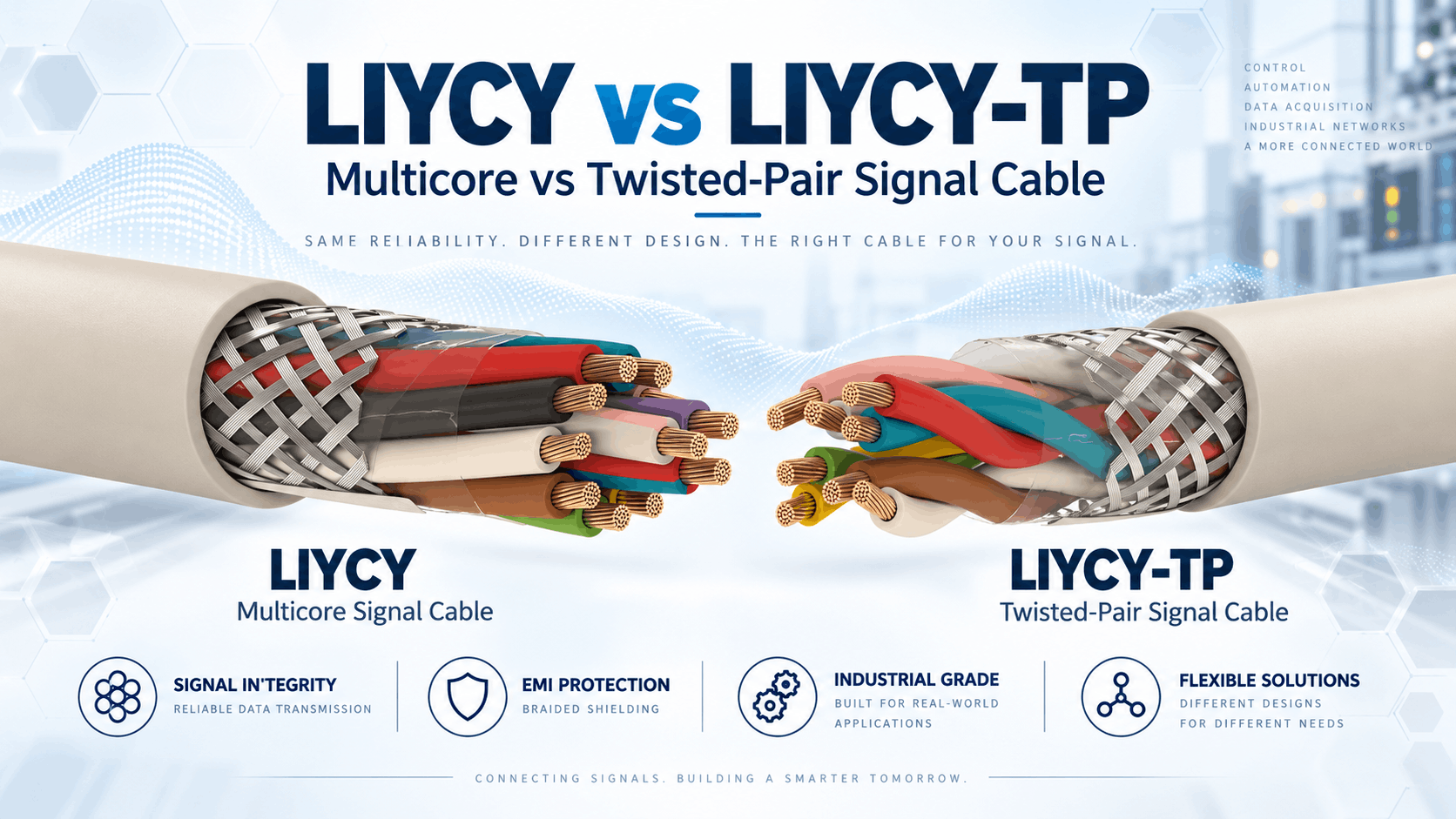
LIYCY vs LIYCY-TP is an important comparison when selecting screened signal cables for industrial automation, measurement systems, control equipment and low-voltage data transmission. The two constructions can use similar conductors, PVC insulation, an overall tinned-copper braid and a PVC outer sheath, but the internal core arrangement is different.
Standard LIYCY is normally a multicore signal cable in which individual insulated cores are stranded together in layers. LIYCY-TP, by contrast, groups the conductors into twisted pairs before those pairs are assembled into the complete cable.
This difference matters because pair twisting improves electrical balance between two related conductors and can reduce susceptibility to electromagnetic interference and crosstalk. As a result, LIYCY-TP is particularly useful when signals naturally operate as two-conductor circuits, differential interfaces or paired analog channels.
However, twisted-pair construction does not automatically make LIYCY-TP a high-speed Ethernet, RS-485 or CAN Bus cable. Those networks can require specific characteristic impedance, capacitance and transmission performance that must be verified from the exact cable datasheet.
Quick answer: choose standard LIYCY when you need a flexible, overall-screened multicore cable for general low-voltage signal and control circuits. Choose LIYCY-TP when the circuits are naturally arranged in pairs and improved pair balance, crosstalk control or noise immunity is desirable. Both constructions can use an overall tinned-copper braid, so the main distinction is multicore versus twisted-pair geometry rather than screened versus unscreened construction.
LIYCY vs LIYCY-TP at a Glance
| Characteristic | LIYCY | LIYCY-TP |
|---|---|---|
| Internal arrangement | Individual cores stranded in layers | Conductors twisted into pairs |
| Typical designation | 4×0.50 mm² | 2×2×0.50 mm² |
| Overall tinned-copper braid | Yes | Yes |
| PVC insulation | Typically yes | Typically yes |
| PVC outer sheath | Typically yes | Typically yes |
| Best suited to paired circuits | Possible | Yes |
| Crosstalk control from pair twisting | Limited | Improved |
| Differential signalling | Possible where technically suitable | Generally better geometry |
| Individually screened pairs | No | Not automatically |
| RS-485 suitability automatic? | No | No |
| CAN Bus suitability automatic? | No | No |
Therefore, the TP suffix should be interpreted primarily as a conductor-geometry feature rather than a completely different cable family.
What Is LIYCY Cable?
LIYCY is a flexible screened signal and control cable commonly used for low-voltage communication, measurement and automation circuits.
A typical construction includes:
- Fine-stranded copper conductors
- PVC core insulation
- Individual colour identification
- Cores stranded together in layers
- Polyester separator
- Overall tinned-copper braid
- PVC outer sheath
The overall braid helps reduce electromagnetic interference from surrounding electrical equipment.
Consequently, LIYCY is widely used near motors, relays, contactors, control cabinets and other environments where ordinary unscreened signal cable could experience electrical noise.
What Does LIYCY Mean?
The designation identifies several construction characteristics.
Within the commonly used European cable nomenclature:
- Li refers to flexible fine-stranded conductors.
- Y indicates PVC insulation.
- C identifies the copper-braid screen.
- Y indicates a PVC outer sheath.
Therefore, LIYCY already tells the buyer that the cable is flexible, PVC-insulated, braid screened and PVC sheathed.
However, the standard LIYCY designation does not itself indicate twisted-pair construction.
What Is LIYCY-TP Cable?
LIYCY-TP retains the basic screened PVC signal-cable concept but adds twisted-pair organization.
The suffix TP means twisted pair.
Instead of assembling each core directly into the overall multicore bundle, the manufacturer first twists two related insulated conductors together.
The resulting pairs are then assembled into the complete cable and protected by the overall tinned-copper braid.
Therefore, a LIYCY-TP construction typically consists of:
- Fine-stranded copper conductors
- PVC core insulation
- Two conductors twisted into each pair
- Pairs stranded together
- Overall separator
- Tinned-copper braid screen
- PVC outer sheath
LIYCY vs LIYCY-TP: The Main Difference
The main difference in LIYCY vs LIYCY-TP is the conductor arrangement.
Standard LIYCY behaves as a conventional multicore cable. Individual insulated conductors are assembled into the overall cable core.
LIYCY-TP creates defined two-conductor circuits by twisting the conductors together in pairs.
This pair geometry can improve electrical balance and reduce the loop area of each two-wire circuit.
As a result, LIYCY-TP can provide better resistance to induced electrical noise for signals that use both conductors together.
Multicore vs Twisted-Pair Cable Construction
Multicore and twisted-pair cable designs solve slightly different wiring problems.
A standard multicore cable provides many individually identifiable conductors inside one overall sheath.
This arrangement works well for:
- Relay contacts
- Discrete control circuits
- Indicator circuits
- Low-voltage auxiliary signals
- General control-panel wiring
A twisted-pair cable deliberately organizes conductors into two-wire electrical circuits.
This approach becomes more attractive for:
- Differential signals
- Analog transmitter loops
- Measurement channels
- Sensor signals
- Serial communication
- Paired low-voltage data circuits
Therefore, the signal architecture should determine whether multicore or paired construction provides the better fit.
Why Twisting Two Conductors Helps Signal Integrity
Electromagnetic fields can induce unwanted voltage into a signal circuit.
If two related conductors follow significantly different physical paths, one conductor can pick up more interference than the other.
Twisting the conductors together continually reverses their physical position relative to external interference sources.
Consequently, the unwanted induced effects tend to become more similar on both conductors.
For differential receivers, this balance can help the receiving circuit reject common-mode noise.
Therefore, pair twisting represents a fundamental electrical design feature rather than merely a convenient way to organize conductors.
LIYCY vs LIYCY-TP for Crosstalk
Crosstalk occurs when electrical energy from one signal circuit couples into another nearby circuit.
In a conventional multicore cable, individual conductors can run close to conductors belonging to several unrelated circuits.
With LIYCY-TP, each two-conductor circuit has a controlled local relationship because its cores remain twisted together.
This construction can help reduce interaction between adjacent signal circuits.
However, the actual crosstalk performance depends on:
- Pair lay length
- Pair-to-pair geometry
- Cable capacitance
- Screening
- Signal frequency
- Cable length
Therefore, the TP suffix indicates a helpful construction principle but does not replace measurable electrical-performance data.
Does LIYCY-TP Have Better EMI Protection?
The answer requires an important distinction.
Both standard LIYCY and LIYCY-TP can use the same type of overall tinned-copper braid.
Therefore, the external cable-level screen can be very similar.
LIYCY-TP adds another form of interference control through balanced pair geometry.
Consequently, it can perform better for paired signal circuits even though the external braid construction is not necessarily different.
This distinction is useful:
Braid screening helps protect the complete cable from external electromagnetic interference.
Pair twisting improves the electrical relationship between the two conductors forming one signal circuit.
LIYCY-TP Does Not Mean Individually Screened Pairs
This is one of the most important specification points.
The abbreviation TP means twisted pair, not individually screened pair.
A typical LIYCY-TP construction uses several twisted pairs underneath one common overall braid.
Therefore, the cable does not automatically contain a separate metallic screen around every pair.
If each signal pair requires its own screen, engineers should specify an individually screened construction explicitly.
For instrumentation systems, this distinction can be particularly important because individual pair screening can reduce pair-to-pair interference more strongly than one common overall screen.
LIYCY-TP vs Individually Screened Pair Cable
Both designs use pairs, but their screening architectures differ.
| Characteristic | LIYCY-TP | Individually Screened Pair Cable |
|---|---|---|
| Conductors twisted in pairs | Yes | Yes |
| Individual pair screen | Usually no | Yes |
| Overall braid | Typically yes | Depends on construction |
| Pair-to-pair isolation | Improved by twisting | Further improved by individual screening |
| Cable complexity | Moderate | Higher |
Consequently, LIYCY-TP can be an efficient solution when pair twisting plus overall screening provides sufficient interference protection.
LIYCY vs LIYCY-TP Cable Notation
The cable designation can immediately reveal whether the product uses individual cores or pairs.
For example:
LIYCY 4×0.50 mm²
This normally describes four individual 0.50 mm² conductors.
By comparison:
LIYCY-TP 2×2×0.50 mm²
This normally describes two pairs, each containing two 0.50 mm² conductors.
Both cables contain four insulated conductors in total.
However, their internal organization is different.
Therefore, engineers should never treat 4×0.50 mm² and 2×2×0.50 mm² as automatically equivalent constructions.
Pair Count vs Core Count
Standard LIYCY specifications usually emphasize conductor count.
Examples include:
- 2×0.25 mm²
- 4×0.50 mm²
- 8×0.75 mm²
- 12×1.00 mm²
LIYCY-TP specifications typically emphasize the number of pairs.
Examples can include:
- 2×2×0.22 mm²
- 4×2×0.25 mm²
- 6×2×0.50 mm²
- 10×2×0.75 mm²
Thus, a 6-pair cable contains 12 insulated signal conductors.
Procurement documents should clearly identify whether a number refers to conductors or pairs.
LIYCY vs LIYCY-TP for Analog Signals
Analog measurement circuits often benefit from paired construction because signal accuracy can be sensitive to electrical noise.
Typical applications include:
- Pressure transmitters
- Temperature transmitters
- Level sensors
- Flow instruments
- Analog PLC inputs
- Data acquisition systems
Where the signal uses two related conductors, LIYCY-TP keeps those conductors physically associated along the cable route.
Therefore, paired construction can provide a more controlled geometry than assigning two arbitrary conductors from a conventional multicore cable.
LIYCY-TP for 4–20 mA Signal Loops
Industrial 4–20 mA transmitters commonly use two-wire circuits.
Because each measurement channel naturally forms a pair, twisted-pair cable can be a practical architecture.
For multiple transmitter loops, a multipair LIYCY-TP cable allows each channel to remain associated with its dedicated partner conductor.
Furthermore, the overall braid can reduce interference from surrounding electrical equipment.
However, cable resistance and loop-voltage calculations still need to suit the transmitter and receiving equipment.
Therefore, pair construction does not eliminate normal instrumentation loop engineering.
LIYCY vs LIYCY-TP for Digital Signals
Digital circuits can also benefit from twisted pairs, particularly when signals use differential transmission.
Differential interfaces transmit information through the voltage difference between two conductors.
Because both conductors experience similar external interference, the receiver can reject much of the common-mode noise.
Pair twisting supports this operating principle.
Consequently, LIYCY-TP can offer a more appropriate physical construction for some low-frequency digital communication circuits than ordinary multicore LIYCY.
Can LIYCY-TP Be Used for RS-485?
Potentially, but not automatically.
This distinction is essential.
RS-485 typically uses a balanced twisted pair, so the physical geometry of LIYCY-TP is directionally appropriate.
However, a proper RS-485 network can also require controlled:
- Characteristic impedance
- Capacitance
- Conductor resistance
- Pair balance
- Shielding
Many RS-485 installations use approximately 120 Ω transmission-line architecture.
Therefore, a generic LIYCY-TP cable should not be described as an RS-485 cable unless its manufacturer confirms the required impedance and electrical characteristics for that application.
Why Twisted Pair Alone Does Not Make an RS-485 Cable
The TP suffix describes conductor geometry.
It does not guarantee a particular characteristic impedance.
Two different twisted-pair cables can have significantly different impedance and capacitance because of differences in:
- Conductor diameter
- Insulation thickness
- Insulation dielectric constant
- Pair spacing
- Twist lay
Consequently, a cable can be twisted-pair and screened while still being unsuitable for a demanding RS-485 network.
Can LIYCY-TP Be Used for CAN Bus?
The same caution applies to CAN Bus.
High-speed CAN networks commonly use approximately 120 Ω balanced transmission lines.
LIYCY-TP offers the useful twisted-pair geometry required by differential CAN signalling.
However, the cable must still provide the appropriate impedance, capacitance and attenuation characteristics for the intended network length and data rate.
Therefore, engineers should not substitute generic LIYCY-TP for a specified CAN cable solely because both products contain twisted pairs.
Can LIYCY-TP Be Used for Modbus RTU?
Modbus RTU commonly operates over an RS-485 physical layer.
Accordingly, the cable-selection requirements are primarily those of the RS-485 network rather than the Modbus application protocol itself.
A LIYCY-TP construction can therefore be considered only when its electrical characteristics satisfy the relevant RS-485 design.
For short, low-speed networks, engineers may have more tolerance than on long or high-speed links.
Nevertheless, the safest specification is to use a cable whose impedance and capacitance are explicitly suited to the communication system.
LIYCY vs LIYCY-TP for Sensors
Industrial sensors can use several electrical interfaces.
Examples include:
- Simple switching contacts
- 24 VDC digital outputs
- 0–10 V analog signals
- 4–20 mA loops
- Serial communication
- Differential measurement signals
Standard LIYCY can be highly suitable for general multiconductor sensor connections.
Meanwhile, LIYCY-TP becomes attractive when individual signals naturally use matched conductor pairs.
Therefore, “sensor cable” alone does not determine whether multicore or twisted-pair construction is better.
LIYCY vs LIYCY-TP for Control Panels
Control panels often contain a large mixture of signal types.
Standard LIYCY provides practical multicore wiring for:
- Relay contacts
- Indicator circuits
- Interlocks
- Switches
- General low-voltage control wiring
LIYCY-TP can provide a more structured approach for paired analog or digital interfaces.
Consequently, one control cabinet can legitimately use both cable types for different circuits.
LIYCY vs LIYCY-TP in Industrial Automation
Industrial automation systems rarely use only one signal architecture.
A production line can contain PLC inputs, analog transmitters, encoders, serial networks and discrete switches at the same time.
For this reason, cable selection should follow signal type rather than standardize every circuit on one product merely for purchasing convenience.
Standard LIYCY is highly versatile where multiple independent conductors need an overall braid.
LIYCY-TP provides an advantage when pairs form the natural electrical building blocks of the system.
LIYCY-TP and Differential Signal Transmission
Differential communication relies on the voltage difference between two signal conductors.
External electrical interference that affects both conductors similarly appears primarily as common-mode noise.
A suitable differential receiver can reject a significant portion of that interference.
Twisting helps because the two conductors repeatedly exchange physical positions along the cable.
Therefore, balanced pair geometry is an important part of robust differential signalling.
However, the entire system must remain balanced. Connectors, terminations and network topology also influence performance.
LIYCY vs LIYCY-TP and Overall Braid Screening
Both products can use an overall tinned-copper braid.
The braid surrounds the complete assembled cable core and reduces coupling from external electromagnetic fields.
Typical industrial noise sources include:
- Motors
- Variable-frequency drives
- Contactors
- Power cables
- Transformers
- Switch-mode power supplies
Therefore, both LIYCY and LIYCY-TP can provide useful EMC protection in industrial environments.
The TP version adds pair geometry on top of that overall screening system.
Why Screen Termination Still Matters
A high-quality tinned-copper braid can only perform effectively when the complete EMC installation uses appropriate screen termination.
Poor bonding can reduce the practical benefit of the screen.
Likewise, long unshielded pigtail connections can introduce unwanted impedance and reduce high-frequency screening effectiveness.
Therefore, cable construction and installation practice should support the same EMC objective.
LIYCY-TP Is Not the Same as Ethernet Cable
Both LIYCY-TP and Ethernet cable contain twisted pairs, but the similarity should not be taken too far.
Ethernet categories such as Cat 5e, Cat 6 and Cat 6A have tightly controlled requirements for:
- Characteristic impedance
- Insertion loss
- NEXT
- Return loss
- ACR
- Propagation delay
- Frequency bandwidth
Generic LIYCY-TP signal cable does not automatically satisfy these category limits.
Therefore, LIYCY-TP should not be substituted for Ethernet cable in structured networks.
LIYCY vs LIYCY-TP and Capacitance
Capacitance is important in low-voltage signal circuits because it affects how the cable loads the transmitter.
Long cable lengths multiply the total capacitance seen by the connected equipment.
For analog and serial circuits, excessive capacitance can reduce signal rise time or communication margin.
Pair geometry directly influences mutual capacitance.
Therefore, engineers should review manufacturer capacitance data when designing long LIYCY or LIYCY-TP runs.
Why Capacitance Matters More on Long Signal Runs
Consider a cable with a specified capacitance per kilometre.
A short 20 m connection contributes only a small fraction of the published kilometre value.
A 500 m route, by contrast, contributes twenty-five times as much cable capacitance.
Consequently, a cable that performs well on a short machine connection may not automatically suit a long serial or measurement link.
This is another reason to evaluate actual electrical parameters rather than only the product name.
LIYCY vs LIYCY-TP and Conductor Resistance
Conductor resistance depends mainly on conductor material, cross-section, construction and temperature.
Pair twisting does not fundamentally eliminate conductor resistance.
Therefore, two cables using the same conductor cross-section can have broadly comparable resistance requirements even when one uses pair construction.
However, the finished pair length can be slightly longer than the cable’s axial length because the conductors follow a helical path.
Manufacturers account for the finished construction when publishing their product data.
LIYCY vs LIYCY-TP and Core Identification
Signal cables commonly use colour-coded cores to simplify termination and maintenance.
DIN 47100 colour sequences are widely associated with European signal and communication cable families.
For twisted-pair versions, colour identification also helps technicians recognize which two cores belong to one pair.
Therefore, the cable schedule should preserve pair assignments during termination rather than selecting conductors randomly.
Why Pair Assignment Matters
If an installer takes one conductor from pair 1 and another from pair 2 to create a differential circuit, the intended twisted-pair advantage is lost.
The two conductors no longer follow the same electromagnetic environment along the route.
Consequently, the circuit can become more susceptible to noise and crosstalk.
Therefore, paired cables should be terminated according to their actual pair organization.
LIYCY vs LIYCY-TP Voltage Rating
The TP suffix does not define voltage rating.
Standard LIYCY and LIYCY-TP product families can use different voltage ratings depending on conductor cross-section, manufacturer and specific construction.
For example, signal-cable products can use relatively low operating-voltage ratings for small conductor sizes while larger sections may use 300/500 V or another defined class.
Therefore, the cable’s operating voltage should always come from the exact manufacturer datasheet.
Pair twisting should never be interpreted as a voltage classification.
LIYCY vs LIYCY-TP Conductor Size
Both cable families can be manufactured in several conductor cross-sections.
Common signal-cable sizes can include:
- 0.14 mm²
- 0.22 mm²
- 0.25 mm²
- 0.34 mm²
- 0.50 mm²
- 0.75 mm²
- 1.00 mm²
- 1.50 mm²
Exact available sizes differ by manufacturer and pair count.
Smaller conductors reduce cable diameter and weight, while larger conductors provide lower electrical resistance.
Consequently, conductor size should follow circuit length, current and electrical requirements rather than the choice between multicore and TP alone.
Flexible Conductors in LIYCY Signal Cable
LIYCY families commonly use fine-stranded copper conductors to provide installation flexibility.
This construction helps route the cable through control panels, machine wiring and confined industrial pathways.
However, flexible conductor construction does not automatically mean the cable is suitable for continuous drag-chain operation.
Therefore, applications involving millions of repetitive flex cycles require a cable specifically designed and tested for continuous movement.
LIYCY vs LIYCY-TP for Fixed and Flexible Installation
Both products can provide useful flexibility during installation and occasional movement.
Typical applications include:
- Control cabinets
- Machine wiring
- Production equipment
- Measurement systems
- Laboratory equipment
Nevertheless, the permitted bend radius and movement conditions should come from the exact product datasheet.
Consequently, the word “flexible” should not be interpreted as universal drag-chain approval.
LIYCY-TP vs LIHCH-TP
Projects that require twisted pairs but also demand halogen-free materials can consider LIHCH-TP rather than LIYCY-TP.
The fundamental architecture remains similar:
- Flexible conductors
- Twisted-pair organization
- Overall copper braid screening
However, LIHCH-TP replaces conventional PVC material systems with halogen-free compounds.
Therefore, LIHCH-TP can be more appropriate in public buildings, transportation infrastructure and enclosed spaces where smoke and corrosive gas behaviour matter.
LIYCY-TP vs LIY(St)Y-PIMF
When pair-to-pair isolation becomes more demanding, engineers can move beyond overall braid screening.
LIY(St)Y-PIMF-type constructions can provide individually screened pairs, depending on the exact design.
This architecture physically separates each signal pair with its own metallic screen.
Consequently, it can offer stronger isolation between sensitive channels than a LIYCY-TP cable using one common braid around all pairs.
However, individually screened constructions also increase cable complexity, diameter and termination effort.
When Standard LIYCY Is the Better Choice
Standard LIYCY can be the more efficient solution when the circuit does not require defined pairs.
Typical examples include:
- Relay contacts
- Switch signals
- Indicator circuits
- General PLC I/O
- Multi-conductor control connections
- Low-voltage auxiliary circuits
In these applications, pair twisting can add complexity without delivering a meaningful electrical advantage.
Therefore, standard multicore LIYCY remains a highly practical screened signal cable.
When LIYCY-TP Is the Better Choice
LIYCY-TP becomes attractive when the electrical circuits naturally operate as pairs.
Potential examples include:
- Analog measurement loops
- Differential signals
- Low-frequency serial interfaces
- Sensor pairs
- Data acquisition channels
- Paired monitoring circuits
In those cases, pair twisting can improve signal organization and electromagnetic balance.
Nevertheless, protocol-specific networks still require verification of impedance and other electrical parameters.
Common LIYCY vs LIYCY-TP Specification Mistakes
Assuming LIYCY-TP Has More Shielding
Both products can use the same overall tinned-copper braid. TP primarily changes the internal conductor geometry.
Assuming TP Means Individually Shielded Pairs
Twisted pair and individually screened pair are different construction concepts.
Using Standard LIYCY for a Differential Circuit Without Reviewing Geometry
The circuit can work electrically, but a dedicated twisted pair can provide better balance and noise rejection.
Using LIYCY-TP as Ethernet Cable
Twisted pairs alone do not establish Cat 5e, Cat 6 or Cat 6A performance.
Using LIYCY-TP for RS-485 Without Checking Impedance
The cable must meet the electrical characteristics required by the actual RS-485 network.
Using LIYCY-TP for CAN Bus Without Verification
CAN applications also require appropriate transmission-line characteristics.
Breaking the Pair During Termination
Using conductors from different pairs eliminates the electrical benefit of the designed pair geometry.
Ignoring Capacitance
Long signal runs can create substantial total cable capacitance.
Assuming Higher Pair Count Means Better Signal Quality
Pair count describes capacity, not electrical performance.
Ignoring Overall Screen Termination
A braid screen needs an appropriate EMC termination strategy to perform effectively.
Assuming LIYCY-TP Is Halogen Free
Standard LIYCY-TP generally uses PVC. Halogen-free projects require an appropriate alternative such as LIHCH-TP.
Using Ordinary Flexible Cable in Continuous Motion
Installation flexibility should not be confused with continuous-flex or drag-chain capability.
How to Choose LIYCY vs LIYCY-TP
Identify Whether the Circuit Is Naturally Paired
Start by checking whether each signal uses two related conductors.
Review the Signal Type
Determine whether the circuit carries discrete control, analog measurement, differential communication or another signal type.
Assess Crosstalk Sensitivity
Where several sensitive channels share one cable, twisted-pair organization can improve separation.
Review the EMI Environment
Both constructions can use an overall braid, but severe electrical-noise environments require a complete EMC assessment.
Check Characteristic Impedance
For RS-485, CAN or other transmission-line applications, confirm that the actual cable meets the required impedance.
Check Capacitance
Long analog and serial circuits can require low-capacitance cable.
Determine Core or Pair Count
Specify individual cores for LIYCY and pair count for LIYCY-TP clearly in the RFQ.
Select Conductor Cross-Section
Choose the conductor size from resistance, current and installation requirements.
Review Voltage Rating
Confirm the maximum operating voltage from the exact cable datasheet.
Check Fire Requirements
Where halogen-free or higher reaction-to-fire performance is required, evaluate the appropriate cable family and CPR classification.
Confirm Installation Movement
Separate fixed or occasional-flexing applications from continuous dynamic movement.
Review the Manufacturer Datasheet
Finally, verify conductor construction, braid coverage, capacitance, voltage, temperature and mechanical data for the exact product.
LIYCY vs LIYCY-TP RFQ Checklist
A professional LIYCY vs LIYCY-TP specification should describe the signal architecture rather than request only “screened signal cable.”
Useful RFQ information includes:
- LIYCY or LIYCY-TP construction
- Number of conductors
- Number of pairs
- Conductor cross-section
- Conductor class
- Copper conductor type
- PVC insulation
- Core colour identification
- Twist-pair requirement
- Overall tinned-copper braid
- Minimum braid coverage where specified
- PVC outer sheath
- Rated operating voltage
- Test voltage
- Maximum conductor resistance
- Maximum mutual capacitance
- Characteristic impedance where required
- Operating temperature
- Minimum bending radius
- Flame-performance requirement
- CPR classification where applicable
- Fixed or occasional-flexing installation
- Signal type
- Communication protocol where applicable
- Cable marking
- Required test documentation
Consequently, manufacturers can determine whether an ordinary screened multicore construction or a paired cable provides the better technical solution.
ETK Kablo LIYCY and LIYCY-TP Signal Cables
ETK Kablo manufactures screened signal and control cables for industrial automation, machinery, measurement systems and building technology.
ETK’s standard LIYCY construction uses flexible stranded copper conductors, PVC insulation, cores stranded in layers, polyester wrapping, an overall tinned-copper braid and a PVC outer jacket.
The standard product range covers multiple conductor counts and cross-sections for general screened signal and control applications.
For circuits requiring paired conductor geometry, ETK also provides LIYCY-TP constructions in its signal-cable portfolio.
ETK’s current quality documentation includes both LIYCY and LIYCY-TP within its declared signal-cable product range.
Therefore, ETK can match multicore or twisted-pair construction to the signal architecture while also considering conductor size, capacitance, screening, fire performance and project-specific requirements.
Frequently Asked Questions About LIYCY vs LIYCY-TP
What is the difference between LIYCY and LIYCY-TP?
Standard LIYCY uses individual cores assembled in a multicore construction, while LIYCY-TP twists the conductors into pairs before assembling the cable.
What does TP mean in LIYCY-TP?
TP means twisted pair.
Is LIYCY-TP screened?
Yes, typical LIYCY-TP constructions use an overall tinned-copper braid screen.
Does standard LIYCY also have a screen?
Yes. The C in LIYCY identifies the copper-braid screening construction.
Is LIYCY-TP double screened?
Not automatically. Pair twisting is not a metallic screen, and standard LIYCY-TP usually uses one overall braid around all pairs.
Are the pairs individually screened?
Not unless the product specification explicitly states individual pair screening.
Which has better crosstalk performance?
LIYCY-TP generally provides better pair organization and crosstalk control because related conductors remain twisted together.
Which is better for analog signals?
Twisted-pair LIYCY-TP can be advantageous for two-wire analog measurement and transmitter circuits, particularly where noise is a concern.
Can LIYCY-TP carry 4–20 mA signals?
Yes, where its conductor resistance, voltage rating and other electrical characteristics suit the loop design.
Can LIYCY-TP be used for RS-485?
Only when the exact product provides the characteristic impedance, capacitance and other parameters required by the RS-485 network.
Is every LIYCY-TP cable 120 Ω?
No. Twisted-pair construction does not automatically establish 120 Ω characteristic impedance.
Can LIYCY-TP be used for Modbus RTU?
It can be considered when Modbus RTU operates over RS-485 and the cable meets the corresponding physical-layer requirements.
Can LIYCY-TP be used for CAN Bus?
Only if the cable’s impedance and electrical characteristics meet the requirements of the CAN network.
Can LIYCY-TP replace Ethernet cable?
No. Generic LIYCY-TP does not automatically meet Ethernet category requirements for impedance, NEXT, return loss and bandwidth.
What does 2×2×0.50 mm² mean?
It normally means two twisted pairs with two 0.50 mm² conductors in each pair, giving four conductors in total.
What is the difference between 4×0.50 and 2×2×0.50?
Both contain four conductors, but the first is a conventional four-core construction while the second organizes the four conductors into two twisted pairs.
Is LIYCY-TP halogen free?
Standard LIYCY-TP normally uses PVC. A halogen-free paired alternative can be specified from another product family such as LIHCH-TP.
Is LIYCY-TP suitable for drag chains?
Not automatically. Continuous-flex applications require a cable specifically designed and tested for repeated dynamic movement.
When should standard LIYCY be chosen?
Choose it for general multicore screened signal and control circuits where defined conductor pairs are not required.
When should LIYCY-TP be chosen?
Choose it when the circuit architecture uses two-conductor channels and improved pair balance or crosstalk control provides an electrical advantage.
Conclusion
The LIYCY vs LIYCY-TP comparison is primarily a question of multicore versus twisted-pair construction.
Standard LIYCY provides flexible individual cores underneath a common tinned-copper braid, making it a versatile solution for screened low-voltage signal and control wiring.
LIYCY-TP retains the overall screened PVC construction but organizes the conductors into defined twisted pairs. This geometry can improve electrical balance, noise rejection and crosstalk performance for analog, differential and paired signal circuits.
However, TP should not be confused with individual pair screening, Ethernet category performance or guaranteed 120 Ω bus impedance.
Therefore, protocol-specific applications such as RS-485, Modbus RTU and CAN require verification of the actual electrical parameters rather than selection by cable name alone.
Choose the Signal Architecture Before the Cable
First, determine whether the application uses independent conductors or natural two-wire circuits.
Next, evaluate the required resistance to electromagnetic interference and crosstalk.
For communication buses, characteristic impedance and capacitance should then be checked against the network specification.
Finally, conductor size, pair count, voltage, fire performance and installation conditions should complete the cable selection.
Ultimately, LIYCY and LIYCY-TP are not competing grades in which one is universally better. Standard LIYCY is optimized for flexible screened multicore signal wiring, while LIYCY-TP provides a more suitable internal geometry when paired circuits form the foundation of the signal system.
Benzer yazılar

EN 50288-7 Instrumentation Cables Explained
EN 50288-7 cable specifications are widely used for instrumentation and control systems that transmit analogue or digital signals betwe...
LIYCY vs LIYY vs LIHCH vs LIHH: Signal Control Cable Comparison
Choosing between LIYCY vs LIYY cable and the halogen-free LIHCH and LIHH alternatives becomes much easier once the specification is div...
YSLY vs YSLCY vs YSLYCY Control Cables: What Is the Difference?
Choosing between YSLY vs YSLCY control cable and the heavier YSLYCY construction requires more than checking whether a cable is flexibl...

SWA Instrumentation Cable for Oil, Gas and Petrochemical Projects
An SWA instrumentation cable combines low-level signal transmission with Steel Wire Armour to provide additional mechanical protection ...
PiMF vs TiMF Instrumentation Cable Explained
Understanding PiMF vs TiMF cable construction is important when an instrumentation system carries multiple low-level analogue or digita...
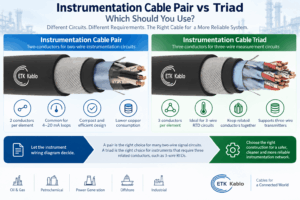
Instrumentation Cable Pair vs Triad: Which Should You Use?
Choosing between an instrumentation cable pair vs triad should begin with the electrical circuit rather than the cable construction. A ...
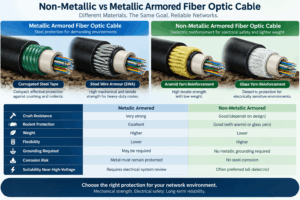
Non-Metallic vs Metallic Armored Fiber Optic Cable
Choosing between metallic vs non-metallic fiber cable protection requires more than comparing steel with aramid or glass yarn. Both con...
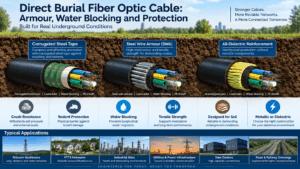
Direct Burial Fiber Optic Cable: Armour, Water Blocking and Protection
Selecting a direct burial fiber cable requires a different approach from selecting cable for an underground duct. In a direct-burial in...
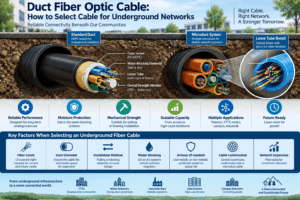
Duct Fiber Optic Cable: How to Select Cable for Underground Networks
Selecting the right underground fiber cable for a duct network requires more than choosing a fiber count and an outdoor jacket. The cab...
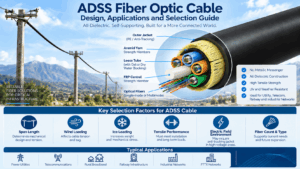
ADSS Fiber Optic Cable: Design, Applications and Selection Guide
ADSS fiber optic cable is designed for aerial telecommunications and data networks where the cable must support its own weight between ...
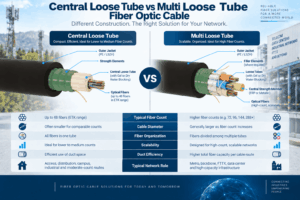
Central Loose Tube vs Multi Loose Tube Fiber Optic Cable: Which Should You Choose?
Choosing between central loose tube vs multi loose tube fiber optic cable starts with the internal cable architecture. Both constructio...
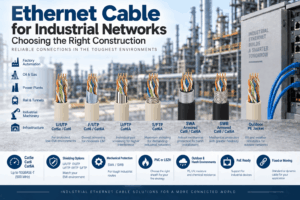
Ethernet Cable for Industrial Networks: Choosing the Right Construction
Choosing the right industrial Ethernet cable involves much more than selecting Cat5e, Cat6 or Cat6A. Industrial networks can expose Eth...


