





 President’s Message
Blog
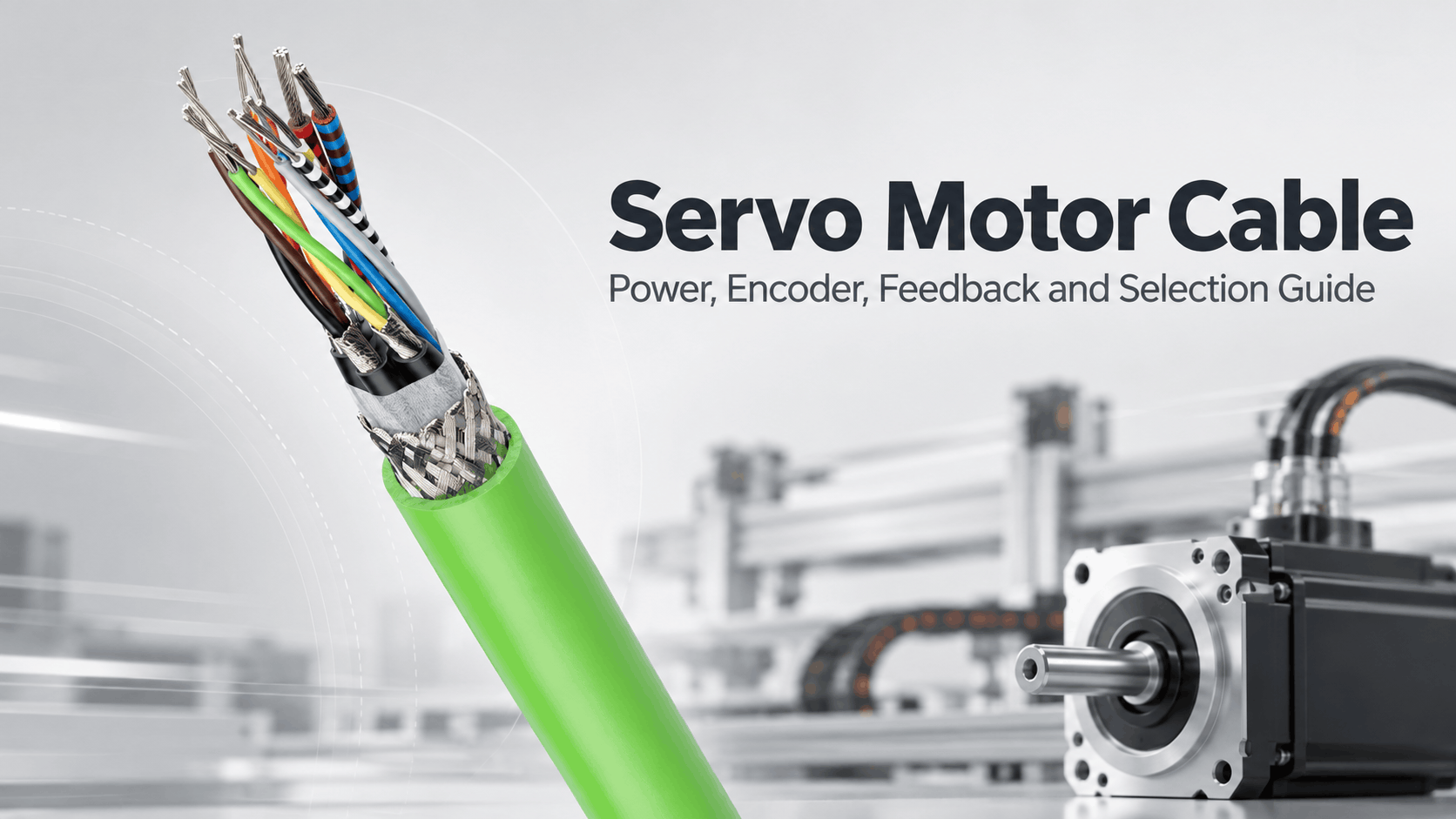
Servo Motor Cable: Power, Encoder, Feedback, Shielding and Selection Guide
Reading Time: 20 minutes
Servo motor cable connects a servo drive with the motor, feedback system or related control components in precision automation equipment. However, there is no single universal servo cable construction. A servo system can require separate power, brake, encoder and feedback cables, or it can use a hybrid one-cable solution that combines several functions.
Therefore, cable selection should begin with the electrical architecture of the servo system rather than with the words “servo cable” alone. Motor voltage, conductor size, encoder type, electromagnetic compatibility, movement, cable length, connector system and environmental conditions can all affect the required construction.
Moreover, servo drives switch electrical power rapidly. As a result, the motor cable can become a significant source of electromagnetic interference, while encoder and feedback circuits can be sensitive to that same interference.
Consequently, screening, capacitance, conductor arrangement and installation practice are especially important in servo applications.
ETK Kablo manufactures control cables and screened industrial cable constructions for automation and motor-related applications. Nevertheless, servo suitability should always be verified against the exact motor, drive and movement requirements rather than inferred from a general control-cable designation.
Quick answer: a servo motor cable can mean the power cable between the servo drive and motor, the encoder or feedback cable returning position information to the drive, or a hybrid cable combining power and feedback functions. Power cables prioritize voltage, current, low capacitance and EMC performance. Encoder and feedback cables prioritize signal integrity, pair construction, screening and compatibility with the specific feedback system.
Servo Motor Cable at a Glance
| Cable Function | Main Purpose | Key Selection Parameters |
|---|---|---|
| Servo Motor Power Cable | Supplies drive output power to the motor | Voltage, conductor size, current, shielding, capacitance, length |
| Servo Encoder Cable | Carries position / speed feedback | Pair layout, shielding, capacitance, protocol, connector pinout |
| Servo Feedback Cable | Returns encoder, resolver or sensor information | Signal type, pair construction, screen design, electrical parameters |
| Brake Cable | Supplies or controls the motor holding brake | Voltage, current, conductor size, integration with power cable |
| Hybrid Servo Cable | Combines power and feedback in one construction | Drive system compatibility, EMC separation, connector system |
| Continuous-Flex Servo Cable | Operates in repetitive moving machinery | Bending cycles, bend radius, acceleration, travel distance, sheath |
| Fixed Servo Cable | Connects stationary drive and motor installations | Electrical performance, routing, shielding, environmental conditions |
Thus, the correct servo cable depends primarily on which connection inside the drive system it serves.
What Is a Servo Motor Cable?
A servo motor cable is an industrial cable used within a closed-loop motion-control system.
A typical servo system contains:
- Servo drive
- Servo motor
- Encoder or resolver
- Controller or PLC
- Motor power connection
- Feedback connection
- Optional holding brake
The servo drive continuously adjusts motor current according to commands and feedback from the motor.
Therefore, the cabling system must support both power transmission and accurate feedback communication.
In some systems, separate cables perform these functions. Meanwhile, newer drive architectures can combine power and feedback in one hybrid connection.
Servo Cable vs Ordinary Control Cable
A general control cable can transmit commands, auxiliary power and switching signals inside industrial machinery.
Servo applications, however, can create more demanding electrical conditions.
For example, servo motor power cables operate downstream of an electronic drive that switches voltage rapidly. Consequently, the cable can experience high-frequency components that conventional mains wiring does not encounter in the same way.
Furthermore, feedback circuits may carry high-speed digital or low-level position information that requires controlled screening and conductor geometry.
Therefore, a conventional screened control cable should not automatically be substituted for a specified servo cable.
Our industrial control cable selection guide explains the broader distinction between general automation wiring and specialized machine connections.
Servo Motor Power Cable Explained
A servo motor power cable connects the output of the servo drive to the motor windings.
For a typical three-phase AC servo motor, the cable can contain:
- Three phase conductors
- Protective earth conductor
- Overall electromagnetic screen
- Optional brake conductors
- Optional temperature-sensor conductors
Some servo cable constructions therefore use a basic 4-core power arrangement. Others add one or more auxiliary pairs for brake or monitoring functions.
Accordingly, an RFQ should specify the complete conductor configuration rather than merely requesting “4-core servo cable.”
AC Servo Motor Cable
An AC servo motor cable carries the controlled AC output from a servo drive to an AC servo motor.
Unlike a conventional direct-on-line motor connection, the waveform is produced electronically by the drive.
Therefore, cable selection needs to consider more than nominal motor voltage.
Important parameters can include:
- Drive output voltage
- Motor current
- Cable length
- Cable capacitance
- Screen construction
- Motor insulation requirements
- Drive manufacturer recommendations
- Installation environment
Furthermore, fast switching edges can create demanding EMC conditions. As a result, screened motor cables are commonly used between servo drives and motors.
Why Servo Motor Cable Shielding Matters
Servo drives can generate substantial electromagnetic noise because semiconductor switches rapidly control the motor voltage and current.
This unwanted energy can couple into nearby:
- Encoder cables
- Feedback circuits
- Analogue sensors
- Instrumentation cables
- Industrial communication networks
- PLC input wiring
Therefore, a shielded servo cable normally includes a conductive screen intended to help control electromagnetic emissions.
Possible constructions include:
- Tinned copper braid
- Aluminium/polyester foil
- Foil plus copper braid
- Other system-specific screening arrangements
Nevertheless, screening alone cannot solve every EMC problem.
Cable routing, bonding, screen termination, equipotential bonding and separation from sensitive circuits all contribute to the final result.
Our control cable shielding guide explains these principles in greater detail.
Copper Braid in Servo Motor Cable
Copper braid is widely used in industrial motor and servo cables because it can provide a low-impedance conductive screen together with good mechanical flexibility.
Coverage and braid design can influence screening effectiveness.
Moreover, a braid can remain mechanically stable under movement better than some rigid metallic constructions.
However, the word “braided” alone does not define EMC performance.
Engineers should also consider:
- Braid coverage
- Copper cross-section
- Material
- Termination method
- Frequency range of the disturbance
- Whether an additional foil layer is present
Consequently, two cables with copper braid can perform differently in the same servo installation.
Foil and Braid Servo Cable
Some servo motor cables combine foil and copper braid.
Foil can provide high surface coverage around the cable core. Meanwhile, copper braid can provide a robust, low-impedance conductive path.
As a result, combined screening can be useful in demanding drive environments.
Nevertheless, additional screen layers increase:
- Cable diameter
- Weight
- Cost
- Termination complexity
Therefore, the complete drive-system EMC requirement should determine the screen architecture.
Why 360-Degree Screen Termination Matters
A high-quality screened cable can lose much of its EMC benefit if the screen is connected poorly.
For high-frequency disturbances, a short and wide low-impedance screen connection is generally more effective than a long thin pigtail.
Consequently, many servo systems use connectors or EMC glands that provide circumferential screen contact.
The screen arrangement should follow the motor and drive manufacturer’s installation instructions.
Furthermore, protective earth and EMC screen functions should not be treated as interchangeable merely because both involve conductive connections.
Servo Motor Cable and IEC 61800-3
IEC 61800-3 provides the current international EMC framework for adjustable-speed electrical power drive systems and machine tools.
Therefore, servo-system EMC should be considered at system level rather than treating the cable as an isolated component.
The cable can influence:
- Conducted emissions
- Radiated emissions
- Immunity
- Interaction with nearby circuits
However, a cable itself should not automatically be described as “IEC 61800-3 certified” unless the applicable conformity basis actually supports that claim.
Instead, the drive system, installation and cable should work together to achieve the required electromagnetic compatibility.
Low-Capacitance Servo Motor Cable
Capacitance becomes particularly important between electronically controlled drives and motors.
Every conductor forms capacitance with other conductors and with the surrounding screen.
As cable length increases, total capacitance also increases.
Consequently, the drive must charge and discharge that capacitance repeatedly as its output switches.
A low-capacitance motor cable can therefore help reduce unwanted capacitive currents and can support longer practical cable runs in suitable drive systems.
For this reason, drive manufacturers can specify maximum:
- Motor cable length
- Core-to-core capacitance
- Core-to-screen capacitance
Thus, conductor size alone is not enough to determine servo cable suitability.
Why PE Insulation Is Common in Low-Capacitance Motor Cables
Polyethylene insulation has electrical properties that can support lower cable capacitance compared with some conventional PVC insulation designs.
As a result, PE-insulated constructions are often used for low-capacitance motor and converter cables.
However, cable capacitance depends on the complete geometry as well as material properties.
Therefore, an engineer should use published capacitance values when the drive manufacturer specifies limits.
The presence of PE insulation alone should not be treated as proof of a particular capacitance value.
2YSLCY Cable and Servo Motors
The keyword 2YSLCY cable frequently appears in searches related to servo and frequency-converter motor applications.
In industry, 2YSLCY-type constructions are commonly associated with screened PE-insulated motor cables intended for electrically noisy drive environments.
Nevertheless, 2YSLCY specifications are not identical across every manufacturer.
Voltage rating, screen arrangement, core configuration, capacitance and sheath properties can differ.
Therefore, procurement teams should review the actual datasheet instead of approving a product only from the designation.
Where ETK 2YSLCY-JZ Fits
ETK Kablo currently manufactures 2YSLCY-JZ control cable with Class 5 stranded copper conductors, PE insulation, a tinned copper braid screen and PVC outer sheath.
The current ETK datasheet lists a 300/500 V operating rating and conductor sizes from 0.50 mm² upward.
Therefore, this exact construction should not automatically be presented as a universal 0.6/1 kV servo motor power cable.
Instead, project engineers should compare its voltage rating, conductor size and electrical characteristics with the specific servo drive and motor requirements.
This distinction is especially important because 2YSLCY products from different manufacturers can use different ratings and screen architectures.
2YSLCY vs Conventional PVC Control Cable
A major construction distinction is the conductor insulation.
ETK’s 2YSLCY-JZ uses PE insulation, while conventional PVC control families such as YSLY use PVC insulation.
Furthermore, 2YSLCY-JZ contains a copper braid screen.
By contrast, a basic YSLY construction remains unscreened.
Consequently, the products serve different electrical environments even when conductor sizes appear similar.
Our YSLY vs YSLCY vs YSLYCY guide explains the broader differences between common industrial control-cable constructions.
Servo Motor Power Cable vs Encoder Cable
A servo motor power cable and a servo motor encoder cable perform fundamentally different functions.
| Characteristic | Servo Power Cable | Servo Encoder / Feedback Cable |
|---|---|---|
| Main Function | Deliver motor power | Return position and speed information |
| Current Level | Relatively high | Generally low |
| Voltage Requirement | Motor-drive dependent | Feedback-system dependent |
| Conductor Size | Selected from motor current | Usually much smaller |
| Pair Construction | Not always required | Frequently important |
| Screening | Important for emissions | Important for signal immunity |
| Capacitance | Important for drive output | Important for feedback signal transmission |
| Connector | Motor power connector | Encoder / feedback connector |
Therefore, the two cables should not be interchanged even when both contain copper conductors and metallic screens.
What Is a Servo Motor Encoder Cable?
A servo motor encoder cable connects the motor’s position-feedback device to the servo drive or controller.
Depending on the servo system, the feedback device can be:
- Incremental encoder
- Absolute encoder
- Resolver
- Sin/cos encoder
- Digital encoder
- Manufacturer-specific serial feedback system
Therefore, an encoder cable is not defined only by conductor count.
Signal voltage, pair geometry, screen arrangement, capacitance, impedance and connector pinout can all matter.
Servo Encoder Cable Construction
A servo encoder cable commonly contains several small conductors or twisted pairs rather than the larger power cores used for motor supply.
Depending on the feedback technology, the design may include:
- Individually twisted pairs
- Overall foil screen
- Copper braid screen
- Individually screened pairs
- Separate supply conductors
- Drain wire
For example, commercially available industrial encoder cables can use complex combinations of paired signal conductors and auxiliary power cores.
Consequently, an ordinary multicore control cable should not be substituted without checking the encoder manufacturer’s cable requirements.
Servo Feedback Cable Explained
The term servo feedback cable is broader than encoder cable.
It describes the connection that returns information from the motor to the drive.
This information can include:
- Rotor position
- Motor speed
- Direction
- Temperature
- Encoder status
Therefore, a servo motor feedback cable may contain both position-signal pairs and auxiliary conductors.
Moreover, different drive manufacturers can use different feedback interfaces.
As a result, cable assemblies are often system-specific.
Servo Encoder Cable vs Resolver Cable
Encoder and resolver feedback technologies are not electrically identical.
A resolver works through analogue excitation and returned sine/cosine signals. Meanwhile, digital encoders can transmit pulse or serial-data information.
Consequently, the required conductor arrangement and electrical parameters can differ.
A cable suitable for one feedback system should therefore not automatically be approved for another.
Always follow the feedback-device and drive manufacturer’s connection specification.
Servo Drive Cable Explained
The phrase servo drive cable can describe several cables around the servo drive.
Depending on context, it may refer to:
- Drive-to-motor power cable
- Drive-to-encoder cable
- Drive communication cable
- Brake cable
- Hybrid motor cable
Therefore, procurement teams should avoid using “servo drive cable” as the only RFQ description.
Instead, specify which drive port and motor connection the cable serves.
Servo Motor Brake Cable
Many servo motors contain a holding brake.
The brake typically requires a separate electrical circuit for release and control.
Manufacturers can provide the brake connection through:
- Separate cable
- Auxiliary cores inside the power cable
- Hybrid servo cable
Consequently, a servo power cable can contain additional small conductors besides the main motor cores.
However, those auxiliary conductors must still match the brake voltage and current requirements.
Servo Motor Temperature Sensor Wiring
Servo motors can also include temperature-monitoring devices.
Depending on the motor, these can include:
- PTC sensors
- NTC sensors
- Thermistors
- Temperature switches
- Other embedded sensors
These signals can require dedicated conductors inside the motor cable or a separate feedback connection.
Therefore, cable selection should account for the complete motor connection diagram rather than only the three-phase power requirement.
Hybrid Servo Motor Cable
Modern servo systems increasingly use one-cable technology.
A hybrid servo cable can combine:
- Motor power
- Protective earth
- Brake supply
- Digital feedback
within one cable and connector system.
As a result, machine builders can reduce:
- Cable count
- Connector count
- Machine routing space
- Installation time
Nevertheless, these cables are often tightly linked to the servo drive manufacturer’s communication and connector architecture.
Therefore, a generic hybrid cable should not be substituted without verifying system compatibility.
Separate Feedback Cable vs One-Cable Servo System
| Consideration | Separate Power + Feedback | One-Cable Technology |
|---|---|---|
| Cable Count | Two or more | One |
| Routing | More cable space | Reduced cable count |
| Connector Architecture | Separate interfaces | Combined interface |
| Maintenance | Functions can be separated | One integrated assembly |
| System Compatibility | Still manufacturer-specific | Often highly system-specific |
| EMC Design | Physical separation easier | Internal cable design must separate power and data effectively |
Thus, one-cable technology can simplify machinery but requires carefully engineered cable construction.
Servo Motor Cable Connectors
Servo motor cable connectors form part of the complete cable assembly rather than merely providing mechanical termination.
Depending on the system, the connector can need to carry:
- Motor phases
- Protective earth
- Brake conductors
- Feedback pairs
- Temperature signals
- Screen connection
Moreover, connector pinouts differ across motor and drive families.
Therefore, cable assemblies should be specified using the exact motor and drive part numbers whenever pre-terminated connectors are required.
Why Connector Pinout Matters
Two connectors can look physically similar while using different pin assignments.
Incorrect wiring can cause:
- Failure to start
- Encoder alarms
- Incorrect feedback
- Brake malfunction
- Equipment damage
Consequently, dimensional connector compatibility alone is not enough.
The electrical pinout and feedback architecture must also match.
Servo Motor Extension Cable
A servo motor extension cable increases the distance between an existing cable assembly and the motor or drive.
However, extending a servo connection is not always as simple as adding another length of cable.
The additional cable can increase:
- Motor-cable capacitance
- Voltage drop
- Signal attenuation
- Connector count
- EMC discontinuities
Therefore, the total permitted cable length should remain within the servo manufacturer’s specified limit.
Furthermore, encoder extension cables should preserve the required pair construction, screen continuity and connector pinout.
Do Not Extend Servo Cable with a Generic Multicore Cable
A temporary generic extension may appear to work at low load or low speed.
Nevertheless, servo systems can become unstable when cable characteristics move outside the intended range.
Possible symptoms include:
- Encoder faults
- Position errors
- EMC alarms
- Drive trips
- Motor overheating
- Intermittent communication faults
Consequently, extension cables should match the original servo-system requirements rather than merely conductor size.
Fixed Servo Motor Cable vs Continuous-Flex Servo Cable
Mechanical movement is another major selection criterion.
A cable installed once between a stationary drive cabinet and fixed motor faces very different mechanical stress from a cable moving thousands or millions of cycles inside a drag chain.
| Characteristic | Fixed Servo Cable | Continuous-Flex Servo Cable |
|---|---|---|
| Movement | Stationary after installation | Repeated bending |
| Conductor Design | Flexible conductor can be sufficient | Optimized fine-stranded dynamic construction |
| Core Stranding | General cable geometry | Designed for repeated movement |
| Sheath | PVC or project-specific | PUR or another dynamic material commonly used |
| Bending Radius | Installation requirement | Critical operating parameter |
| Flex Cycles | Usually not specified | Defined by manufacturer testing |
Therefore, the word “flexible” should not be interpreted as “drag-chain suitable.”
Does Class 5 Mean Drag-Chain Suitable?
No.
IEC 60228 defines standardized conductor requirements, including flexible copper conductors.
However, conductor class does not by itself establish:
- Millions of bending cycles
- Dynamic minimum bend radius
- Travel distance
- Acceleration capability
- Torsional performance
Consequently, a Class 5 cable can be flexible for installation while remaining unsuitable for continuous movement.
The current IEC 60228 edition is IEC 60228:2023.
Servo Cable for Drag Chains
Servo systems on machine axes, gantries and automated handling equipment often move continuously.
Therefore, the cable must be engineered around repeated bending.
Important parameters include:
- Minimum dynamic bend radius
- Maximum acceleration
- Maximum travel speed
- Travel distance
- Number of flex cycles
- Operating temperature
- Torsion where applicable
Moreover, dynamic screening is important because a braid or foil system must remain electrically effective after repeated motion.
As a result, a normal stationary servo cable should not automatically be installed in a cable chain.
PUR Servo Cable vs PVC Servo Cable
Outer sheath material influences mechanical and environmental performance.
PVC can provide an economical and practical sheath for many fixed or moderate-motion indoor applications.
PUR, by contrast, is commonly selected for demanding dynamic machinery because it can provide strong abrasion, oil and mechanical resistance depending on the compound.
Nevertheless, PUR alone does not prove drag-chain suitability.
The complete cable design must support continuous bending.
Therefore, buyers should ask for dynamic performance data rather than specifying “PUR servo cable” as the entire requirement.
Oil-Resistant Servo Motor Cable
Machine tools and industrial automation equipment can expose cables to oils, coolants and lubricants.
Accordingly, servo cable sheath material may need defined fluid resistance.
Typical environments include:
- CNC machines
- Metalworking equipment
- Packaging machines
- Automotive production
- Assembly lines
However, “oil resistant” is not one universal performance level.
Therefore, the required oil test or manufacturer’s documented resistance should be specified where chemical exposure is significant.
Servo Motor Cable for CNC Machines
CNC machinery is a classic servo application because multiple axes require precise position control.
A typical machine can use servo motors for:
- X-axis motion
- Y-axis motion
- Z-axis motion
- Rotary axes
- Tool handling
- Other automated movement
Many of these axes move continuously. Therefore, the servo cable may need cable-chain performance in addition to EMC and electrical capability.
Moreover, machine-tool environments can contain coolant, metal particles and motor noise.
Consequently, sheath and screen design become especially important.
Servo Motor Cable for Robotics
Robots create even more complex cable movement than ordinary linear drag chains.
Robot cables can experience:
- Bending
- Torsion
- Rotation
- Acceleration
- Reversal
Therefore, a cable rated only for linear chain movement should not automatically be used through a rotating robot joint.
Torsion-rated cable requires a construction specifically engineered and tested for that movement.
Servo Motor Cable for Packaging Machinery
Packaging systems often operate at high cycle rates and use numerous synchronized servo axes.
Consequently, cabling must combine:
- Electrical reliability
- High flex life
- Compact diameter
- EMC performance
- Oil or cleaning resistance where required
Downtime can be expensive in high-speed packaging lines.
Therefore, dynamic cable performance should be considered a machine-availability issue rather than merely a cable specification.
Servo Motor Cable for Automotive Production
Automotive manufacturing uses servo systems throughout robotics, assembly, handling and automated tooling.
As a result, servo cables can face combinations of:
- Continuous movement
- High acceleration
- Oil exposure
- Welding environments
- Electrical noise
- Large cable bundles
Therefore, one standard servo cable may not suit every station within the same factory.
Servo Cable Near VFD and Motor Power Cables
Servo feedback circuits should be routed carefully around high-power drive wiring.
Physical separation can reduce electromagnetic coupling before the screen has to manage it.
For example, machine designers may separate:
- Motor power cables
- Encoder cables
- Analogue sensor cables
- Industrial network cables
Furthermore, crossing noisy power routes at a suitable geometry can reduce long parallel exposure.
Therefore, good routing and good shielding should complement each other.
Servo Cable vs VFD Motor Cable
Servo motor cables and VFD motor cables overlap significantly because both operate between electronic drives and motors.
Both can require:
- Suitable voltage rating
- Low capacitance
- EMC shielding
- Flexible conductors
- Oil-resistant materials
However, servo systems more frequently involve integrated brake conductors, feedback systems, specialized connectors and continuous high-dynamic movement.
Consequently, every servo cable is not merely a generic VFD cable with a different name.
Servo Motor Cable vs Instrumentation Cable
Instrumentation cable is designed primarily for process measurement and low-level analogue or digital signals.
A servo power cable, by contrast, supplies a motor from an electronic drive.
Therefore, the two cable families have fundamentally different electrical duties.
Encoder or feedback wiring can look more similar to instrumentation cable because both can use screened pairs.
Nevertheless, servo feedback cable can have protocol-specific electrical and connector requirements.
Our control vs instrumentation cable guide explains the broader differences.
Can YSLYCY Be Used as Servo Cable?
YSLYCY is a screened flexible control-cable family.
It can be useful around industrial machinery where control circuits require electromagnetic screening.
However, it should not automatically replace a dedicated servo power or encoder cable.
The engineer must verify:
- Voltage rating
- Current capacity
- Capacitance
- Screen performance
- Movement rating
- Connected equipment requirements
Therefore, YSLYCY suitability depends on the exact servo circuit rather than the fact that the cable is screened.
Can YSL(St)CY Be Used Near Servo Drives?
ETK’s YSL(St)CY-JZ screened control cable combines Al/PET foil and tinned copper braid around a flexible multicore control construction.
This can provide useful EMI protection for appropriate control circuits operating around electrically noisy machinery.
Nevertheless, the current product is rated as a 300/500 V control cable.
Therefore, its suitability should be determined from the actual circuit function rather than treating it as a universal servo motor power cable.
Servo Motor Cable Voltage Rating
Servo power cable voltage must match the drive and motor system.
Industrial servo and motor cables can commonly be found in ratings such as 0.6/1 kV, although lower-voltage feedback cables use very different ratings.
Consequently, one servo system may contain both:
- 0.6/1 kV-class motor power cable
- Low-voltage encoder / feedback cable
Therefore, the phrase “servo cable voltage” has no single answer.
Each cable function should be specified separately.
Servo Motor Cable Conductor Size
Motor power conductor size should follow the servo-system electrical design.
Important inputs include:
- Motor rated current
- Peak current
- Cable length
- Installation conditions
- Ambient temperature
- Voltage drop
- Applicable drive recommendations
Moreover, servo drives can supply short-duration peak currents during acceleration.
Therefore, conductor size should not be selected only from average operating current.
Servo Motor Cable Length
The maximum motor cable length is normally determined by the drive manufacturer rather than by the cable manufacturer alone.
Longer cables increase:
- Total capacitance
- Voltage drop
- EMC exposure
- Potential motor terminal voltage effects
Consequently, the same cable can be acceptable at 10 meters but unsuitable at a much longer distance for a particular drive.
Always confirm the maximum permitted cable length from the drive documentation.
Servo Encoder Cable Length
Encoder and feedback cable length also has limits.
However, these limits relate primarily to the feedback interface rather than motor power.
Longer feedback runs can increase:
- Capacitance
- Signal attenuation
- Propagation effects
- Noise exposure
Therefore, feedback cable length must follow the specific encoder or servo-drive system requirements.
Servo Motor Cable Bending Radius
Minimum bending radius depends on cable construction and whether the bend is static or dynamic.
A fixed cable can permit one bending radius during installation. Meanwhile, a continuous-flex cable can require a much larger dynamic bending radius during repeated operation.
Consequently, purchasing specifications should distinguish:
- Fixed bending radius
- Occasional-flex bending radius
- Continuous dynamic bending radius
Ignoring this distinction can shorten cable life substantially.
Servo Cable Temperature Range
Temperature influences conductor resistance, insulation life and mechanical flexibility.
Therefore, the specification should distinguish between:
- Storage temperature
- Installation temperature
- Fixed operating temperature
- Dynamic operating temperature
A cable can remain electrically functional at a low temperature while becoming too stiff for continuous movement.
Consequently, dynamic machinery requires particular attention to minimum operating temperature.
Servo Motor Cable Standards
There is no single universal IEC publication titled “servo motor cable standard” that defines every industrial servo cable construction.
Instead, several standards can influence different aspects of the system.
| Standard | Relevance |
|---|---|
| IEC 61800-3 | EMC requirements for adjustable-speed power drive systems and machine tools |
| IEC 60204-1 | Electrical equipment of machinery |
| IEC 60228 | Conductor requirements for insulated electric cables |
| IEC 60332-1-2 | Single-cable vertical flame-propagation testing where applicable |
| Drive Manufacturer Specification | Maximum cable length, capacitance, feedback and connector requirements |
Therefore, the servo drive manufacturer’s specification often has a direct influence on cable approval.
IEC 60204-1 and Servo Machinery
IEC 60204-1 covers the electrical equipment of machinery.
The current consolidated edition includes requirements relevant to power-drive systems, EMC, protective bonding and machine electrical safety.
Accordingly, servo cabling should be coordinated with the wider machine electrical design.
Nevertheless, IEC 60204-1 does not remove the need to follow the servo-drive manufacturer’s specific cable requirements.
Servo Cable Flame Performance
Servo cables installed inside industrial machinery can also require defined flame performance.
For example, finished cables can be tested against applicable flame-propagation standards.
However, flame retardancy does not establish:
- Servo compatibility
- EMC performance
- Drag-chain suitability
- Oil resistance
- Encoder compatibility
Therefore, fire performance should remain one separate line item within the complete cable specification.
Servo Cable Manufacturer Selection
A servo cable manufacturer should be able to understand more than conductor count and cable diameter.
For a serious industrial project, the supplier should evaluate:
- Power or feedback function
- Voltage rating
- Conductor configuration
- Capacitance requirements
- Screen design
- Movement type
- Sheath material
- Temperature range
- Oil and chemical exposure
- Connector requirements
- Applicable tests
Moreover, custom servo cables often require close cooperation between the cable manufacturer, OEM machine builder and drive supplier.
What Should a Servo Motor Cable RFQ Include?
| RFQ Item | Information to Provide |
|---|---|
| Cable Function | Motor power, encoder, feedback, brake or hybrid |
| Drive Manufacturer | Brand and model |
| Motor Manufacturer | Brand and motor model |
| Rated Voltage | Required voltage class |
| Motor Current | Rated and relevant peak current |
| Conductor Size | Required or calculated mm² / AWG |
| Core Configuration | Phases, PE, brake and auxiliary conductors |
| Feedback Type | Encoder, resolver or specific digital feedback system |
| Screening | Braid, foil, combined or system-specific requirement |
| Maximum Cable Length | Actual route distance |
| Movement | Fixed, occasional flex, drag chain or torsion |
| Dynamic Requirements | Bend radius, travel, acceleration and cycles |
| Sheath | PVC, PUR, LSZH or project-specific |
| Oil / Chemical Resistance | Required exposure conditions |
| Temperature | Installation and operating limits |
| Connector | Connector type and pinout if preassembled |
| Standards | Applicable machinery, EMC, flame or regional requirements |
Providing this information allows manufacturers to evaluate technically suitable constructions rather than interpreting the phrase “servo cable” differently.
Common Servo Motor Cable Specification Mistakes
- Using “servo cable” without stating whether it means power or feedback
- Using generic screened control cable as a servo motor power cable without checking voltage
- Selecting conductor size only from nominal motor current
- Ignoring peak servo current
- Ignoring cable capacitance
- Exceeding the drive manufacturer’s maximum motor cable length
- Using power cable as encoder cable
- Using generic multicore cable as an encoder extension
- Ignoring screen continuity
- Using long screen pigtails in high-frequency EMC applications
- Routing encoder cable alongside noisy motor feeders unnecessarily
- Assuming Class 5 means drag-chain suitable
- Assuming PUR automatically means continuous-flex
- Using a linear-flex cable in a torsional robot application
- Ignoring dynamic bending radius
- Ignoring oil or coolant exposure
- Assuming every 2YSLCY cable has the same voltage rating
- Assuming every 2YSLCY construction has the same screen design
- Ordering connectors without confirming pinout
- Ignoring brake and temperature-sensor conductors
Servo Motor Cable Selection Checklist
- Is this a power, encoder, feedback or hybrid cable?
- Which servo drive is used?
- Which servo motor is used?
- What motor voltage is required?
- What is the rated and peak current?
- What conductor size is required?
- Is a PE conductor required?
- Are brake conductors needed?
- Are temperature-sensor conductors needed?
- What feedback system is used?
- Does the feedback cable require twisted pairs?
- What screen architecture is required?
- What is the total cable length?
- Does the drive specify capacitance limits?
- Is the cable fixed or moving?
- Is drag-chain performance required?
- Is robot torsion required?
- What minimum bend radius applies?
- Is oil resistance required?
- What connector and pinout are required?
Industrial Servo Cable vs RC Servo Cable
Industrial servo motor cable should not be confused with RC servo wiring used in hobby electronics.
RC servo extension cables are small low-voltage leads used between radio-control receivers and miniature servo actuators.
Industrial servo systems, by contrast, can operate high-power motors, precision encoders and electronically controlled drive systems.
Therefore, search terms such as “RC servo extension cable” or “servo Y lead” describe a completely different product category from industrial servo motor cable.
This distinction is important when sourcing cables for CNC machines, robotics and industrial automation.
ETK Kablo and Servo Motor Cable Applications
ETK Kablo manufactures screened flexible control-cable constructions for industrial automation and machine applications.
Relevant existing families include:
- 2YSLCY-JZ
- YSLCY-JZ
- YSLYCY-JZ
- YSL(St)CY-JZ
- Other project-specific screened control constructions
Depending on the project, these cable technologies can provide useful building blocks for motor-related control and automation applications.
However, the exact servo requirement must be matched to the proposed cable’s:
- Voltage rating
- Conductor size
- Capacitance
- Screen architecture
- Dynamic movement capability
- Environmental performance
Therefore, ETK should treat a servo inquiry as an application-specific engineering request rather than automatically relabelling a standard control cable as a servo motor cable.
For broader automation cable selection, see ETK’s Industrial Control Cable Selection guide.
Frequently Asked Questions About Servo Motor Cable
What is a servo motor cable?
A servo motor cable connects elements of an industrial servo drive system. Depending on context, it can carry motor power, encoder feedback, brake power or combined power and feedback signals.
What cable is used for a servo motor?
The correct cable depends on the servo system. Power connections require a cable suitable for drive output voltage, motor current, EMC and cable length, while the feedback system requires a compatible encoder or resolver cable.
Does a servo motor need two cables?
Many conventional systems use one motor power cable and one feedback cable. However, one-cable servo technologies can combine power and digital feedback into one hybrid connection.
What is a servo motor power cable?
A servo motor power cable carries the electronically controlled output from the servo drive to the motor. It commonly includes motor phase conductors, protective earth and an electromagnetic screen.
What is a servo motor encoder cable?
A servo motor encoder cable carries position and speed information from the motor encoder back to the servo drive or controller.
What is a servo feedback cable?
A servo feedback cable carries information such as position, speed, direction or motor status from the motor feedback device to the drive.
Are servo encoder and feedback cables the same?
Encoder cable is one type of feedback cable. Resolver and other feedback technologies can use different cable constructions.
Why are servo motor cables shielded?
Servo drives generate high-frequency electromagnetic disturbances. A suitable cable screen helps control emissions from power wiring and protects sensitive feedback circuits from external interference.
Does servo cable need copper braid shielding?
Copper braid is widely used, but the required screen depends on the servo system and EMC design. Some constructions also use foil plus braid.
What is 2YSLCY cable?
2YSLCY is a designation commonly associated with PE-insulated screened industrial motor/control cables. Exact voltage, screening and capacitance specifications vary by manufacturer, so the actual datasheet should always be checked.
Is 2YSLCY a servo motor cable?
2YSLCY-type cable is frequently used for converter-fed motor applications and can be relevant to servo systems. However, suitability depends on voltage rating, conductor size, capacitance, screen construction and the servo drive manufacturer’s requirements.
Is ETK 2YSLCY-JZ rated 0.6/1 kV?
The current ETK Kablo 2YSLCY-JZ product page lists a 300/500 V operating rating. Therefore, this exact product should not be described as a universal 0.6/1 kV servo power cable.
What is a low-capacitance servo cable?
A low-capacitance cable limits capacitance between conductors and between conductors and the screen. This can reduce capacitive currents and support longer motor cable runs in suitable drive systems.
Can standard control cable be used for a servo motor?
Only when the exact control cable satisfies the electrical, EMC, capacitance, movement and environmental requirements of the servo circuit. A generic control cable should not be assumed suitable.
Can YSLYCY be used for servo motors?
YSLYCY can provide screened control wiring around industrial machinery, but servo motor power use requires verification of voltage, current, capacitance, screening and drive compatibility.
Can a servo cable be used in a drag chain?
Only if the exact cable is designed and rated for continuous-flex operation. Flexible conductor construction alone does not establish drag-chain performance.
Does Class 5 cable mean continuous flex?
No. Class 5 describes flexible conductor construction. Continuous movement requires additional cable design and dynamic testing.
What is a servo motor extension cable?
A servo motor extension cable extends the motor or feedback connection. It should preserve the original cable’s electrical characteristics, screening and connector compatibility while remaining within the servo manufacturer’s maximum permitted length.
How long can a servo motor cable be?
There is no universal maximum. The servo drive manufacturer normally defines the permitted motor and feedback cable lengths according to drive design, cable capacitance and feedback technology.
What connector is used for servo motor cables?
Connector types vary by motor and drive manufacturer. The correct assembly must match both the physical connector and electrical pinout.
Can servo motor cables be PUR?
Yes. PUR sheaths are common in demanding dynamic and industrial environments, but PUR material alone does not prove that a cable is suitable for continuous flexing.
What is the difference between servo cable and VFD cable?
Both can connect electronically controlled drives to motors and require EMC-conscious construction. However, servo systems often add encoder feedback, brake circuits, specialized connectors and high-dynamic movement requirements.
Is RC servo cable the same as industrial servo motor cable?
No. RC servo cables are low-voltage hobby-electronics connections. Industrial servo cables are designed for automation drives, motors and feedback systems.
Conclusion: Select Servo Motor Cable by System Function
Servo motor cable selection begins with understanding what the cable actually does inside the motion-control system.
A servo motor power cable carries electronically controlled power from the drive to the motor. Therefore, voltage rating, conductor size, capacitance, cable length and electromagnetic shielding are major selection factors.
Meanwhile, servo encoder and feedback cables carry precision information back to the drive. Consequently, pair geometry, capacitance, screening, protocol compatibility and connector pinout can become more important than conductor current capacity.
Mechanical requirements matter just as much. A fixed servo cable does not automatically suit a drag chain, while a continuous-flex cable designed for linear motion may not tolerate robotic torsion.
Furthermore, familiar product designations should not replace technical verification. For example, 2YSLCY is widely associated with screened motor-drive applications, yet voltage ratings and constructions vary between manufacturers.
Therefore, the strongest specification identifies the servo drive, motor, cable function, electrical values, feedback system, maximum length, movement, screen architecture, environment and connector requirements before selecting a product.
Ultimately, the correct servo cable is not simply the most heavily shielded or most flexible cable. It is the cable whose electrical, EMC and mechanical characteristics match the complete servo drive system throughout the expected operating life of the machine.
Benzer yazılar

Cat6 B2ca Cable: CPR Fire Performance, Standards and Selection Guide
Cat6 B2ca cable combines Category 6 Ethernet transmission performance with a high reaction-to-fire classification for permanently insta...

Servo Motor Cable: Power, Encoder, Feedback, Shielding and Selection Guide
Servo motor cable connects a servo drive with the motor, feedback system or related control components in precision automation equipmen...

Hybrid Fiber Optic Cable for Power and Data: Design, Applications and Selection Guide
Hybrid fiber optic cable combines optical fibers for high-speed communication with copper conductors that can deliver electrical power ...

Composite Fiber Optic Cable: Fiber + Copper Hybrid Cable Design, Applications and Selection Guide
Composite fiber optic cable combines optical fibers with one or more additional transmission or electrical elements inside a coordinate...

LPCB Approved Cable: LPCB Certification, Standards and Fire-Resistant Cable Guide
LPCB approved cable is a cable whose specific product construction has received third-party certification under the Loss Prevention Cer...
PROFIBUS Cable: DP vs PA, Impedance, Shielding and Selection Guide
PROFIBUS cable is a purpose-designed industrial communication cable used to connect automation equipment over a defined fieldbus networ...
Fire-Resistant Power Cable vs Fire-Resistant Signal Cable: What Is the Difference?
Power vs signal cable is an important distinction when specifying fire-resistant circuits. Two cables can both maintain circuit integri...

Shielded vs Unshielded Outdoor Telephone Cable: When Is Screening Required?
Shielded outdoor telephone cable includes a metallic screen around the communication core to reduce the effect of external electromagne...
BS 6387 CWZ Cable Testing Explained
BS 6387 CWZ is a fire-resistance test designation used for cables that must maintain circuit integrity under defined fire conditions. I...

Aerial Telephone Cable: Messenger Wire, Mechanical Load and Outdoor Construction
Aerial telephone cable is designed for copper communication routes installed above ground between poles or other approved support point...

Copper vs Fiber for Data Center Networks: When Should You Use Each?
Copper vs fiber for data centers is not a question with one universal winner. Modern data centers commonly use both media because serve...

Cat6 vs Cat6A for PoE++ Networks: Which Should You Specify?
Cat6 vs Cat6A for PoE++ is no longer only a bandwidth decision. When an Ethernet cable carries both high-speed data and high levels of ...


