





 President’s Message
Blog
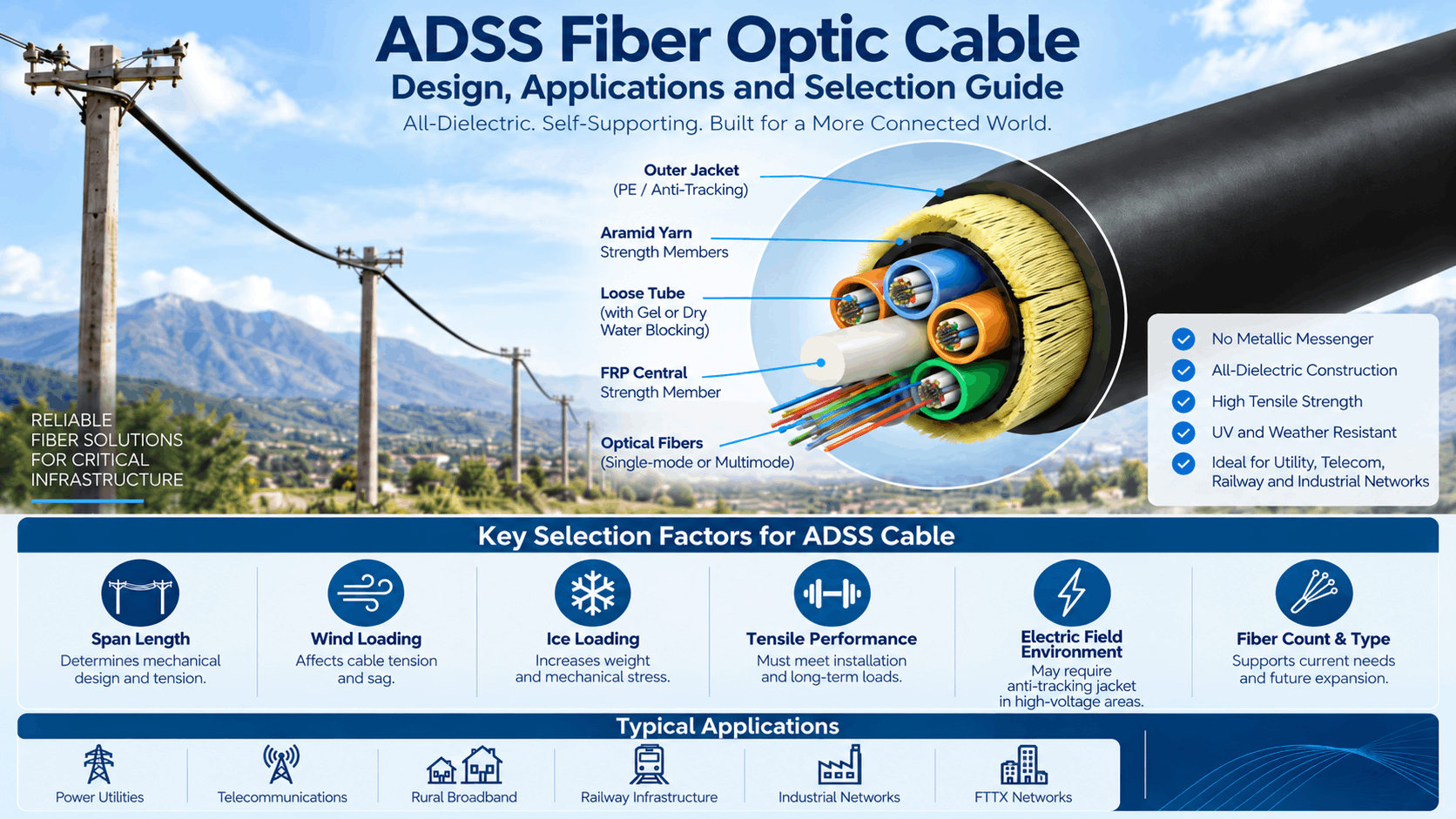
ADSS Fiber Optic Cable: Design, Applications and Selection Guide
Reading Time: 17 minutes
ADSS fiber optic cable is designed for aerial telecommunications and data networks where the cable must support its own weight between poles or towers without relying on a metallic messenger wire. ADSS stands for All-Dielectric Self-Supporting, which describes two of its defining characteristics: the cable contains no conductive metallic support element, and its tensile structure allows it to span between support points independently.
This construction makes ADSS particularly useful along electrical utility corridors, telecommunications pole routes, railway infrastructure, industrial networks and rural broadband systems. However, selecting an ADSS cable requires more than specifying fiber count and span length. Wind, ice, tensile load, sag, temperature, electric-field exposure, fiber type, outer jacket, water blocking and attachment hardware can all influence the correct design.
Therefore, an ADSS cable should be engineered as part of the complete aerial route rather than treated as a standard outdoor fiber cable with additional aramid yarn.
Quick answer: Choose ADSS when an aerial fiber route requires a completely dielectric, self-supporting construction without a separate metallic messenger. Define the pole-to-pole span, environmental loading, required tensile performance, electric-field conditions, fiber count and sheath requirements before selecting the cable. Shorter and lighter routes may use more compact ADSS constructions, while demanding spans require greater tensile reinforcement and careful control of sag, strain and long-term mechanical loading.
ADSS Fiber Optic Cable at a Glance
| Characteristic | ADSS Design | Why It Matters |
|---|---|---|
| Full name | All-Dielectric Self-Supporting | Identifies a non-metallic aerial cable that supports itself |
| Metallic messenger | Not required | Reduces dependence on a separate support wire |
| Tensile reinforcement | Typically aramid yarns and dielectric strength elements | Carries longitudinal mechanical load |
| Electrical conductivity | All-dielectric construction | No metallic current path through the cable |
| Typical installation | Aerial poles and utility structures | Suitable for overhead telecom and power-line corridors |
| Fiber construction | Central or multi loose tube depending on design | Supports different fiber counts and mechanical architectures |
| Outer sheath | Typically UV-resistant PE or project-specific anti-tracking material | Protects against weather and electrical-surface stress where required |
| Water protection | Gel or dry water-blocking systems | Supports long-term outdoor reliability |
| Span capability | Project-specific | Depends on load, sag, tensile strength and cable design |
| Main selection factors | Span, wind, ice, electric field, fiber count and route conditions | Determines the required cable construction |
The most important point is that ADSS is not one fixed cable design.
Instead, it is a family of self-supporting aerial constructions engineered for different span lengths, loads and network requirements.
What Is ADSS Fiber Optic Cable?
An ADSS fiber optic cable is a completely dielectric optical cable designed to span between poles or towers using its own internal strength system.
Unlike a figure-8 cable, ADSS does not depend on an integrated steel messenger wire. Likewise, unlike OPGW, it does not form part of the electrical ground-wire system of a transmission line.
A typical ADSS construction can include:
- Single-mode or multimode optical fibers
- Loose buffer tubes
- Central dielectric strength member where applicable
- Water-blocking materials
- Aramid yarn tensile members
- Ripcords
- UV-resistant PE outer sheath
- Anti-tracking outer sheath where required by the electrical environment
Because the strength system is dielectric, the cable can provide substantial tensile performance without introducing steel support elements into the cable structure.
What Does All-Dielectric Mean?
All-dielectric means the cable does not rely on conductive metallic components for its structural or transmission function.
Instead, manufacturers use dielectric materials such as:
- FRP or GRP strength members
- Aramid yarns
- Glass yarns
- Polymeric buffer tubes
- Polyethylene sheaths
This characteristic provides an important advantage near electrical infrastructure because the cable itself does not create a metallic conductive path between support points.
Moreover, the optical fibers transmit information using light, so electromagnetic interference from nearby power equipment does not affect the optical transmission in the way it can affect copper communication circuits.
What Does Self-Supporting Mean?
Self-supporting means the fiber cable carries the mechanical loads associated with the aerial span without requiring a separate messenger wire.
The cable must therefore tolerate forces created by:
- Its own weight
- Span length
- Wind pressure
- Ice loading
- Temperature changes
- Installation tension
- Long-term static loading
- Aeolian vibration
For this reason, tensile design is one of the most important differences between ADSS and conventional outdoor duct fiber optic cable.
How Is an ADSS Fiber Optic Cable Constructed?
The exact structure varies according to fiber count, span requirement and mechanical design. Nevertheless, several construction elements appear frequently in ADSS cables.
Optical Fibers
ADSS cables can use different optical fiber standards according to transmission requirements.
Typical options include:
- G.652.D
- G.657.A1
- G.657.A2
- OM1
- OM2
- OM3
- OM4
- OM5
For long-distance utility and telecommunications networks, single-mode fiber remains the most common choice because it supports long transmission distances with low attenuation.
Loose Tubes
Outdoor ADSS cables commonly protect optical fibers inside loose buffer tubes.
The loose tube allows the fibers to remain mechanically isolated from much of the cable strain. In addition, the design gives the fibers controlled excess length so that cable elongation does not transfer directly to the glass fiber.
Depending on fiber count and cable architecture, ADSS can use a central loose tube or a multi loose tube construction.
Central Strength Member
Multi loose tube ADSS designs commonly use an FRP or similar dielectric strength member at the center of the cable.
The loose tubes strand around this element, creating a stable cable core and helping control mechanical behaviour.
Because FRP is non-metallic, the cable can retain its all-dielectric construction.
Aramid Yarn Strength Members
Aramid yarn is one of the defining mechanical elements of many ADSS designs.
The yarns provide high tensile strength without adding conductive metal to the cable.
Increasing the amount and arrangement of aramid reinforcement can help the manufacturer engineer cables for more demanding mechanical loads.
However, simply adding more yarn does not determine the final span capability. The complete geometry, cable diameter, sag, load case and strain limits also matter.
Water-Blocking Elements
Since ADSS operates outdoors, moisture control forms another important part of the cable design.
Manufacturers can use:
- Gel-filled loose tubes
- Water-swellable yarns
- Water-swellable tapes
- Dry-core water-blocking systems
Therefore, buyers can specify dry or gel-filled constructions independently from the ADSS mechanical architecture.
Outer Sheath
The outer sheath protects the cable from sunlight, moisture, weather and environmental exposure.
UV-resistant polyethylene is widely used for outdoor ADSS constructions.
However, power-line applications can create another requirement: resistance to electrical tracking on the cable surface.
In those cases, the project may require an appropriate anti-tracking jacket rather than a conventional PE sheath.
Why Is Aramid Yarn Important in ADSS Cable?
Aramid yarn allows the cable to carry substantial tensile loads while remaining dielectric.
This provides an excellent strength-to-weight relationship for aerial applications.
Aramid reinforcement can help control:
- Installation tension
- Long-term tensile load
- Span-related stress
- Sag behaviour
- Environmental loading
Meanwhile, the yarn system transfers mechanical load through the cable without exposing the optical fibers to excessive strain.
For this reason, ADSS design requires careful coordination between the optical fiber excess length and the mechanical strength system.
ADSS Cable Span Length: Why There Is No Universal Maximum
Buyers frequently ask for an ADSS cable based only on span length.
For example:
“We need ADSS for a 150-meter span.”
However, span length alone does not provide enough information to engineer the cable.
The same distance can create very different mechanical loads depending on:
- Wind speed
- Ice thickness
- Cable diameter
- Cable weight
- Temperature
- Pole height
- Required sag
- Attachment position
- Safety factors
Consequently, manufacturers should not select a cable solely from the nominal pole spacing.
Short-Span, Medium-Span and Long-Span ADSS
The market often describes ADSS constructions as short-, medium- or long-span cables.
These terms can help organize a product portfolio, but they are not universal engineering classifications with identical span limits across every manufacturer.
A more useful approach is to compare:
- Maximum allowable installation tension
- Maximum operating tension
- Rated tensile strength
- Cable weight
- Outside diameter
- Permitted fiber strain
- Environmental load case
Therefore, a buyer should avoid assuming that a cable marketed as “long-span ADSS” will suit every route of the same nominal length.
What Is Sag in an ADSS Installation?
Sag is the vertical displacement between the cable’s attachment points and the lowest point of the suspended span.
It directly affects cable tension.
A tighter cable generally produces less sag but higher tensile load. Conversely, greater sag can reduce tension but may conflict with required clearances.
Therefore, the cable and aerial-route design need to balance:
- Mechanical stress
- Ground clearance
- Electrical clearances
- Road and railway crossings
- Adjacent utility infrastructure
Sag should therefore come from the route engineering calculation rather than from a generic percentage applied to every ADSS project.
Wind Loading and ADSS Cable Selection
Wind creates lateral force on the suspended cable.
As wind speed increases, the mechanical load on the cable and support hardware can rise significantly.
Cable diameter also matters because a larger exposed surface presents a greater area to the wind.
For this reason, ADSS selection should consider the project’s defined wind condition rather than only the cable’s static tensile rating.
Ice Loading and ADSS Cable Selection
In cold climates, ice accumulation can increase the effective weight and diameter of an aerial cable.
This additional mass can increase:
- Vertical loading
- Cable tension
- Sag
- Hardware loading
- Pole or tower loading
Moreover, a combined wind-and-ice condition can create a more severe load case than either factor individually.
Therefore, projects in regions with icing risk should provide the required environmental load assumptions in the cable specification.
Aeolian Vibration and ADSS Fiber Optic Cable
Aerial cables can experience small-amplitude, high-frequency vibration caused by steady wind flowing across the cable.
This phenomenon is known as aeolian vibration.
Over time, repeated vibration can stress the cable and attachment hardware.
Consequently, long-term ADSS reliability depends not only on static tensile strength but also on the cable and hardware system’s behaviour under repeated mechanical cycling.
For utility applications, the applicable mechanical qualification and hardware requirements should therefore form part of the project specification.
ADSS Cable Near High-Voltage Power Lines
The all-dielectric construction makes ADSS particularly attractive along power-line corridors.
However, this does not mean that electrical conditions can be ignored.
An ADSS cable installed in the electric field around high-voltage conductors can experience electrical stress on the outer jacket.
Contamination and moisture on the sheath surface can create leakage currents. Under sufficiently severe conditions, these effects can contribute to electrical tracking and dry-band arcing.
Therefore, line voltage alone does not determine whether a standard PE jacket is suitable.
What Is Dry-Band Arcing?
When moisture and contamination create a conductive film on the cable surface, leakage current can flow along the jacket.
Local heating can dry small sections of this conductive path.
As a result, electrical voltage can develop across the dry section and produce a small arc.
Repeated arcing can damage a jacket that is not designed for the electrical environment.
For this reason, high-electric-field applications can require special tracking-resistant sheath compounds and careful selection of the cable attachment position.
Standard PE vs Anti-Tracking ADSS Jacket
| Requirement | Standard Outdoor PE | Anti-Tracking Jacket |
|---|---|---|
| UV resistance | Yes when properly formulated | Yes when properly formulated |
| Weather protection | Yes | Yes |
| General telecom pole route | Commonly suitable | May be unnecessary |
| High electrical surface stress | Must be evaluated carefully | Designed for more demanding electrical environments |
| Main selection factor | Outdoor environmental exposure | Outdoor exposure + tracking resistance |
The correct sheath should come from the actual electric-field environment and project specification.
Therefore, buyers should avoid specifying anti-tracking material simply because an ADSS cable will be installed somewhere near a power line.
ADSS vs Figure-8 Fiber Optic Cable
ADSS and figure-8 cables are both used for aerial fiber networks, but their support systems are fundamentally different.
| Characteristic | ADSS | Figure-8 / Messenger-Wired Cable |
|---|---|---|
| Support system | Integrated dielectric strength system | Separate or integrated messenger element |
| Metallic support | No | Commonly steel messenger |
| All-dielectric | Yes | Not when steel messenger is used |
| Typical environment | Utility, telecom and high-voltage corridors | Telecom distribution and conventional pole networks |
| Grounding of support wire | Not required for dielectric cable structure | Metallic messenger may introduce bonding considerations |
| Main design advantage | Dielectric self-supporting aerial route | Simple messenger-supported aerial construction |
Neither construction is universally better.
A conventional telecom route may use messenger-supported fiber efficiently, while an electrical utility corridor can strongly favour ADSS because of its dielectric structure.
ADSS vs OPGW: What Is the Difference?
OPGW, or Optical Ground Wire, is a metallic overhead conductor that combines optical fibers with the electrical grounding or shield-wire function of a power transmission line.
ADSS performs a different role.
It is a separate, non-metallic communication cable suspended from utility structures without replacing the electrical ground wire.
| Characteristic | ADSS | OPGW |
|---|---|---|
| Metallic construction | No | Yes |
| Electrical ground-wire function | No | Yes |
| Fiber transmission | Yes | Yes |
| Installation position | Selected pole/tower attachment position | Typically ground/shield-wire position |
| Installation on existing line | Can provide flexibility depending on route engineering | More closely integrated with transmission-line ground-wire system |
Therefore, ADSS and OPGW should not be treated as direct substitutes without reviewing the utility’s electrical and structural requirements.
ADSS vs Conventional Non-Metallic Armored Fiber Cable
Another common mistake is assuming that every fiber cable reinforced with aramid yarn is automatically ADSS.
It is not.
A non-metallic armored duct cable can use aramid or glass reinforcement for tensile and rodent protection while still requiring external support or a protected pathway.
An ADSS construction, by contrast, must support the mechanical load of the aerial span itself.
Therefore:
Non-metallic reinforcement does not automatically mean self-supporting.
Central Loose Tube vs Multi Loose Tube ADSS
ADSS can use different internal loose-tube architectures.
A central loose tube construction can provide:
- Compact diameter
- Lower cable weight
- Efficient moderate fiber counts
- Simple internal architecture
Meanwhile, multi loose tube ADSS becomes increasingly attractive for:
- Higher fiber counts
- Large utility networks
- Telecom backbone systems
- Fiber-group organization
- Scalable network capacity
Therefore, the tube architecture should follow fiber capacity and mechanical design rather than the ADSS name itself.
How Many Fibers Can an ADSS Cable Contain?
ADSS fiber count depends on cable architecture and manufacturer design.
Common configurations can include:
- 12 fibers
- 24 fibers
- 48 fibers
- 72 fibers
- 96 fibers
- 144 fibers
Higher custom counts can also be possible depending on the required construction.
ETK Kablo’s aerial portfolio includes configurations up to 144 fibers as standard category coverage, with additional project-specific designs available depending on requirements.
However, increasing fiber count can increase tube count, cable diameter and weight. Consequently, the mechanical span design should be reviewed together with the required fiber capacity.
Which Fiber Type Should Be Used in ADSS?
Single-mode fiber dominates long-distance aerial utility and telecom networks.
Typical options include:
G.652.D
G.652.D remains a widely used standard single-mode fiber for conventional long-distance telecommunications and backbone networks.
G.657.A1
G.657.A1 offers improved bending performance while retaining strong compatibility with conventional single-mode systems.
G.657.A2
G.657.A2 provides even greater bend tolerance and can be valuable where network routing creates tighter optical bends.
However, the ADSS mechanical cable design and optical fiber standard remain separate decisions.
The required fiber should therefore follow the optical network design rather than the aerial support requirement.
ADSS Fiber Optic Cable for Power Utilities
Electrical utilities represent one of the most important ADSS applications.
Utilities can use aerial fiber for:
- Substation communication
- SCADA
- Teleprotection
- Grid monitoring
- Smart-grid infrastructure
- Private utility networks
- Operational communications
The dielectric construction allows fiber communication to share utility corridors without adding a metallic support element to the ADSS cable itself.
However, electrical-field conditions and pole geometry still require engineering review.
ADSS Fiber Optic Cable for Telecommunications Networks
Telecom operators can also use ADSS on conventional pole infrastructure.
Potential applications include:
- Metro networks
- Rural broadband
- FTTX feeders
- Backbone links
- Mobile network backhaul
- 5G transport infrastructure
- Interbuilding connections
ADSS can be particularly attractive when operators want to eliminate the separate steel messenger used by conventional aerial fiber constructions.
ADSS Fiber Optic Cable for Rural Broadband
Rural networks can involve long pole routes and limited underground infrastructure.
Consequently, aerial deployment can provide a practical way to extend broadband coverage.
ADSS can support these networks by combining:
- Optical transmission
- Outdoor weather resistance
- Dielectric construction
- Self-supporting tensile strength
- Multiple fiber-count options
Nevertheless, rural routes can still experience severe wind, ice and long-span conditions. Therefore, route-specific mechanical data remains essential.
ADSS Fiber Optic Cable for Railway Infrastructure
Railway networks can use aerial fiber for communications, signaling support, operational networks and trackside infrastructure.
ADSS becomes particularly useful where pole-based fiber routes provide an efficient alternative to underground pathways.
Project engineers should consider:
- Span length
- Wind loading
- Clearance
- Electrification systems
- Fiber capacity
- UV exposure
- Trackside mechanical conditions
In addition, railway projects can impose project-specific fire, documentation or approval requirements that remain separate from ADSS mechanical design.
ADSS Fiber Optic Cable for Industrial Networks
Large industrial campuses can use ADSS to connect:
- Production buildings
- Control rooms
- Remote process areas
- Utilities
- Substations
- Security infrastructure
- Warehouse facilities
Aerial fiber can avoid excavation and provide strong electromagnetic immunity around electrically noisy industrial equipment.
Therefore, ADSS can be an efficient choice where poles or utility structures already exist along the required route.
ADSS Fiber Optic Cable for FTTX Networks
FTTX networks can use ADSS in feeder and distribution layers where aerial infrastructure is available.
For example, a higher-count ADSS backbone can carry fibers along a primary pole route, while smaller distribution and drop cables serve the final access network.
Fiber-count selection should therefore reflect:
- Homes passed
- Splitter architecture
- Spare capacity
- Future expansion
- Branching strategy
The self-supporting construction affects the aerial route, while the optical network topology determines how many fibers the cable needs.
ADSS Cable and Lightning
Because ADSS contains no metallic support conductor, the cable does not provide a conductive metallic path along the span.
This characteristic can provide an important advantage in lightning-prone and power-line environments compared with metallic messenger constructions.
However, it would be incorrect to say that an ADSS network can never suffer lightning-related damage.
Poles, hardware, nearby equipment and extreme electrical events can still affect the overall installation.
Therefore, “all-dielectric” should be interpreted accurately rather than marketed as universal immunity to every lightning-related event.
Does ADSS Need Grounding?
The dielectric cable itself does not require electrical grounding in the same way as a metallic messenger or metallic armour layer.
This simplifies one aspect of the aerial communication route.
Nevertheless, poles, equipment, closures and other metallic components can have separate grounding requirements according to the utility or telecommunications system design.
Therefore, ADSS eliminates the metallic cable-grounding requirement, not every grounding consideration in the complete network.
Is ADSS Suitable for Direct Burial?
ADSS is primarily an aerial self-supporting cable architecture.
Therefore, it should not automatically be specified for direct burial simply because the cable has a durable outdoor sheath.
Underground networks can require different mechanical and moisture protection, including:
- Crush resistance
- Rodent protection
- Steel or dielectric armour
- Water blocking
- Appropriate burial sheath
If a route transitions from aerial to underground, the project should evaluate the underground section separately.
Is ADSS Suitable for Duct Installation?
An ADSS cable may physically pass through short duct sections associated with an aerial route, depending on the cable design and installation requirements.
However, a dedicated duct cable can provide a more efficient construction when the complete route is underground.
ADSS contains tensile reinforcement specifically intended for aerial self-support, so using it where that feature adds no value can result in unnecessary material and cost.
IEEE 1222 and ADSS Fiber Optic Cable
IEEE 1222 provides an important reference for ADSS cables used on electric utility power lines.
The standard addresses areas such as:
- Cable construction
- Mechanical performance
- Optical performance
- Electrical considerations
- Environmental performance
- Testing
- Installation-related requirements
- Accessories
For utility projects, the applicable edition and project-specific requirements should therefore appear clearly in the procurement specification.
However, specifying IEEE 1222 alone does not define the span, fiber count, sheath system or environmental load case. Those values still need to come from the project.
ADSS Cable Hardware Matters
The cable itself represents only one part of the aerial system.
ADSS routes also require compatible hardware such as:
- Suspension assemblies
- Dead-end assemblies
- Protective rods where required
- Vibration-control accessories
- Downlead hardware
- Storage devices
The hardware must match the cable diameter, tension and route conditions.
Therefore, a project should coordinate cable and hardware selection rather than sourcing both independently from unrelated mechanical assumptions.
Maximum Allowable Tension vs Rated Tensile Strength
Several tensile values can appear in an ADSS technical specification, and buyers should not treat them as interchangeable.
Depending on the manufacturer and standard, documentation can distinguish between:
- Rated tensile strength
- Maximum installation tension
- Maximum operating tension
- Everyday tension
- Long-term tensile load
Each value describes a different mechanical condition.
Therefore, a purchasing specification should define the required loading philosophy rather than asking only for “high tensile ADSS.”
ADSS Cable and Fiber Strain
Optical glass can tolerate limited strain, but excessive long-term strain can degrade reliability.
ADSS construction must therefore allow the cable strength elements to carry the primary aerial load while keeping fiber strain within the required limits.
Manufacturers achieve this through a combination of:
- Fiber excess length
- Loose-tube design
- Stranding geometry
- Aramid strength system
- Cable elongation control
This is one reason why two ADSS cables with similar outside diameter and fiber count can have very different span capabilities.
ADSS Cable Outside Diameter and Weight
Outside diameter and weight directly influence aerial mechanical loading.
A heavier cable increases vertical load, while a larger diameter can increase wind and ice exposure.
On the other hand, reducing diameter too aggressively can limit:
- Fiber capacity
- Strength-member volume
- Mechanical protection
- Long-span capability
Therefore, the optimal ADSS design balances compactness with the required mechanical margin.
Which ADSS Fiber Optic Cable Should You Choose?
| Project Requirement | ADSS Feature to Consider | Reason |
|---|---|---|
| Moderate fiber count, compact route | Central loose tube ADSS | Can reduce diameter and weight |
| High fiber count | Multi loose tube ADSS | Provides scalable fiber organization |
| Demanding span | Higher tensile reinforcement | Additional mechanical capacity may be required |
| High wind or ice region | Route-specific mechanical design | Environmental loads strongly affect tension |
| Power-line corridor | All-dielectric ADSS + electrical-field review | Avoids metallic support while addressing surface electrical stress |
| High electrical surface stress | Tracking-resistant jacket where required | Reduces risk of surface tracking damage |
| Conventional telecom pole route | Standard PE ADSS where suitable | Provides UV-resistant self-supporting construction |
| Long-distance optical transmission | G.652.D or project-specified single-mode fiber | Supports long-haul optical performance |
| Tight optical routing requirement | G.657.A1/A2 where appropriate | Provides improved bend performance |
The final cable should satisfy all of these requirements simultaneously.
Therefore, span length should never be the only parameter used for ADSS selection.
Common Mistakes When Specifying ADSS Fiber Optic Cable
1. Specifying Only the Span Length
Span alone does not define wind, ice, sag, temperature or tensile loading.
2. Assuming Every All-Dielectric Fiber Cable Is ADSS
A dielectric duct cable can still require external support. ADSS must support the aerial span independently.
3. Assuming Aramid Yarn Automatically Makes a Cable Self-Supporting
Aramid provides tensile reinforcement, but the complete cable needs to meet the required aerial mechanical design.
4. Ignoring Wind and Ice
Environmental loading can materially increase cable and hardware tension.
5. Choosing Jacket Material Only by UV Resistance
High-voltage corridors can also require evaluation of electrical tracking performance.
6. Assuming High-Voltage Line Means Anti-Tracking Jacket Automatically
The required jacket depends on the actual electrical field at the cable location, not simply the nominal line voltage.
7. Assuming ADSS Is the Same as OPGW
OPGW is a metallic ground wire containing optical fibers. ADSS is a separate dielectric self-supporting cable.
8. Assuming ADSS Is the Same as Figure-8 Cable
Figure-8 designs commonly rely on a messenger element, while ADSS carries the span through its dielectric strength system.
9. Ignoring Fiber Strain
High tensile strength alone is insufficient if cable elongation transfers excessive strain to the optical fibers.
10. Ignoring Hardware Compatibility
Suspension and dead-end hardware must match the cable diameter and mechanical design.
11. Assuming ADSS Means Unlimited Span
Every ADSS design has mechanical limits. Long spans require project-specific engineering.
12. Assuming ADSS Is Suitable for Direct Burial
Self-supporting aerial construction does not automatically provide the mechanical protection required for underground installation.
13. Ignoring Future Fiber Capacity
A route that is difficult to access later can justify additional spare fibers during the initial installation.
14. Selecting Fiber Type Based on the ADSS Name
ADSS defines mechanical architecture. G.652.D, G.657.A1, G.657.A2 and multimode options remain separate optical choices.
What Should Buyers Include in an ADSS Cable RFQ?
A request that states only “48-core ADSS fiber cable” leaves many critical engineering parameters unresolved.
A useful RFQ should define:
- Required fiber count
- Fiber type
- G.652.D, G.657.A1, G.657.A2 or other required standard
- Nominal span length
- Maximum span where applicable
- Pole or tower arrangement
- Required sag or route-clearance criteria where defined
- Wind load or design wind speed
- Ice loading where applicable
- Temperature range
- Required tensile performance
- Maximum installation tension
- Long-term operating tension requirements
- Required crush resistance
- Outer jacket material
- Standard PE or anti-tracking requirement
- Electrical-field information for power-line routes
- Dry or gel water-blocking preference
- Central or multi loose tube construction where specified
- Cable outside-diameter limitation
- Cable weight limitation where relevant
- Applicable IEEE or project standard
- Hardware requirements where cable and accessories form one package
- Cable marking
- Drum length
- Routine test requirements
- Type-test documentation
This information allows the manufacturer to engineer the cable according to the actual aerial environment rather than selecting a generic ADSS construction based only on fiber count.
ETK Kablo ADSS Fiber Optic Cable Solutions
ETK Kablo manufactures ADSS fiber optic cable constructions for telecommunications, power utility, railway, industrial, broadband and infrastructure networks.
The aerial fiber optic portfolio includes all-dielectric self-supporting designs that use dielectric tensile elements to support the cable between poles without requiring a separate metallic messenger wire.
Depending on the required capacity and mechanical design, ETK Kablo can supply central loose tube and multi loose tube aerial constructions. The broader aerial portfolio supports fiber counts up to 144 cores, while project-specific configurations can be evaluated according to network and mechanical requirements.
Single-mode options include G.652.D, G.657.A1 and G.657.A2 fibers, while multimode constructions such as OM1, OM2, OM3, OM4 and OM5 are also available where the optical application requires them.
ADSS designs can combine loose-tube fiber protection, water-blocking systems, dielectric strength members, aramid yarn reinforcement and UV-resistant outer sheaths according to the span and environmental conditions.
For power-line applications, the cable design can also be evaluated according to the electrical environment and required outer-jacket performance.
The appropriate ETK construction should therefore be selected by combining optical capacity with span, tensile load, weather conditions, route geometry and electrical-field requirements.
Frequently Asked Questions
What does ADSS mean in fiber optic cable?
ADSS means All-Dielectric Self-Supporting. The cable contains no metallic support element and uses dielectric strength members to support itself between poles or towers.
What is ADSS fiber optic cable used for?
ADSS is used for aerial telecom, utility, railway, industrial, FTTX and broadband networks where a self-supporting dielectric fiber cable is required.
Does ADSS need a messenger wire?
No. The defining characteristic of ADSS is that its own dielectric strength system supports the aerial span without a separate metallic messenger.
Does ADSS cable contain metal?
A true all-dielectric ADSS construction does not rely on metallic cable elements. Dielectric materials such as FRP and aramid yarn provide the structural strength.
Why is aramid yarn used in ADSS cable?
Aramid yarn provides high tensile strength with low weight and no electrical conductivity. It allows the cable to carry aerial mechanical loads while maintaining an all-dielectric design.
What is the maximum span of ADSS cable?
There is no universal maximum span for every ADSS cable. Span capability depends on the cable design, tensile strength, weight, wind, ice, sag, temperature and route conditions.
Can ADSS cable be installed on power poles?
Yes. Power-line corridors are a major ADSS application. However, the cable position, electrical field, span and environmental loads must be evaluated for the specific route.
Does ADSS cable need grounding?
The dielectric cable itself does not require grounding like metallic armour or a steel messenger. Other metallic equipment and infrastructure can still have separate grounding requirements.
Is ADSS immune to electromagnetic interference?
Optical transmission is immune to electromagnetic interference, and the all-dielectric cable does not contain a conductive metallic support path. However, electrical-field effects on the outer jacket can still matter near high-voltage conductors.
What is an anti-tracking ADSS cable?
An anti-tracking ADSS cable uses an outer sheath designed to resist electrical tracking under more demanding electric-field conditions near power lines.
Does every ADSS cable require an anti-tracking jacket?
No. The requirement depends on the electrical field at the intended cable position and the project’s utility specification. Standard PE can remain suitable in less demanding environments.
What is dry-band arcing on ADSS cable?
Dry-band arcing can occur when surface leakage current flows through contamination and moisture on the cable jacket, creating localized dry areas where electrical arcing develops. Repeated arcing can damage unsuitable sheath materials.
What is the difference between ADSS and OPGW?
ADSS is a separate all-dielectric self-supporting fiber cable. OPGW is a metallic overhead ground wire that also contains optical fibers and performs an electrical shield-wire function.
What is the difference between ADSS and figure-8 fiber cable?
ADSS uses its internal dielectric tensile system for support. Figure-8 cable typically uses an integrated messenger element, commonly steel, to carry the aerial mechanical load.
Can ADSS cable use G.652.D fiber?
Yes. G.652.D is widely used in ADSS for long-distance utility and telecommunications networks. G.657.A1 and G.657.A2 can also be supplied where improved bending performance is required.
Can ADSS cable contain 144 fibers?
Yes. High-count multi loose tube ADSS constructions can support 144 fibers and other project-specific counts depending on manufacturer design.
Can ADSS cable be directly buried?
ADSS is primarily engineered for self-supporting aerial installation. Direct burial should use a construction specifically designed for underground mechanical and environmental conditions.
Is ADSS cable suitable for rural broadband?
Yes. ADSS can provide an efficient aerial fiber solution for rural broadband where poles are available and underground civil works would be difficult or expensive.
Which standard applies to ADSS cable?
IEEE 1222 is an important reference for ADSS cable used on electric utility power lines. Projects can also impose additional telecom, utility and customer-specific requirements.
Conclusion
An ADSS fiber optic cable combines optical transmission, dielectric construction and self-supporting tensile strength into one aerial cable system.
Its main advantage is that the cable can span between poles or towers without a metallic messenger wire. Aramid yarns, dielectric strength members and loose-tube architecture carry the mechanical loads while the optical fibers remain protected from excessive strain.
However, successful ADSS selection depends on much more than fiber count or nominal pole spacing.
Span length, sag, wind, ice, temperature, tensile load, cable weight and electric-field exposure all influence the required design. High-voltage corridors can also introduce tracking and dry-band arcing considerations, making outer-jacket selection particularly important.
ADSS should also be distinguished clearly from figure-8 messenger cable, OPGW and conventional non-metallic armored fiber. Each construction solves a different aerial or mechanical problem.
For engineers and purchasing teams, the best approach is therefore to define the optical capacity and aerial route conditions first, provide the manufacturer with the environmental and mechanical load data, and then select the ADSS construction that delivers the required long-term optical and mechanical performance without unnecessary over-specification.


