





 President’s Message
Blog
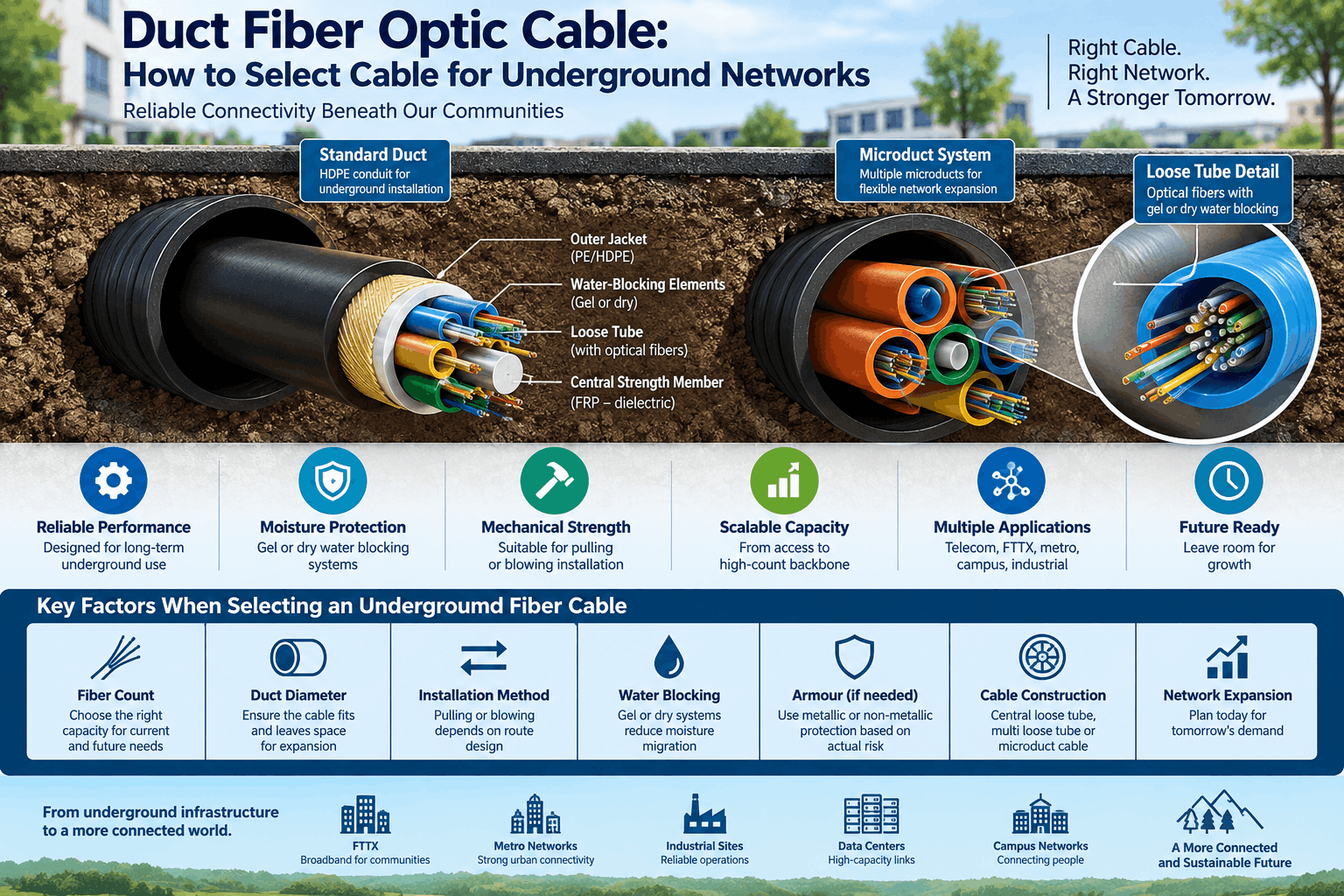
Duct Fiber Optic Cable: How to Select Cable for Underground Networks
Reading Time: 14 minutes
Selecting the right underground fiber cable for a duct network requires more than choosing a fiber count and an outdoor jacket. The cable must fit the available conduit, tolerate the intended pulling or blowing method, resist moisture, withstand installation tension and maintain reliable optical performance throughout the expected network life.
Duct installation also changes the mechanical protection strategy. Because the conduit already protects the cable from many external hazards, a heavily armored construction may not always be necessary. However, rodent exposure, damaged ducts, flooding, high pulling loads or industrial conditions can still justify additional reinforcement.
Therefore, the correct duct fiber optic cable should be selected as part of the complete underground pathway. Fiber count, loose-tube architecture, cable diameter, water blocking, tensile strength, sheath material, installation method, duct dimensions and future expansion all need to work together.
Quick answer: For most underground duct networks, start with a compact loose-tube outdoor fiber cable using a durable PE or HDPE sheath and appropriate water blocking. Select central loose tube for moderate fiber counts and compact diameter, or multi loose tube for higher-count scalable backbones. Use microduct-compatible cable when air blowing into small ducts is required. Add metallic or non-metallic armour only when the route presents a genuine mechanical or rodent risk.
Underground Fiber Cable Selection at a Glance
| Project Requirement | Construction to Consider | Main Reason |
|---|---|---|
| Standard telecom duct | Loose-tube PE/HDPE cable | Outdoor moisture and mechanical protection with efficient duct use |
| Moderate fiber count | Central loose tube | Compact and relatively lightweight construction |
| High fiber count | Multi loose tube | Scalable fiber organization |
| Small microduct | Microduct / micro cable | Reduced outside diameter for blowing |
| Long blowing route | Low-friction, blowing-optimized construction | Improves installation efficiency |
| High rodent risk | Armored or reinforced fiber cable | Additional physical protection |
| Electrical isolation required | All-dielectric reinforced cable | No metallic armour or conductive strength element |
| Flood-prone duct | Strong longitudinal water blocking | Limits moisture migration through the cable |
| Direct burial without conduit | Dedicated direct-burial construction | Higher mechanical and environmental exposure |
The most important distinction is that a duct installation already provides a protective pathway.
Consequently, the cable does not always need the same level of armour as a cable placed directly into the ground.
What Is a Duct Fiber Optic Cable?
A duct fiber optic cable is an outdoor optical cable designed for installation inside a conduit, pipe or duct system.
The cable typically uses a loose-tube construction because loose tubes help protect the optical fibers against mechanical and thermal stress.
A typical duct cable can include:
- Single-mode or multimode optical fibers
- PBT loose tubes
- Gel or dry water-blocking materials
- FRP or another central strength member
- Water-swellable yarns or tapes
- Additional dielectric strength members
- Ripcord
- PE or HDPE outer sheath
Depending on the route, manufacturers can also add metallic or non-metallic mechanical protection.
Why Are Loose-Tube Cables Common in Underground Ducts?
Loose-tube construction allows optical fibers to remain relatively isolated from the mechanical stress experienced by the outer cable.
For example, during installation the cable may experience:
- Pulling tension
- Bending
- Sidewall pressure
- Temperature change
- Vibration
- Local compression
The fibers sit with controlled excess length inside the tube. Therefore, moderate elongation of the cable structure does not transfer directly to the glass fiber.
In addition, loose tubes provide an efficient location for gel or dry water-blocking systems.
Duct Cable vs Direct Burial Fiber Cable
Duct and direct-burial installations are both underground, but they expose the cable to different mechanical conditions.
| Characteristic | Duct Installation | Direct Burial |
|---|---|---|
| External pathway | Protective conduit surrounds cable | Cable is placed directly in ground |
| Mechanical exposure | Reduced by duct | Higher |
| Stone / soil contact | Normally avoided | Direct exposure possible |
| Rodent protection | Duct provides some protection | Cable may need stronger protection |
| Installation | Pulling, blowing or jetting | Trenching and laying |
| Typical armour need | Project-dependent | More commonly required |
| Future replacement | Potentially easier if duct remains usable | Usually requires renewed excavation |
Therefore, “underground fiber cable” should not automatically mean “armored fiber cable.”
A well-protected duct can allow a lighter cable construction, while direct burial can justify additional armour and environmental protection.
Central Loose Tube for Duct Networks
A central loose tube cable places the optical fibers inside one main buffer tube.
This architecture can provide several advantages for underground ducts:
- Compact outside diameter
- Lower cable weight
- Straightforward cable preparation
- Efficient use of duct space
- Good suitability for moderate fiber counts
For this reason, central loose tube designs can be especially attractive for access networks, campus interconnections, industrial links and lower-count telecom distribution routes.
However, fiber-count capability depends on the actual product design.
Multi Loose Tube for High-Capacity Underground Networks
Multi loose tube cable divides the fibers among several buffer tubes.
The manufacturer then strands those tubes around a central strength member, typically FRP or another suitable structural element.
This construction becomes increasingly useful when a network requires:
- Higher fiber counts
- Large metro backbones
- FTTX feeder routes
- Multiple network branches
- Future expansion capacity
- Clear fiber-group organization
Moreover, technicians can identify fibers first by tube and then by fiber color, which can simplify management of large fiber populations.
Central Loose Tube vs Multi Loose Tube for Duct Installation
| Requirement | Central Loose Tube | Multi Loose Tube |
|---|---|---|
| Compactness | Strong advantage at moderate counts | Depends on fiber count and design |
| High fiber count | Limited by product architecture | Strong advantage |
| Fiber organization | All fibers in one main tube | Fibers grouped across tubes |
| Duct utilization | Very efficient for moderate counts | Efficient for high-capacity routes |
| Network scalability | Good where capacity is sufficient | Excellent for large backbones |
Therefore, the correct architecture depends mainly on required capacity and available duct space.
What Is a Microduct Fiber Optic Cable?
A microduct cable is a compact fiber optic cable designed for installation inside small-diameter subducts or microducts.
Operators often use these systems to divide one larger underground duct into several independent pathways.
This architecture can provide important network-planning advantages:
- Higher pathway utilization
- Smaller cable diameter
- Incremental network expansion
- Separate routes for different operators or services
- Easier future cable deployment
Instead of filling the entire duct with one large cable, operators can install individual micro cables as network demand develops.
Standard Duct Cable vs Microduct Cable
| Characteristic | Standard Duct Cable | Microduct Cable |
|---|---|---|
| Typical pathway | Conventional conduit | Small microduct |
| Cable diameter | Standard outdoor dimensions | Highly compact |
| Installation | Pulling or blowing | Frequently air blown |
| Mechanical design | Balanced for conventional duct handling | Optimized for compactness and blowing |
| Network expansion | Depends on remaining duct space | Very flexible with spare microducts |
Nevertheless, smaller does not automatically mean better.
The cable must still provide sufficient tensile, crush, bending and environmental performance for its intended route.
Pulling vs Blowing Fiber Cable into a Duct
The installation method can influence cable design significantly.
Pulling
During pulling, installers use a pulling element to draw the cable through the duct.
Therefore, the cable must tolerate the required longitudinal tensile load.
Important parameters include:
- Maximum installation tension
- Bending radius
- Duct bends
- Route length
- Friction
- Pulling equipment
Excessive pulling tension can damage the cable structure or transfer undesirable strain to the optical fibers.
Air Blowing or Jetting
Air-blown installation uses compressed air and mechanical feeding to move the cable through the duct.
Instead of applying the entire installation load from one end, blowing distributes forces differently along the route.
Consequently, blowing can make long duct installations more efficient when the cable and conduit system are designed for it.
Important factors include:
- Cable outside diameter
- Duct inside diameter
- Outer-sheath friction
- Cable stiffness
- Cable weight
- Route bends
- Duct cleanliness
- Air pressure
Is Every Duct Cable Suitable for Air Blowing?
Not necessarily.
A cable may physically fit inside a duct but still lack the geometry, stiffness or surface characteristics required for efficient blowing.
Therefore, projects that plan air-blown installation should state that method in the RFQ.
This allows the manufacturer to recommend a cable with appropriate:
- Outside diameter
- Weight
- Bending stiffness
- Sheath surface
- Mechanical strength
Why Cable Diameter Matters in Underground Ducts
Duct space represents a valuable infrastructure asset.
A cable that is unnecessarily large can reduce future network flexibility.
For example, excessive cable diameter can:
- Reduce available conduit capacity
- Limit future cable additions
- Increase friction
- Complicate installation around bends
- Require larger ducts
Therefore, project engineers should compare the actual cable outside diameter rather than selecting only by fiber count.
Should You Choose the Smallest Possible Cable?
No.
Extreme compactness can create trade-offs.
A smaller cable may have less room for:
- Tensile reinforcement
- Mechanical protection
- Large loose tubes
- Additional jackets
- Armour
Consequently, the goal should be an efficient diameter rather than the absolute minimum diameter.
Duct Fill and Future Network Capacity
When selecting an underground fiber cable, engineers should consider not only whether the cable fits today but also how much usable pathway remains afterward.
Future expansion can include:
- Additional fiber cables
- New operators
- New buildings
- Additional FTTX subscribers
- 5G transport requirements
- New data-center capacity
Therefore, reserving duct capacity can sometimes provide more long-term value than installing the physically largest cable that fits.
Exact duct-fill limits should follow the applicable project practice and installation system rather than one universal percentage.
Why Water Blocking Matters in Duct Fiber Cable
A common misconception is that a conduit keeps the fiber cable dry.
In reality, underground ducts can contain water because of:
- Condensation
- Flooding
- Groundwater
- Damaged duct joints
- Drainage problems
Therefore, outdoor duct cables normally require effective moisture protection.
The cable can use:
- Thixotropic gel
- Water-swellable yarn
- Water-swellable tape
- Dry water-blocking materials
Gel-Filled vs Dry Duct Fiber Cable
| Characteristic | Gel-Filled | Dry Water-Blocked |
|---|---|---|
| Moisture protection | Strong | Strong when correctly designed |
| Preparation cleanliness | Gel removal required | Cleaner handling |
| Traditional outside-plant use | Very common | Increasingly common |
| Installation efficiency | Proven solution | Can simplify preparation and splicing |
Neither technology is automatically superior.
Instead, the project should choose according to operator preferences, maintenance practices and cable design.
PE and HDPE Sheaths for Underground Fiber Cable
Polyethylene-based outer jackets are widely used on underground duct cables because suitable formulations provide strong environmental performance.
Potential advantages include:
- Moisture resistance
- Abrasion resistance
- UV resistance
- Chemical resistance
- Durability during pulling
HDPE can also provide a robust low-friction external surface for appropriate duct installations.
However, exact environmental performance should come from the manufacturer’s technical data rather than the material name alone.
Does a Duct Fiber Optic Cable Need Armour?
Not automatically.
The duct already provides substantial mechanical separation from the surrounding soil.
Therefore, an unarmored or non-metallic reinforced duct cable can often provide the most efficient combination of:
- Lower diameter
- Lower weight
- Greater flexibility
- Easier installation
- Lower material cost
However, armour can become appropriate when the route presents additional risks.
When Should an Underground Duct Cable Be Armored?
Consider additional mechanical protection when:
- Rodent activity is severe
- Duct condition is poor
- Industrial mechanical risk is high
- Sections may become exposed
- Project specifications explicitly require armour
- Crush resistance must exceed the standard duct construction
Nevertheless, the armour should solve a defined problem rather than simply make the cable “stronger.”
Steel Tape Armour for Duct Fiber Optic Cable
Corrugated steel tape can provide effective mechanical and rodent protection with a relatively compact metallic armour layer.
This type of construction can help protect against:
- Crushing
- Impact
- Rodent attack
- Local mechanical damage
For this reason, steel tape is commonly considered for outdoor and underground fiber routes where moderate-to-high mechanical protection is required.
Steel Wire Armour for Underground Fiber Cable
Steel wire armour provides a heavier mechanical protection system.
SWA can become relevant where the cable faces:
- High mechanical loads
- Strong tensile requirements
- Severe rodent exposure
- Heavy industrial conditions
- Direct-burial sections
However, SWA also increases cable diameter, weight and stiffness.
Therefore, using SWA inside a well-protected telecom duct can represent unnecessary over-specification unless the route genuinely requires it.
Non-Metallic Armored Duct Fiber Cable
Projects can also require mechanical reinforcement without introducing conductive steel components.
Non-metallic protection can use materials such as:
- Glass yarn
- Aramid yarn
- FRP
- Other dielectric reinforcing systems
This construction can provide advantages near:
- Power infrastructure
- Substations
- Rail electrification
- Industrial electrical equipment
In addition, dielectric reinforcement eliminates metallic-armour grounding considerations.
Rodent Protection in Underground Duct Networks
Ducts reduce rodent exposure but do not necessarily eliminate it.
Rodents can enter damaged chambers, conduits or underground access points.
Therefore, high-risk networks can use:
- Corrugated steel tape
- Steel wire armour
- Glass-yarn reinforcement
- Other rodent-resistant constructions
The correct level of protection should follow the actual route risk.
Single-Mode vs Multimode for Underground Networks
The installation method does not determine the optical fiber type.
Instead, optical design should follow the network distance and transmission requirements.
Single-Mode Fiber
Single-mode fiber is the most common choice for outside-plant duct networks because it supports long transmission distances.
Typical fiber options include:
- G.652.D
- G.657.A1
- G.657.A2
Multimode Fiber
Multimode fibers such as OM3, OM4 and OM5 can remain appropriate for shorter campus or facility links.
However, long public telecom, metro and FTTX routes normally favour single-mode fiber.
G.652.D vs G.657.A1 vs G.657.A2 in Duct Networks
G.652.D remains a standard choice for conventional telecom backbone networks.
Meanwhile, G.657.A1 and G.657.A2 offer progressively improved bend performance.
This can provide advantages in:
- Dense underground chambers
- FTTX distribution
- Small closures
- Constrained routing
- Microduct systems
Nevertheless, bend-insensitive fiber does not remove the need to respect the cable’s specified minimum bending radius.
Fiber Count: How Much Capacity Should You Install?
Underground routes are expensive to build, so spare fiber capacity can provide significant long-term value.
Common cable counts can include:
- 12 fibers
- 24 fibers
- 48 fibers
- 72 fibers
- 96 fibers
- 144 fibers
- 288 fibers
The correct count depends on:
- Current connections
- Future network growth
- Redundancy
- FTTX architecture
- Operator leasing strategy
- Backbone capacity
- Available duct space
Therefore, installing a cable that exactly matches today’s active fiber demand can create unnecessary future civil works.
Duct Fiber Cable for FTTX Networks
FTTX networks commonly use underground ducts at feeder and distribution levels.
A typical architecture can combine:
- High-count multi loose tube feeder cable
- Smaller distribution cable
- Microduct networks
- Drop cables toward final subscribers
For example, spare microducts can allow operators to blow additional fiber cables as subscriber demand grows.
Consequently, underground pathway planning can become as important as cable selection itself.
Duct Fiber Cable for Metro and Telecom Backbones
Metropolitan telecom networks often require high fiber counts and long underground routes.
Therefore, designers typically prioritize:
- High fiber capacity
- Strong water blocking
- Efficient duct utilization
- Low optical attenuation
- Reliable pulling or blowing performance
- Future spare capacity
Multi loose tube cables can provide particularly effective fiber organization for these networks.
Duct Fiber Cable for Campus Networks
Campus networks may connect:
- Office buildings
- Factories
- Warehouses
- Data centers
- Hospitals
- Universities
- Utility buildings
A moderate-count central loose tube cable can often provide enough capacity while maintaining a compact diameter.
However, larger campuses may benefit from a high-count multi-tube backbone.
Duct Fiber Cable for Data Center Campuses
Data center campuses can require very high fiber density between buildings.
Therefore, the underground pathway should support:
- High-count fiber cables
- Redundant routes
- Multiple ducts or microducts
- Future capacity growth
- Efficient cable replacement
Because fiber-count requirements can grow quickly, network designers should evaluate both cable capacity and available conduit capacity together.
Duct Fiber Cable for Industrial Networks
Industrial plants can use underground duct fiber to connect control rooms, substations, production areas and remote equipment.
Fiber offers a major advantage because optical transmission remains immune to electromagnetic interference.
However, industrial routes can also introduce:
- Oil
- Chemicals
- Heavy machinery
- Rodents
- Water
- High mechanical loads
Therefore, the outer sheath and reinforcement system should reflect the actual industrial environment.
What Mechanical Values Should Buyers Review?
A proper underground fiber specification should go beyond fiber count and cable diameter.
Important mechanical parameters include:
- Maximum installation tension
- Long-term tensile load
- Crush resistance
- Impact resistance
- Minimum bending radius
- Cable weight
- Outside diameter
For blown installations, cable stiffness and sheath friction can also materially influence installation performance.
Why Bending Radius Matters in Underground Ducts
Duct systems rarely follow a perfectly straight route.
Cables can pass through:
- Manholes
- Handholes
- Chambers
- Sweeping bends
- Building entries
- Vertical risers
Therefore, installers must respect the specified minimum bending radius during and after installation.
Excessive bending can create optical loss through macro-bending or mechanical stress within the cable.
Does Underground Fiber Cable Need UV Resistance?
Even though the main route is underground, sections of the cable can remain exposed during:
- Storage
- Installation
- Outdoor cabinets
- Building entries
- Transition routes
Consequently, outdoor PE/HDPE cable jackets commonly include UV-resistant formulations.
Does Duct Fiber Cable Need CPR Classification?
For a cable installed completely outside a building, CPR requirements may differ from those applying to permanent cable installations inside construction works.
However, a duct route can enter:
- Buildings
- Tunnels
- Data centers
- Stations
- Technical facilities
Therefore, the fire classification of the entering cable section should follow the applicable local requirements and project fire strategy.
A standard PE outdoor sheath should not automatically be assumed suitable for long indoor routing.
Transition from Underground Duct to Indoor Cable
Many fiber routes enter a building after traveling through an outdoor duct.
At this point, the project can:
- Splice to an indoor-rated cable
- Use an appropriate indoor/outdoor cable
- Apply another compliant transition method
The correct solution depends on local regulations, fire classification and building design.
Which Underground Fiber Cable Should You Choose?
| Network Condition | Cable to Consider | Reason |
|---|---|---|
| Moderate count, standard duct | Central loose tube PE cable | Compact and efficient |
| High-count telecom backbone | Multi loose tube PE cable | Scalable fiber organization |
| Microduct network | Micro fiber cable | Optimized diameter for small subducts |
| Air-blown installation | Blowing-optimized cable | Improved installation efficiency |
| Flood-prone duct | Strong water-blocked construction | Reduces moisture migration |
| Rodent-prone duct | Armored or reinforced construction | Additional mechanical barrier |
| High electrical environment | All-dielectric construction | Avoids conductive metallic elements |
| Direct burial | Dedicated burial cable | Higher external mechanical exposure |
| Large future expansion expected | High-count cable or microduct strategy | Preserves scalable network capacity |
Common Mistakes When Selecting Duct Fiber Optic Cable
1. Assuming Every Underground Cable Needs Steel Armour
A protective duct can remove much of the mechanical exposure. Armour should solve an actual project risk.
2. Treating Duct Installation and Direct Burial as the Same
The two installation methods create different mechanical requirements.
3. Ignoring Cable Diameter
An unnecessarily large cable consumes valuable duct capacity and can complicate installation.
4. Choosing the Smallest Cable Without Reviewing Strength
Compactness must be balanced against tensile, crush and handling requirements.
5. Assuming the Duct Will Remain Dry
Underground conduits can contain water, so water blocking remains important.
6. Choosing Cable Without Defining Pulling or Blowing
The installation method affects cable geometry and mechanical requirements.
7. Assuming Any Small Cable Is a Microduct Cable
Microduct cables require construction optimized for the intended installation system.
8. Ignoring Future Duct Capacity
A network design should leave room for growth wherever economically practical.
9. Assuming PE Sheath Means Direct Burial
Outer sheath material alone does not establish burial suitability.
10. Assuming Armour Automatically Provides Water Blocking
Mechanical protection and longitudinal water protection are separate features.
11. Ignoring Rodents Inside Duct Systems
Damaged or accessible ducts can still expose cables to rodent attack.
12. Specifying Fiber Count Without Future Spare Capacity
Underground civil work usually costs much more than installing additional fibers during the original deployment.
13. Ignoring Bending Radius
Underground chambers and duct bends can create damaging cable geometry if the route is poorly designed.
14. Choosing Fiber Type Based Only on Cable Construction
G.652.D, G.657.A1, G.657.A2 and multimode options should follow optical requirements rather than duct type.
What Should Buyers Include in a Duct Fiber Cable RFQ?
A request that states only “96-core underground fiber cable” leaves many important requirements undefined.
A useful RFQ should include:
- Required fiber count
- Fiber type
- G.652.D, G.657.A1, G.657.A2 or multimode requirement
- Central or multi loose tube preference where applicable
- Standard duct or microduct installation
- Duct inside diameter
- Cable maximum outside diameter
- Pulling or blowing installation method
- Maximum installation tension
- Crush resistance
- Minimum bending radius
- Water-blocking requirement
- Gel-filled or dry design preference
- Metallic or non-metallic strength member requirement
- Armour requirement
- Rodent protection requirement
- PE / HDPE / other sheath requirement
- UV resistance
- Chemical resistance where applicable
- Operating and installation temperature
- Direct-burial sections if any
- Indoor transition requirements
- Applicable IEC or ITU-T requirements
- Cable marking
- Drum length
- Optical test documentation
- Mechanical and environmental test reports
Consequently, the cable manufacturer can recommend the construction according to the actual duct system rather than simply quoting the most common outdoor fiber cable.
IEC and ITU-T Standards for Duct Fiber Optic Cable
The IEC 60794 family provides important requirements and test frameworks for outdoor optical fiber cables.
IEC 60794-3 addresses outdoor optical cables broadly, including cables intended for duct and directly buried applications.
IEC 60794-3-10 provides a family specification specifically covering optical telecom cables for duct and directly buried use.
In addition, ITU-T L.100 addresses optical fiber cables for duct and tunnel applications and includes performance considerations for cables installed by pulling.
However, a standard reference alone does not define the complete project specification.
Fiber count, cable diameter, mechanical loads, water blocking, installation method and route environment still need to be identified separately.
ETK Kablo Duct Fiber Optic Cable Solutions
ETK Kablo manufactures underground fiber cable constructions for telecom, broadband, FTTX, metro, campus, data-center and industrial duct networks.
The duct fiber optic portfolio includes loose-tube designs with single-mode G.652.D, G.657.A1 and G.657.A2 fibers as well as multimode alternatives where required by the network.
Depending on project capacity, ETK can provide central loose tube and multi loose tube constructions, including high-count designs for metropolitan and backbone networks.
ETK Kablo also manufactures compact microduct-oriented fiber cables where reduced outside diameter and blowing efficiency are important.
Water protection can use gel-filled or dry water-blocking systems, while PE and HDPE outer jackets provide durable protection for underground outdoor environments.
Where additional mechanical resistance is required, the cable design can incorporate metallic or non-metallic reinforcement according to the project conditions.
Therefore, the appropriate ETK solution should be selected by combining fiber capacity, duct dimensions, installation method, environmental exposure, mechanical requirements and future network growth.
Frequently Asked Questions
What is a duct fiber optic cable?
A duct fiber optic cable is an outdoor optical cable designed for installation inside a conduit or underground duct. It commonly uses loose tubes, water blocking, strength members and a durable PE or HDPE outer sheath.
What type of fiber cable is used in underground ducts?
Loose-tube outdoor fiber cables are commonly used. Central loose tube, multi loose tube and microduct constructions can all be appropriate depending on fiber count, duct size and installation method.
Does underground duct fiber cable need armour?
Not always. The duct already provides substantial mechanical protection. Armour becomes more useful where rodents, poor duct condition, industrial exposure or project requirements create additional risk.
What is the difference between duct fiber and direct burial fiber?
Duct cable runs inside protective conduit, while direct-burial cable is placed directly into the ground. Direct burial generally exposes the cable to higher mechanical risk and often requires additional protection.
Can unarmored fiber optic cable be installed underground?
Yes, inside a suitable protective duct when the complete cable design meets the required outdoor, moisture, tensile and mechanical conditions.
What is microduct fiber cable?
Microduct cable is a compact optical cable engineered for installation inside small-diameter microducts, commonly using air blowing or jetting.
Is microduct cable the same as normal duct cable?
No. Microduct cables are typically optimized for smaller diameter, lower weight and blowing performance, while conventional duct cables use a broader range of sizes and constructions.
Can fiber cable be blown into ducts?
Yes, when the cable and duct system are suitable for air-blown installation. Cable diameter, stiffness, sheath friction and route design all influence blowing performance.
Can fiber optic cable be pulled through a duct?
Yes. The cable must remain within its specified maximum installation tension and minimum bending radius throughout the pulling process.
Does water enter underground fiber ducts?
Yes. Condensation, groundwater, flooding or damaged joints can introduce water into underground ducts. Therefore, water-blocking cable construction remains important.
Is gel-filled fiber cable better than dry fiber cable?
Both can provide effective moisture protection. Gel-filled construction is well established, while dry water-blocking designs can simplify preparation and splicing.
Which sheath is best for underground duct fiber?
PE and HDPE are commonly used for outdoor duct cables because they can provide strong moisture, abrasion and environmental resistance. The exact compound should match the project conditions.
Which fiber type should be used underground?
Single-mode G.652.D, G.657.A1 and G.657.A2 are commonly used in long-distance outside-plant networks. Multimode fiber can remain appropriate for shorter campus or facility links.
Which construction is better for 96 or 144 fibers?
Multi loose tube construction often provides efficient organization at higher fiber counts, although the final selection depends on cable diameter and manufacturer design.
Is central loose tube suitable for underground duct installation?
Yes. Central loose tube cables can provide compact, lightweight solutions for moderate-count underground networks.
Is fiber optic cable affected by electromagnetic interference underground?
The optical fibers themselves are immune to electromagnetic interference. Metallic strength or armour components can still introduce electrical bonding considerations depending on cable construction.
Which standards apply to duct fiber optic cable?
The IEC 60794-3 family includes requirements for outdoor optical cables and duct installations. ITU-T L.100 also provides guidance for optical fiber cables used in duct and tunnel applications.
Conclusion
Selecting the right underground fiber cable requires treating the duct, cable and installation method as one system.
For conventional underground networks, loose-tube PE or HDPE cables provide an efficient combination of moisture protection, mechanical performance and optical reliability.
Central loose tube designs can reduce diameter and weight at moderate fiber counts, while multi loose tube construction provides scalable organization for high-capacity telecom, FTTX and metro backbones.
Microduct cables add another option where operators want compact, air-blown cables and incremental network expansion.
Meanwhile, armour should be added only when the actual route requires additional rodent, crush or mechanical protection. A protective duct often allows a lighter and more installation-efficient cable than direct burial.
Most importantly, cable diameter, water blocking, tensile strength, bending radius, fiber count and installation method should all be defined before procurement.
For engineers and purchasing teams, the best approach is therefore to understand the underground pathway first, plan present and future fiber capacity second, and then select the cable architecture that provides reliable long-term performance without consuming unnecessary duct space or adding unnecessary mechanical layers.
Benzer yazılar
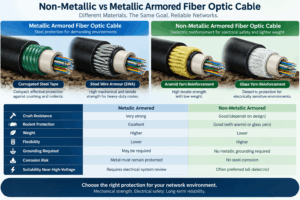
Non-Metallic vs Metallic Armored Fiber Optic Cable
Choosing between metallic vs non-metallic fiber cable protection requires more than comparing steel with aramid or glass yarn. Both con...
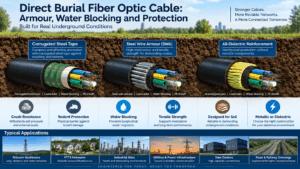
Direct Burial Fiber Optic Cable: Armour, Water Blocking and Protection
Selecting a direct burial fiber cable requires a different approach from selecting cable for an underground duct. In a direct-burial in...
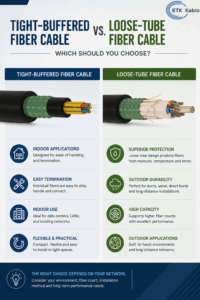
Tight-Buffered Fiber Cable vs. Loose-Tube Fiber Cable: Which Should You Choose?
Choosing the correct fiber optic cable requires more than selecting single-mode or multimode fiber.
One of the most important constr...


