





 President’s Message
Cat 7A Data Cable
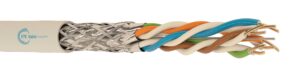
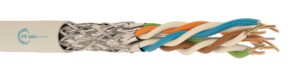
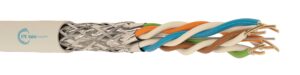
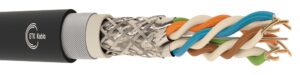
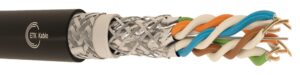
CAT 7A Data Cables | High-Performance, Shielded, Future-Ready | ETK Kablo
ETK Kablo’s CAT 7A portfolio is engineered for high-density, noise-sensitive networks that demand low latency, stable throughput, and robust EMI immunity. With individually shielded pairs and an overall braid (S/FTP), our CAT 7A cables deliver clean signal integrity across mission-critical environments such as data centers, hospitals, broadcasting facilities, and smart buildings.
Why Choose ETK Kablo CAT 7A?
- High throughput: Supports 10 Gbps applications over standard channel lengths.
- Wide bandwidth headroom: Class FA performance (up to 1000 MHz per ISO/IEC 11801); enhanced designs may be verified to higher frequencies depending on construction and testing.
- Superior shielding: S/FTP (foil-screened pairs + overall braid) minimizes alien crosstalk and external interference.
- Safer materials: LSZH (Low Smoke Zero Halogen) outer jacket to reduce smoke and corrosive gases.
- CPR compliance: Options available for B2ca and Cca Euroclasses (s/d/a sub-classes per project need).
- Consistent quality: Manufactured and tested to ISO/IEC 11801, EN 50173, and aligned with TIA/EIA installation practices.
Structure & Materials
- Conductor: Bare copper, solid.
- Insulation: High-performance PE/foam-skin variants (design-dependent).
- Shielding: S/FTP preferred for CAT 7A (foil per pair; overall braid for S/FTP).
- Jacket: LSZH for indoor/building use; UV-resistant or PE options for specific environments on request.
- Drain & foil: Tinned copper drain with Al-polyester foil per pair (design-dependent).
Standards & Compliance
- Performance: ISO/IEC 11801 Class FA; EN 50173.
- Fire & safety: CPR (EN 50575) classes B2ca/Cca options; LSZH compounds for low smoke & halogen-free behavior.
- Installation practice: TIA/EIA-568 guidelines for terminations and channel topology.
Applications
- Data centers: top-of-rack/end-of-row switching, high-density LAN.
- Healthcare & labs: EMI-sensitive environments with continuous uptime needs.
- Broadcast & media: stable, low-noise links for AV over IP distribution.
- Commercial & smart buildings: backbone and horizontal cabling with strong shielding.
- Industrial networks: environments with drives, motors, and high EMI.
Product Range & Options
- Shielding: S/FTP (default for maximum EMI protection).
- Jacket: LSZH (indoor), enhanced jacket compounds for specific conditions on request.
- CPR classes: B2ca, Cca (s/d/a sub-class configurations available).
- Colors & lengths: Standard colors; 500 m drums; custom cuts available.
Installation Notes
- Observe minimum bend radius and pull tension ratings during installation.
- Maintain pair twist up to the termination; use shielded connectors and bonding per design.
- For 10G performance at full reach, follow certified channel design and field certification.
CAT 7 / CAT 7A — Frequently Asked Questions
What is the difference between Cat7 and Cat 7A?
Cat7 (ISO/IEC Class F) supports up to 600 MHz bandwidth, while Cat7A (Class FA) extends this to 1000 MHz. Both use S/FTP construction (individually foil-shielded pairs with an overall braid), but Cat7A has tighter alien-crosstalk limits and higher electrical headroom, making it ideal for high-density or noisy environments.
What is Cat7 cable used for?
Cat7 cables are used in data centers, commercial buildings, broadcast and AV systems, and industrial networks that demand low interference, stable latency, and robust screening. They are designed to support 10 GbE transmission with excellent electromagnetic immunity.
How fast is a Cat 7A Ethernet cable?
Cat7A supports data rates of up to 10 Gbps over 100 m channels with a bandwidth capacity of 1000 MHz. For even higher data rates such as 25 GbE or 40 GbE, Cat8 cabling is recommended for shorter runs (up to 30 m).
Is Cat7 faster than Cat6?
Yes. While Cat6 supports 1 Gbps at 100 m and 10 Gbps only up to about 55 m, Cat7 delivers 10 Gbps over the full 100 m with 600 MHz bandwidth and enhanced shielding. For most 10 GbE installations, Cat6A or Cat7 are the preferred options.


