





 President’s Message
Fire Resistant FE180 Fiber Optic Cable
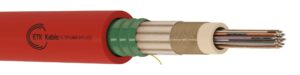
U-D(ZN)(SR)H FE180 Fire Resistant (B2ca) Fiber Optic Cable
SKU:
SLT(FR)-SA-SHFJ-(GY12)-(FE180.PH120)
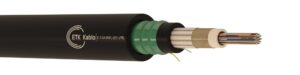
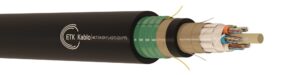
Fire Resistant Fiber Optic Cable with FE180 Performance
Fire Resistant Fiber Optic Cable helps maintain critical optical communication during defined fire-test conditions. ETK Kablo manufactures specialized FE180 fiber optic cable constructions for tunnels, railway systems, airports, hospitals, data centers, industrial facilities and other infrastructure where communication continuity can form part of the fire-safety strategy.
ETK Kablo's fire-resistant fiber optic portfolio includes both central loose tube and multi loose tube constructions with mica-based fire barriers, halogen-free jacket materials, mechanical reinforcement and corrugated steel tape protection. Depending on the exact product, additional performance such as PH120 and CPR B2ca can also be available.
Fire resistance, flame retardancy, LSZH performance and CPR classification describe different cable characteristics. Therefore, procurement teams should specify each required performance separately and verify it against the exact cable construction being supplied.
What Is a Fire Resistant Fiber Optic Cable?
A fire resistant fiber optic cable is designed to maintain optical transmission for a defined period under the conditions of an applicable fire-resistance or circuit-integrity test.
Standard fiber optic cables can continue transmitting data reliably under normal operating conditions but may lose functionality rapidly if heat and flame damage the surrounding cable structure. Fire-resistant constructions use additional protective elements to delay this failure and help preserve the optical path during the specified fire test.
ETK Kablo fire-resistant designs can use components such as mica tape, halogen-free materials, glass yarn reinforcement, protective jackets and metallic armor to create a cable construction suitable for demanding fire-survival requirements.
What Does FE180 Mean for Fiber Optic Cable?
FE180 is a fire-resistance designation associated with maintaining circuit or transmission integrity under specified laboratory fire-test conditions.
For an ETK Kablo fire-resistant fiber optic construction, circuit integrity is tested according to IEC 60331-25 with FE180 performance.
FE180 should not be interpreted as a general statement that every cable installed in every building fire will continue operating for exactly 180 minutes. The classification relates to performance under the conditions of the applicable standardized test.
This distinction is important for consultants, contractors and procurement departments because fire engineering requirements should refer to the actual test and classification required by the project.
FE180 vs PH120 Fiber Optic Cable
FE180 and PH120 are related to fire-survival performance, but they are not interchangeable classifications.
FE180 addresses circuit or transmission integrity under the applicable fire test. PH120 evaluates functionality under a different test method that also includes mechanical effects during fire exposure.
| Classification | Main Performance Concept | Relevant Test Example |
|---|---|---|
| FE180 | Circuit or transmission integrity during defined fire exposure | IEC 60331-25 for applicable optical cable constructions |
| PH120 | Functional integrity during fire exposure with mechanical effects | EN 50200 for applicable constructions |
| B2ca | Reaction-to-fire performance under the European CPR system | EN 50575 and associated classification/test framework |
Selected ETK Kablo fire-resistant fiber optic constructions combine FE180 with PH120 performance. However, this should be confirmed for the exact product rather than assumed for every cable in the category.
Fire Resistance vs Flame Retardancy
A fire resistant fiber optic cable and a flame-retardant fiber optic cable do not describe the same performance.
Flame retardancy primarily addresses how a cable limits flame propagation. Fire resistance focuses on whether the optical transmission path continues functioning during specified fire exposure.
A cable can therefore be flame retardant without being fire resistant. Likewise, a fire-resistant cable can also meet specified flame-propagation requirements, but buyers should verify each performance separately.
| Requirement | What It Addresses |
|---|---|
| Fire Resistance | Maintaining transmission or circuit integrity during specified fire conditions |
| Flame Retardancy | Limiting flame propagation along the cable |
| Low Smoke | Reducing smoke generation during combustion |
| Halogen-Free | Restricting halogen-containing corrosive gases |
| CPR Euroclass | Reaction-to-fire performance for applicable construction products |
Critical infrastructure projects can require several of these characteristics in the same cable.
FE180 Is Not the Same as CPR B2ca
One of the most important procurement distinctions is the difference between FE180 fire resistance and B2ca reaction-to-fire classification.
FE180 concerns the cable's ability to maintain optical functionality during the specified fire-resistance test. B2ca, by contrast, belongs to the European CPR reaction-to-fire classification system and evaluates how the cable contributes to fire development.
A cable can therefore have B2ca performance without necessarily providing FE180 circuit integrity. Likewise, an FE180 cable does not automatically carry a B2ca classification.
ETK Kablo offers selected fiber optic constructions that combine high CPR reaction-to-fire performance with separate fire-resistance requirements. The exact CPR classification, Declaration of Performance and fire-resistance documentation should always correspond to the cable being supplied.
B2ca Fire Resistant Fiber Optic Cable
For European projects requiring enhanced reaction-to-fire performance, ETK Kablo offers selected B2ca fiber optic cable constructions.
A full B2ca designation can also include additional classifications describing smoke production, flaming droplets and acidity. These requirements should be defined by the relevant national regulation, consultant specification or project fire strategy.
B2ca should not be specified simply because a cable is LSZH or fire resistant. The CPR class belongs to the exact tested and certified construction.
Fire-Resistant Cable Construction
Fire-survival performance depends on the complete cable design rather than the outer jacket alone.
ETK Kablo fire-resistant fiber optic constructions can include:
- Single-mode or multimode optical fibers
- PBT loose tubes
- Water-blocking materials
- FRP central strength members in applicable multi-tube designs
- Glass-yarn reinforcement
- Mica-tape fire barriers
- Halogen-free inner and outer jackets
- Corrugated steel tape armor
- Ripcords for controlled jacket removal
Mica tape plays an important role in these fire-resistant constructions because it creates a heat-resistant barrier around critical cable elements. The number and position of mica layers vary according to the individual design.
Armored Fire Resistant Fiber Optic Cable
Critical infrastructure can expose fiber cables to mechanical risks as well as fire. ETK Kablo therefore offers armored fire resistant fiber optic cable constructions with corrugated steel tape.
The steel armor improves resistance against crushing, impact and other external mechanical forces. At the same time, the internal fire-barrier system supports the required fire-survival performance.
Mechanical armor and fire resistance solve different engineering problems. Steel tape should therefore not be assumed to create fire resistance by itself, and fire-resistant materials should not be assumed to provide sufficient mechanical protection for every installation.
Central Loose Tube Fire Resistant Fiber Optic Cable
ETK Kablo's fire-resistant portfolio includes central loose tube constructions for applications requiring a compact optical cable architecture.
In these designs, the optical fibers share one main protective tube. Fire barriers, strength elements, armor and halogen-free jackets are then added around the optical core according to the required cable design.
Selected ETK Kablo central loose tube FE180 constructions cover fiber counts from low-count configurations up to several dozen fibers, depending on the exact product.
Multi Loose Tube Fire Resistant Fiber Optic Cable
Projects requiring greater optical capacity can use a multi loose tube fire resistant fiber optic cable.
In this architecture, several fiber-bearing tubes are stranded around a central strength member. This arrangement supports higher fiber counts while retaining the additional fire barriers, mechanical reinforcement and protective jackets required by the cable design.
ETK Kablo's U-DQ(ZN)H(SR)H construction provides a multi loose tube fire-resistant option with configurations reaching up to 144 fibers.
This makes the construction particularly relevant for large transport, infrastructure and communication backbones that require both high optical capacity and specialized fire performance.
LSZH and Fire Resistant Fiber Optic Cable
ETK Kablo fire-resistant fiber cables use halogen-free jacket materials in their fire-resistant constructions.
LSZH or LSOH materials help reduce smoke and corrosive halogen gas emissions during combustion. This can be particularly important in enclosed or heavily occupied environments such as tunnels, metro systems, hospitals, airports and public buildings.
However, LSZH does not mean fire resistant. A standard LSZH fiber cable can still lose transmission during a fire if it does not include the fire-survival construction required for FE180 or another applicable circuit-integrity rating.
Applications for Fire Resistant Fiber Optic Cable
Fire-resistant optical communication can be required wherever loss of data or control signals during an emergency could affect safety or critical operations.
Typical applications include:
- Railway and metro communication systems
- Road and rail tunnels
- Airports
- Hospitals and healthcare facilities
- Data centers and critical digital infrastructure
- Power plants
- Industrial facilities
- Emergency communication networks
- Public buildings
- Transportation control systems
- Critical infrastructure
The building or application alone does not determine the required rating. The cable specification should follow the project's fire engineering, communication-system and regulatory requirements.
Single-Mode and Multimode Fire Resistant Fiber Cable
Fire resistance describes cable survival during fire exposure and does not determine the optical transmission type.
Depending on the construction, ETK Kablo fire-resistant cables can incorporate single-mode or multimode optical fibers. ETK Kablo fire-resistant products include G.652.D single-mode and multimode versions in selected constructions.
Fiber type should therefore be selected according to transmission distance, bandwidth, optical equipment and network architecture, while the fire-performance requirements should be specified independently.
Mechanical and Environmental Performance
A critical fiber cable must perform mechanically during installation before its fire-survival capability ever becomes relevant.
Depending on the selected ETK Kablo construction, product-specific tests can include:
- Tensile performance
- Crush resistance
- Impact resistance
- Torsion
- Repeated bending
- Bending radius
- Temperature cycling
- Water penetration
- Fire resistance
- Functional integrity with mechanical shock where applicable
The specified values vary significantly between cable constructions. Procurement teams should therefore use the technical datasheet for the exact product rather than applying one mechanical or environmental rating to the complete category.
How to Specify a Fire Resistant Fiber Optic Cable
Fire-resistant fiber procurement requires more information than fiber type and fiber count alone. The complete fire and installation requirements should be defined at the RFQ stage.
| Specification Item | Information to Provide |
|---|---|
| Fiber Type | Required single-mode or multimode fiber |
| Fiber Count | Required current and future optical capacity |
| Fire Resistance | FE180 or other project-specific circuit-integrity requirement |
| Functional Integrity | PH120 or another applicable requirement where specified |
| CPR Classification | B2ca or other Euroclass when required by the project |
| Construction | Central loose tube or multi loose tube |
| Mechanical Protection | Required armor and mechanical performance |
| Sheath | Halogen-free and project-specific material requirements |
| Installation Environment | Indoor, indoor/outdoor, tunnel, infrastructure or project-specific route |
| Documentation | Datasheet, fire-test documentation, CPR documents where applicable and project certificates |
ETK Kablo Fire Resistant Fiber Optic Cable Range
ETK Kablo offers several specialized FE180 fiber optic cable constructions rather than one universal fire-resistant design.
| Construction | Main Design Concept |
|---|---|
| U-D(ZN)(SR)H FE180 | Central loose tube, mica fire barrier, glass-yarn reinforcement, corrugated steel tape and halogen-free jacket |
| U-D(ZN)H(SR)H FE180 | Central loose tube with fire barrier, halogen-free inner jacket, corrugated steel tape and halogen-free outer jacket |
| U-DQ(ZN)H(SR)H FE180 | Multi loose tube, FRP strength member, multiple fire-barrier elements, corrugated steel tape and halogen-free jackets |
The exact fire rating, CPR classification, fiber type, fiber count and mechanical performance should be confirmed against the selected product datasheet.
Why Choose ETK Kablo for Fire Resistant Fiber Optic Cable?
ETK Kablo combines fiber optic cable manufacturing capability with specialized fire-resistant cable engineering for critical infrastructure projects.
The portfolio includes both central and multi loose tube FE180 constructions, metallic mechanical protection, halogen-free materials and selected solutions that combine separate fire-resistance and CPR requirements.
This allows contractors, consultants, telecom companies, system integrators and infrastructure buyers to define the optical, mechanical and fire-performance requirements together rather than sourcing a generic fiber cable and assuming that one fire characteristic covers every project requirement.
Frequently Asked Questions About Fire Resistant Fiber Optic Cable
What is a fire resistant fiber optic cable?
A fire resistant fiber optic cable is designed to maintain optical transmission during specified fire-test conditions for the period and performance defined by the applicable test classification.
What does FE180 mean?
FE180 is a fire-resistance or circuit-integrity designation. For applicable ETK Kablo fiber optic constructions, FE180 performance is associated with IEC 60331-25 testing. It should be interpreted according to the standardized test conditions rather than as a guarantee of real-world fire duration.
What is the difference between FE180 and PH120?
FE180 and PH120 use different fire-performance concepts and test conditions. PH120 includes mechanical effects during the fire test, while FE180 addresses circuit or transmission integrity under the applicable fire-resistance test. A project may require one or both.
Is FE180 the same as B2ca?
No. FE180 describes fire-resistance or circuit-integrity performance, while B2ca describes reaction-to-fire performance under the European CPR classification system. The two requirements should be specified and verified separately.
Is every ETK Kablo fire resistant fiber optic cable B2ca?
No. ETK Kablo offers selected B2ca-classified fiber optic constructions, but the exact CPR performance must be verified for the specific product being purchased.
Is LSZH fiber optic cable automatically fire resistant?
No. LSZH describes smoke and halogen characteristics of the cable materials. Fire resistance requires separate cable construction and testing for circuit or transmission integrity.
Does ETK Kablo manufacture high-fiber-count fire resistant fiber cable?
Yes. ETK Kablo's multi loose tube U-DQ(ZN)H(SR)H FE180 construction includes versions reaching up to 144 fibers.
What information should I provide when requesting a quotation?
Provide the fiber type, fiber count, required FE or PH classification, CPR class if applicable, cable construction, armor requirement, installation environment, quantity, delivery length and required project documentation.


