





 President’s Message
Braided Foil Screened
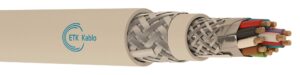
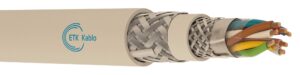
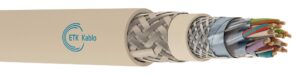
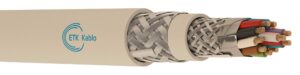
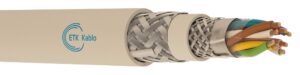
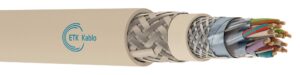
Braided Foil Screened Steel Wire Braided Signal Control Cable
PVC braided foil screened steel wire braided signal control cables combine two electromagnetic screening layers with a separate galvanized steel wire braid for additional mechanical protection.
ETK Kablo manufactures this cable range in LIY(St)CYSWBY and LI2Y(St)CYSWBY constructions. Standard multicore, TP/TT and PiMF/TiMF versions provide different conductor-grouping and screening options for industrial signal and control circuits.
An Al/PET foil and tinned copper braid form the overall electromagnetic screening system. A PVC inner jacket separates the screened signal core from the galvanized steel wire braid, which provides a separate mechanical reinforcement layer.
What Is a Braided Foil Screened Steel Wire Braided Signal Cable?
A braided foil screened steel wire braided signal cable combines several layers with different engineering functions:
- Al/PET foil for overall electromagnetic screening,
- tinned copper braid for additional electromagnetic screening,
- PVC inner jacket between the screened core and mechanical braid,
- galvanized steel wire braiding for mechanical protection,
- PVC outer jacket for external cable protection.
The Al/PET foil and tinned copper braid work together as the electrical screening system.
The galvanized steel wire braid performs a different function. It surrounds the PVC inner jacket and provides mechanical reinforcement rather than serving as the primary electromagnetic screen.
Foil, Copper Braid and Steel Wire Braid
This cable family contains three metallic elements that should be distinguished during specification.
| Construction Element | Material | Main Function |
|---|---|---|
| Foil Screen | Al/PET tape | Overall electromagnetic screening |
| Electrical Braid Screen | Tinned copper braiding | Additional electromagnetic screening |
| Mechanical Braid | Galvanized steel wire braiding | Mechanical reinforcement and protection |
The foil provides broad metallic coverage around the cable core, while the tinned copper braid forms a flexible conductive screening layer.
Together, these layers provide combined electromagnetic screening for sensitive signal circuits.
The galvanized steel wire braid sits outside the PVC inner jacket and addresses mechanical exposure separately.
LIY(St)CYSWBY and LI2Y(St)CYSWBY Constructions
ETK Kablo manufactures two principal conductor-insulation systems within this range.
| Cable Family | Conductor Insulation | Electromagnetic Screen | Mechanical Protection |
|---|---|---|---|
| LIY(St)CYSWBY | PVC | Al/PET foil + tinned copper braid | Galvanized steel wire braiding |
| LI2Y(St)CYSWBY | Solid polyethylene | Al/PET foil + tinned copper braid | Galvanized steel wire braiding |
Both families use Class 5 stranded electrolytic copper conductors together with UV-resistant PVC inner and outer jackets.
The principal difference is the conductor insulation.
LIY(St)CYSWBY uses PVC conductor insulation, while LI2Y(St)CYSWBY uses solid polyethylene conductor insulation.
The 2Y designation therefore identifies the polyethylene conductor-insulation system. It does not indicate a different overall screening system, steel wire braid or jacket construction.
PVC Inner and Outer Jackets
The products in this category use UV-resistant PVC for both the inner and outer jackets.
The PVC inner jacket covers the foil-and-copper-braid-screened signal core before the galvanized steel wire braid is applied.
The PVC outer jacket then covers the complete mechanically protected construction.
Current ETK Kablo product data identifies the standard jacket color as RAL 7035 grey.
These products belong to the PVC signal-control range and should remain distinct from corresponding LSZH constructions that use halogen-free jacket systems.
Standard, TP/TT and PiMF/TiMF Versions
ETK Kablo offers three conductor-grouping and screening architectures within this category.
| Version | Conductor Arrangement | Individual Pair / Triad Screen | Overall Screen |
|---|---|---|---|
| Standard | Cores stranded in layers | No | Al/PET foil + tinned copper braid |
| TP/TT | Twisted pairs or triads | No | Al/PET foil + tinned copper braid |
| PiMF/TiMF | Pairs or triads | Al/PET foil | Al/PET foil + tinned copper braid |
All three constructions also use galvanized steel wire braiding outside the PVC inner jacket for mechanical reinforcement.
What Do TP and TT Mean?
TP refers to conductors arranged as twisted pairs, while TT refers to conductors arranged as twisted triads.
In LIY(St)CYSWBY-TP/TT and LI2Y(St)CYSWBY-TP/TT cables, insulated conductors are first grouped into pairs or triads. These groups are then assembled together.
The complete grouped cable core receives an overall Al/PET foil and tinned copper braid.
TP/TT therefore describes conductor organization.
It does not mean that every pair or triad has an individual metallic screen.
PiMF and TiMF Steel Wire Braided Signal Cable
PiMF identifies pairs individually screened in metallic foil, while TiMF identifies individually screened triads.
In the current ETK Kablo PiMF/TiMF constructions, every pair or triad receives:
- individual polyester wrapping,
- a tinned copper earthing wire,
- an individual Al/PET foil screen.
The individually screened pairs or triads are then stranded together.
The complete assembled core receives an additional overall screening system consisting of Al/PET foil and tinned copper braiding.
Therefore, PiMF/TiMF versions provide individual circuit screening together with combined overall foil-and-braid screening.
A galvanized steel wire braid is then applied outside the PVC inner jacket for separate mechanical protection.
ETK Kablo Braided Foil Screened Steel Wire Braided Cable Range
| Product | Insulation | Configuration |
|---|---|---|
| LIY(St)CYSWBY Signal Control Cable | PVC | Standard multicore |
| LIY(St)CYSWBY-TP/TT Signal Control Cable | PVC | Twisted pairs / triads |
| LIY(St)CYSWBY-PiMF/TiMF Signal Control Cable | PVC | Individually screened pairs / triads |
| LI2Y(St)CYSWBY Signal Control Cable | Solid polyethylene | Standard multicore |
| LI2Y(St)CYSWBY-TP/TT Signal Control Cable | Solid polyethylene | Twisted pairs / triads |
| LI2Y(St)CYSWBY-PiMF/TiMF Signal Control Cable | Solid polyethylene | Individually screened pairs / triads |
Electrical and Mechanical Characteristics
The current products use Class 5 stranded electrolytic copper conductors according to IEC 60228, EN 60228 and DIN VDE 0295.
Published conductor cross-sections range from 0.22 mm² to 2.50 mm². Available conductor counts and pair or triad configurations depend on the selected construction.
Current product data publishes:
- 250 V DC operating voltage for applicable smaller conductor sizes,
- 300/500 V operating voltage for applicable larger conductor sizes,
- minimum bending radius of 7.5 × overall cable diameter,
- operating temperature range of -30°C to +70°C.
The selected product datasheet should determine the exact values for each project.
Flame Retardancy
Current products in this category publish single-cable flame-retardancy testing according to:
- IEC 60332-1-2,
- VDE 0482-332-1-2,
- BS EN 60332-1-2.
Flame retardancy should not be confused with fire resistance.
Standard LIY(St)CYSWBY and LI2Y(St)CYSWBY cables should not automatically be described as FE180 or PH120 cables. Projects requiring defined circuit integrity during fire exposure require a dedicated fire-resistant cable construction.
Typical Applications
Braided foil screened steel wire braided signal cables can suit fixed industrial installations that require strong electromagnetic screening together with additional mechanical protection.
Typical applications include:
- industrial automation systems,
- process control installations,
- measurement and monitoring circuits,
- PLC and control-system connections,
- sensors and actuators,
- factory and production infrastructure,
- building automation systems,
- signal circuits routed through mechanically exposed fixed areas.
The final cable selection should consider signal sensitivity, electromagnetic interference, mechanical exposure and installation conditions.
Foil Screened vs Braid Screened vs Braided Foil Screened SWB Cable
ETK Kablo offers three principal electromagnetic-screening systems within the PVC steel wire braided signal-control range.
| Construction | Electromagnetic Screen | Mechanical Protection |
|---|---|---|
| Foil Screened | Al/PET foil + tinned copper earthing wire | Galvanized steel wire braid |
| Braid Screened | Tinned copper braid | Galvanized steel wire braid |
| Braided Foil Screened | Al/PET foil + tinned copper braid | Galvanized steel wire braid |
For a foil-only electromagnetic screen, see the Foil Screened Steel Wire Braided Signal Control Cable range.
For a copper-braid electromagnetic screen without an additional overall foil layer, see the Braid Screened Steel Wire Braided Signal Control Cable range.
The products on this page combine both Al/PET foil and tinned copper braid as their overall electromagnetic screening system.
All three screening options belong to the broader Steel Wire Braided Signal Control Cable range.
Steel Wire Braided vs Steel Wire Armored Signal Cable
Steel wire braiding and steel wire armor are separate mechanical constructions.
The cables on this page use galvanized steel wire braiding outside the PVC inner jacket.
They should therefore not be described as Steel Wire Armored (SWA) products simply because both constructions provide additional mechanical protection.
The installation requirements and specified mechanical construction should determine whether a Steel Wire Braided or Steel Wire Armored cable is appropriate.
How to Specify a Braided Foil Screened SWB Signal Cable
A quotation request should define the electrical, screening and mechanical requirements separately.
| Requirement | Information to Specify |
|---|---|
| Cable Family | LIY(St)CYSWBY or LI2Y(St)CYSWBY |
| Configuration | Standard, TP/TT or PiMF/TiMF |
| Conductor Size | Required cross-section according to the signal circuit |
| Conductor Insulation | PVC or solid polyethylene |
| Overall Screening | Al/PET foil + tinned copper braid |
| Individual Screening | Specify PiMF/TiMF where individually screened pairs or triads are required |
| Mechanical Protection | Galvanized steel wire braiding |
| Installation Environment | Define route, mechanical exposure and environmental conditions |
| Fire Requirement | Define flame, CPR or circuit-integrity requirements separately |
| Documentation | Required datasheet, DoP or project-specific documentation |
Why Choose ETK Kablo for Braided Foil Screened Steel Wire Braided Cable?
ETK Kablo manufactures braided foil screened steel wire braided signal control cables for industrial applications requiring combined electromagnetic screening and additional mechanical protection.
The range combines Class 5 stranded copper conductors, Al/PET foil, tinned copper braiding, UV-resistant PVC inner and outer jackets and galvanized steel wire braiding.
LIY(St)CYSWBY and LI2Y(St)CYSWBY insulation options, together with standard, TP/TT and PiMF/TiMF constructions, allow engineers, distributors, system integrators and industrial contractors to select the cable according to the signal circuits and installation conditions.
Frequently Asked Questions About Braided Foil Screened Steel Wire Braided Cable
What is a braided foil screened steel wire braided signal cable?
It is a signal or control cable that combines Al/PET foil and tinned copper braid for electromagnetic screening with a separate galvanized steel wire braid for mechanical protection.
Why does this cable contain two different braid layers?
The tinned copper braid forms part of the electromagnetic screening system. The galvanized steel wire braid provides separate mechanical reinforcement outside the PVC inner jacket.
Does the galvanized steel wire braid replace the electrical screen?
No. The dedicated electromagnetic screening system consists of Al/PET foil and tinned copper braiding. The galvanized steel wire braid primarily provides mechanical protection.
What is the difference between LIY(St)CYSWBY and LI2Y(St)CYSWBY?
LIY(St)CYSWBY uses PVC conductor insulation, while LI2Y(St)CYSWBY uses solid polyethylene conductor insulation. Both use Al/PET foil and tinned copper braid screening, PVC inner and outer jackets and galvanized steel wire braiding.
What does TP/TT mean?
TP/TT describes conductors arranged as twisted pairs or twisted triads before the overall screening layers are applied.
Are TP/TT pairs individually screened?
No. The current TP/TT constructions use overall Al/PET foil and tinned copper braiding around the complete assembled cable core.
What does PiMF/TiMF mean?
PiMF/TiMF identifies individually foil-screened pairs or triads. Each pair or triad receives an individual Al/PET foil screen with a tinned copper earthing wire. The complete cable core then receives additional overall Al/PET foil and tinned copper braid screening.
What is the difference between braid screened and braided foil screened cable?
Braid-screened constructions use a tinned copper braid as the overall electromagnetic screen. Braided foil screened constructions combine Al/PET foil with the tinned copper braid.
What is the difference between SWB and SWA?
SWB uses galvanized steel wire braiding as the mechanical protection layer. SWA uses a different steel wire armor construction. The terms should not be treated as interchangeable.
Is this cable LSZH?
No. The products in this category use PVC inner and outer jackets. ETK Kablo maintains separate LSZH constructions for projects that require halogen-free jacket materials.
Is this cable fire resistant?
Not automatically. The current products publish flame-retardancy testing, but this does not establish FE180, PH120 or another defined circuit-integrity rating.
What information should I provide when requesting a quotation?
Provide the required LIY(St)CYSWBY or LI2Y(St)CYSWBY family, conductor cross-section, standard, TP/TT or PiMF/TiMF configuration, operating voltage, installation conditions, mechanical requirements, quantity, packing length and required project documentation.


