





 President’s Message
Blog
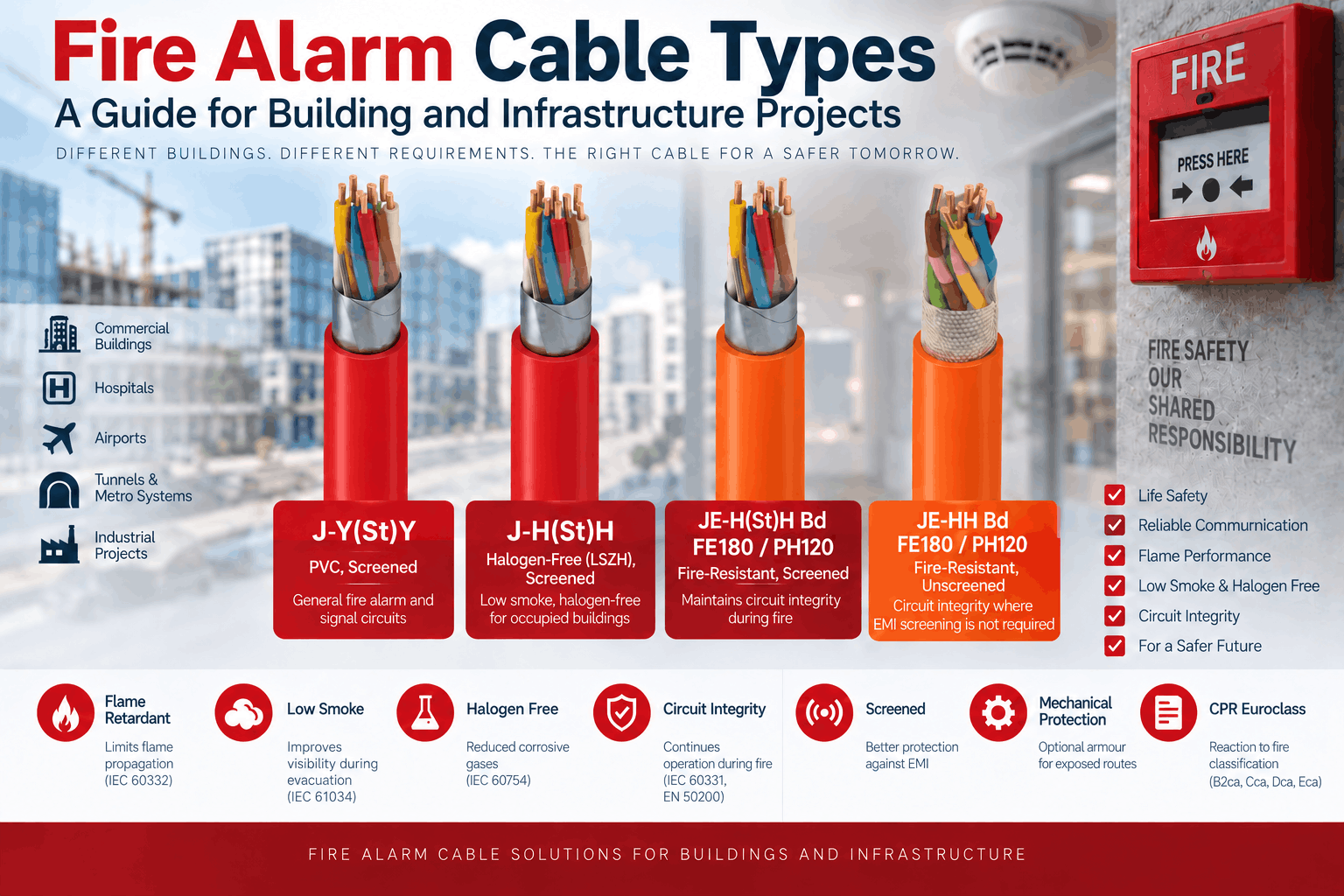
Fire Alarm Cable Types: A Guide for Building and Infrastructure Projects
Reading Time: 13 minutes
Choosing the right fire alarm cable types for a building or infrastructure project requires more than selecting a red cable and connecting detectors to a control panel. Fire alarm wiring can differ in conductor construction, screening, sheath material, smoke performance, flame propagation, circuit integrity and mechanical protection.
A conventional indoor fire detection loop may only require a screened flame-retardant signal cable. A hospital, tunnel or airport may require halogen-free and low-smoke materials. Meanwhile, a safety-critical circuit that must continue operating during a fire requires a specifically tested fire-resistant cable with circuit-integrity performance.
The correct cable therefore depends on the function of the circuit, the fire strategy of the building, electromagnetic conditions, installation route, local regulations and the requirements of the fire alarm system manufacturer.
Quick answer: Standard PVC fire alarm cables such as J-Y(St)Y can suit general indoor alarm and communication circuits where PVC is permitted. J-H(St)H provides a halogen-free, low-smoke alternative for occupied and enclosed environments. If the circuit must remain operational during fire, use a specifically tested fire-resistant cable such as JE-H(St)H Bd FE180/PH120 or another construction that matches the required circuit-integrity standard. Screening, armour, CPR class and fire-survival duration should all be specified separately.
Fire Alarm Cable Types at a Glance
| Cable Type | Main Characteristic | Typical Fire Performance | Typical Application |
|---|---|---|---|
| J-Y(St)Y | PVC, overall screened | Flame-retardant according to specified test | General indoor fire alarm and signal circuits where PVC is permitted |
| J-H(St)H | Halogen-free, low-smoke, overall screened | Flame-retardant + LSZH-related performance | Hospitals, airports, public buildings and enclosed areas |
| JE-H(St)H Bd FE180 / PH120 | Halogen-free, screened, fire-resistant | Circuit integrity under specified fire conditions | Critical fire alarm, evacuation and emergency signal circuits |
| JE-HH Bd FE180 / PH120 | Halogen-free, unshielded, fire-resistant | Circuit integrity under specified fire conditions | Critical circuits where additional EMI screening is not required |
| LIH(St)H / LIHCH fire-resistant families | Flexible signal/control constructions | Available with specified fire-survival performance | Emergency controls, alarm interfaces and safety-related signal circuits |
| Armored fire-safety cable | Additional mechanical protection | Depends on the underlying fire-resistant construction | Exposed industrial and infrastructure routes |
These categories should not be interpreted as a simple ranking from basic to premium.
Each type solves a different project requirement.
What Is a Fire Alarm Cable?
A fire alarm cable is a low-voltage cable used to transmit signals, data or power within fire detection, alarm, evacuation and related life-safety systems.
Depending on the system design, fire alarm wiring can connect:
- Smoke detectors
- Heat detectors
- Manual call points
- Fire alarm control panels
- Sounders
- Beacons
- Input and output modules
- Fire damper controls
- Monitoring interfaces
- Emergency communication equipment
Not every circuit performs the same function. Therefore, not every cable within the fire alarm system necessarily requires the same construction.
Fire Alarm Cable Is Not Automatically Fire Resistant
This is the most important distinction in this guide.
A cable can be specifically designed for fire alarm signal transmission without being a fire-resistant circuit-integrity cable.
For example, a flame-retardant fire alarm cable can be designed to limit flame propagation. However, it may still lose electrical continuity when directly exposed to fire.
A fire-resistant cable has a different objective: it is designed and tested to maintain the required circuit for a defined period under specified fire conditions.
Therefore:
Fire alarm cable = describes the application.
Flame retardant = describes flame propagation behaviour.
Fire resistant = describes circuit survival under specified fire conditions.
The project must determine which properties are actually required.
J-Y(St)Y Fire Alarm Cable: PVC Screened Construction
J-Y(St)Y is a screened PVC communication and signal cable that can be used for fire detection and alarm circuits where the project permits PVC materials.
A typical construction includes:
- Solid copper conductors
- PVC insulation
- Twisted signal elements
- Overall Al/PET foil screen
- Tinned copper drain or earth wire
- PVC outer sheath
The overall screen provides protection against electromagnetic interference, helping maintain stable signal communication between alarm devices and control equipment.
Where Is J-Y(St)Y Suitable?
J-Y(St)Y can be considered for:
- General commercial buildings
- Protected indoor installations
- Fire detection loops
- Alarm signal circuits
- Building automation interfaces
- Control and monitoring circuits
- Projects where PVC is permitted
Its main advantage is that it provides a practical, screened communication cable without requiring halogen-free materials where the project does not demand them.
Is J-Y(St)Y Fire Resistant?
Not automatically.
A J-Y(St)Y cable may meet a specified flame-propagation requirement, but that does not prove that it will maintain circuit continuity during fire.
If a fire alarm circuit must continue operating during the fire, the project should specify an appropriate circuit-integrity cable instead.
J-H(St)H Fire Alarm Cable: Halogen-Free and Low Smoke
J-H(St)H provides a halogen-free alternative for fire alarm and low-voltage communication systems.
In ETK Kablo’s standard J-H(St)H Lg construction, solid copper conductors are insulated with a halogen-free compound, assembled into the required cable geometry and surrounded by an Al/PET overall screen with a tinned copper earth wire.
The outer sheath is also halogen-free.
Why Choose J-H(St)H Instead of J-Y(St)Y?
The main reason is fire-related material behaviour.
J-H(St)H can be selected where the project requires:
- Low smoke emission
- Halogen-free materials
- Reduced corrosive combustion gases
- Flame-retardant performance
- Overall electromagnetic screening
This makes it particularly relevant to enclosed or highly occupied environments.
Typical J-H(St)H Applications
J-H(St)H can be considered for:
- Hospitals
- Airports
- Metro stations
- Railway stations
- Hotels
- Shopping centers
- High-rise buildings
- Data centers
- Schools
- Government buildings
- Public infrastructure
The final requirement should still come from the project’s fire strategy and applicable regulations.
J-H(St)H vs J-Y(St)Y: What Is the Difference?
| Characteristic | J-H(St)H | J-Y(St)Y |
|---|---|---|
| Primary material philosophy | Halogen-free | PVC |
| Low-smoke requirement | Designed for low-smoke applications | Not equivalent to LSZH construction |
| Halogen-free performance | Yes, according to applicable requirements | No |
| Overall screen | Yes | Yes |
| General fire alarm use | Yes | Yes where PVC is permitted |
| Circuit integrity automatically included? | No | No |
The key decision is therefore similar to many other cable families:
J-H(St)H = halogen-free, low-smoke fire alarm signal cable.
J-Y(St)Y = PVC fire alarm signal cable.
If circuit integrity is required, the project needs to move beyond this material comparison and specify a tested fire-resistant construction.
Fire-Resistant Fire Alarm Cable: When Circuit Integrity Matters
Some fire alarm and emergency circuits must continue operating after a fire has started.
Examples can include:
- Critical detection loops
- Voice evacuation
- Emergency communication
- Smoke-control interfaces
- Fire-fighting system controls
- Emergency shutdown signals
- Other safety-related control circuits
For these applications, the cable may require a specific circuit-integrity classification.
Fire-resistant cables use specialized insulation and fire barriers designed to preserve the electrical path during defined fire tests.
JE-H(St)H Bd FE180 PH120 Fire-Resistant Cable
JE-H(St)H Bd FE180 PH120 is an example of a screened fire-resistant signal cable for safety-critical circuits.
Its construction can include:
- Solid copper conductors
- Fire-survival insulation
- Pair-based cable construction
- Protective wrapping
- Overall Al/PET screen
- Tinned copper earth wire
- Halogen-free outer sheath
The defining difference from standard J-H(St)H is not simply the colour or sheath material.
It is the tested circuit-integrity capability.
What Does FE180 Mean?
FE180 describes cable integrity under the conditions of the referenced fire test for a nominal 180-minute period.
It should not be interpreted as a guarantee that any installed system will operate for exactly three hours in every real fire.
What Does PH120 Mean?
PH120 describes circuit-integrity performance for 120 minutes under the conditions of the applicable test, including mechanical shock.
This makes it particularly relevant where a fire-survival circuit must withstand both heat and mechanical stress.
Screened vs Unscreened Fire-Resistant Cable
Fire resistance and screening are separate specification decisions.
A screened construction such as JE-H(St)H includes a metallic screen to help protect signal circuits from electromagnetic interference.
An unshielded construction such as JE-HH may be appropriate where the project does not require the additional EMI barrier.
| Requirement | Screened Fire-Resistant Cable | Unscreened Fire-Resistant Cable |
|---|---|---|
| Circuit integrity | Available | Available |
| EMI protection | Higher due to dedicated screen | No dedicated overall signal screen |
| Construction complexity | Higher | Lower |
| Typical selection logic | EMI-sensitive safety circuits | Low-EMI safety circuits where screening is unnecessary |
This distinction prevents another common procurement error: assuming that every fire-resistant cable must automatically be screened.
FE180, PH120 and E30-E90 in Fire Alarm Projects
These classifications should not be treated as one simple ladder.
FE180 addresses cable-level integrity under a specified fire test.
PH120 addresses circuit integrity under fire with mechanical shock.
E30, E60 and E90 relate to the functional integrity of an approved installed cable system, including the cable and its relevant support or fixing arrangement.
Therefore, a project that requires E90 should not simply buy a cable marked with a fire-survival rating and assume that any installation method will reproduce E90 system performance.
The approved support and fixing system matters.
Flame-Retardant vs Fire-Resistant Fire Alarm Cable
| Performance | Flame-Retardant Fire Alarm Cable | Fire-Resistant Fire Alarm Cable |
|---|---|---|
| Main purpose | Limit flame propagation | Maintain circuit integrity |
| Example test family | IEC 60332 | IEC 60331 / EN 50200 or project-specified equivalent |
| Continues operating during fire? | Not necessarily | Designed to do so under specified test conditions |
| Typical application | General detection and alarm wiring | Critical life-safety circuits |
This distinction should appear clearly in every fire alarm cable schedule.
LSZH Fire Alarm Cable: When Is It Required?
LSZH materials are particularly valuable in areas where smoke and corrosive combustion gases can increase risk during evacuation.
Projects may therefore specify LSZH fire alarm cable in:
- Tunnels
- Underground stations
- Airports
- Hospitals
- Hotels
- High-rise buildings
- Data centers
- Large public buildings
- Transportation infrastructure
However, LSZH itself does not prove circuit integrity.
A project requiring both low-smoke halogen-free behaviour and continued operation during fire needs a cable that meets both sets of requirements.
IEC 60332: Flame Propagation
The IEC 60332 family addresses flame propagation characteristics of electrical and optical cables.
A cable complying with the applicable flame-retardancy requirement is designed to resist the spread of flame under defined laboratory conditions.
This is relevant to fire alarm cables because cable routes can pass through shafts, trays and building pathways where uncontrolled flame propagation could contribute to fire spread.
However, IEC 60332 performance should not be confused with circuit integrity.
IEC 60754 and IEC 61034 for Fire Alarm Cable
Halogen-free fire alarm cables are commonly evaluated against additional fire-related tests.
IEC 60754 addresses characteristics of gases released from cable materials during combustion, including halogen acid gas and acidity-related performance.
IEC 61034 addresses smoke density.
These tests matter particularly in enclosed buildings because fire-safety cable performance involves more than whether the cable itself propagates flame.
CPR Euroclass for Fire Alarm Cables
For applicable cables permanently installed in European construction works, the project may also require a specific CPR Euroclass.
Examples include:
- B2ca
- Cca
- Dca
- Eca
Additional classifications can also address:
- Smoke
- Flaming droplets
- Acidity
CPR is a reaction-to-fire classification and should not be confused with circuit-integrity classifications such as FE180 or PH120.
A fire alarm cable can therefore require both a CPR classification and separate fire-survival performance.
Conventional vs Addressable Fire Alarm Systems: Does the Cable Change?
Not necessarily.
A conventional fire alarm system groups devices into zones, while an addressable system communicates individually with devices on a loop.
However, the words “conventional” and “addressable” do not by themselves define the cable construction.
Engineers should review:
- Fire alarm panel manufacturer’s requirements
- Loop resistance
- Cable capacitance
- Maximum circuit length
- Screening requirements
- Conductor size
- Fire-performance requirement
- Local fire alarm installation code
A cable that works electrically on one system should not automatically be assumed suitable for another without checking the manufacturer’s design limits.
Screened Fire Alarm Cable: When Is Shielding Required?
Many fire alarm cables use an overall Al/PET foil screen because alarm circuits can pass near:
- Power cables
- Electrical distribution boards
- Motors
- Variable-frequency drives
- Building automation wiring
- Communication equipment
The metallic screen helps reduce electromagnetic interference entering the alarm circuit.
This can be particularly important for long loops or electrically noisy environments.
However, screen termination and grounding should follow the fire alarm system manufacturer’s instructions and project EMC philosophy.
Do Fire Alarm Cables Need Armour?
Not automatically.
Most fire alarm cabling inside protected building pathways does not require steel armour simply because it belongs to a life-safety system.
Mechanical protection should be considered when the route itself is exposed to:
- Impact
- Crushing
- Rodent damage
- Heavy industrial activity
- Underground conditions
- External mechanical stress
If armour is required, the cable still needs to satisfy the fire and electrical requirements of the circuit.
Armour does not create fire resistance.
Fire Alarm Cable for Commercial Buildings
Commercial buildings often use screened fire alarm cables for detection loops, alarm devices and control interfaces.
Where local requirements permit PVC, J-Y(St)Y-type constructions can provide a practical solution.
Where the building fire strategy requires low-smoke and halogen-free materials, J-H(St)H is generally the more appropriate family to consider.
Critical circuits that must remain operational during fire should then be specified with the required circuit-integrity performance.
Fire Alarm Cable for Hospitals
Hospitals create particularly demanding life-safety conditions because occupants may not be able to evacuate quickly without assistance.
The specification can therefore place greater emphasis on:
- LSZH materials
- Low smoke emission
- Halogen-free performance
- Circuit integrity
- Reliable emergency communication
- Fire compartmentation strategy
Different hospital circuits may still require different cable types.
A standard alarm loop and a critical evacuation circuit should not automatically receive identical specifications.
Fire Alarm Cable for Airports
Airports combine high occupancy with large buildings, long cable routes, critical operational areas and complex evacuation requirements.
Common design considerations include:
- Low smoke
- Halogen-free materials
- Screening
- Long signal routes
- Fire-resistant emergency circuits
- CPR requirements where applicable
The cable type should match the specific function rather than applying one fire-alarm cable construction throughout the entire airport.
Fire Alarm Cable for Tunnels and Metro Systems
Tunnels and metro infrastructure provide some of the strongest reasons for strict cable fire performance.
These environments combine:
- Restricted evacuation
- Limited ventilation
- Long cable routes
- High passenger density
- Critical communication systems
- Demanding emergency-response requirements
Projects can therefore require combinations of:
- LSZH materials
- Low smoke
- Low corrosive-gas emission
- Flame retardancy
- Circuit integrity
- Functional integrity
- Mechanical protection
The exact test combination should come from the project specification rather than the generic label “tunnel cable.”
Fire Alarm Cable for Industrial and Oil & Gas Projects
Industrial installations introduce another set of risks.
Fire alarm cable routes may pass near:
- Motors
- High-voltage equipment
- Switchgear
- Process equipment
- Outdoor infrastructure
- Mechanically exposed areas
This can increase the importance of screening, mechanical protection and environmental resistance.
However, even within the same refinery or industrial plant, a protected control building and an outdoor process area may justify different fire alarm cable constructions.
Fire Alarm Cable Conductor Size
Conductor size should be selected according to the electrical requirements of the circuit rather than by assuming one diameter is suitable for every fire alarm system.
Common signal-cable conductor diameters and cross-sections can include:
- 0.6 mm
- 0.8 mm
- 1.0 mm
- 1.5 mm²
- 2.5 mm²
The correct size can depend on:
- Loop length
- Conductor resistance
- Voltage drop
- Current requirement
- Connected devices
- Fire alarm panel design
- Project specification
Increasing conductor size can reduce resistance but also increases cable diameter, weight and cost.
Pair Count and Cable Construction
Fire alarm cables can be supplied with different numbers of pairs or conductors according to system design.
A project may require:
- Single-pair cables
- Multi-pair cables
- Star-quad constructions
- Individual cores
- Flexible multicore control-style cables
The required cable geometry should follow the electrical architecture of the fire alarm or emergency system.
Does Fire Alarm Cable Have to Be Red?
Not universally.
Red is widely associated with fire alarm cabling and is commonly specified to make life-safety circuits easy to identify.
However, cable colour depends on:
- Regional practice
- Project specification
- Applicable code
- Cable family
- Client requirements
For example, ETK’s standard J-H(St)H fire alarm construction uses a red sheath, while other cable families and fire-resistant products can use different identification colours.
Therefore, sheath colour should never be used as proof of technical fire performance.
Which Fire Alarm Cable Type Should You Choose?
| Project Requirement | Cable Type to Consider | Reason |
|---|---|---|
| General indoor alarm circuit where PVC is permitted | J-Y(St)Y | Screened, practical PVC signal construction |
| Occupied building requiring LSZH | J-H(St)H | Halogen-free and low-smoke construction |
| Critical screened circuit requiring fire survival | JE-H(St)H Bd FE180 / PH120 | Combines screening with tested circuit integrity |
| Critical low-EMI circuit requiring fire survival | JE-HH Bd fire-resistant construction | Fire-survival capability without dedicated signal screen |
| Emergency control circuit requiring flexible construction | Relevant LIH fire-resistant family | Signal/control architecture can better match application |
| Mechanically exposed fire-safety route | Appropriate fire-rated construction + mechanical protection | Mechanical and fire requirements must both be met |
| Tunnel, metro or high-risk public infrastructure | Project-specific LSZH + circuit-integrity cable | Multiple fire-performance requirements commonly apply |
The correct choice should always follow the circuit function and project fire strategy.
Common Mistakes When Specifying Fire Alarm Cables
1. Assuming Every Fire Alarm Cable Is Fire Resistant
Some fire alarm cables are flame retardant or LSZH but are not designed to maintain circuit integrity during direct fire exposure.
2. Assuming LSZH Means Circuit Integrity
LSZH addresses smoke and halogen characteristics. Fire resistance requires separate testing.
3. Assuming Red Sheath Means Fire Rated
Colour is primarily an identification feature. Compliance must come from the cable construction and test documentation.
4. Using IEC 60332 as Proof of Fire Survival
IEC 60332 addresses flame propagation. It does not demonstrate that the electrical circuit remains operational during fire.
5. Ignoring EMI Screening
Long alarm loops and electrically noisy routes can benefit from an appropriate screened construction.
6. Specifying Fire Resistance Without Duration or Test Standard
Terms such as “fire resistant” are incomplete unless the project defines the required classification and test method.
7. Assuming E90 Is a Cable-Only Rating
E30, E60 and E90 relate to the tested installed system and should be coordinated with approved fixing and support arrangements.
8. Choosing Cable Only by Conductor Size
Electrical resistance matters, but fire behaviour, screening, sheath material and system compatibility are equally important.
9. Using the Same Cable for Every Circuit
Detection loops, sounders, evacuation systems and critical controls can have different fire-survival requirements.
10. Ignoring Local Regulations and Panel Manufacturer Requirements
A technically capable cable can still be unsuitable if it does not match the local installation standard or the fire alarm system manufacturer’s limits.
What Should Be Included in a Fire Alarm Cable RFQ?
A request that states only “fire alarm cable” leaves many important technical requirements unresolved.
A useful RFQ should consider defining:
- Fire alarm system type
- Circuit function
- Number of pairs or cores
- Conductor diameter or cross-section
- Operating voltage
- Maximum conductor resistance
- Screening requirement
- Drain or earth wire requirement
- PVC or LSZH construction
- Flame-propagation requirement
- Smoke-density requirement
- Halogen and corrosive-gas requirements
- Required circuit-integrity classification
- FE180 or PH requirement where applicable
- E30, E60 or E90 system requirement where applicable
- CPR Euroclass where applicable
- Mechanical protection requirement
- Indoor or outdoor installation
- Sheath colour
- Applicable product and installation standards
- Fire alarm panel manufacturer’s requirements
- Cable marking
- Packaging length
- DoP, certificates and test reports
This gives cable manufacturers a much clearer basis for quotation and helps purchasing teams compare technically equivalent offers.
ETK Kablo Fire Alarm and Fire-Resistant Cable Solutions
ETK Kablo manufactures multiple fire alarm cable types for building, industrial and infrastructure projects.
The standard fire alarm range includes J-Y(St)Y Lg PVC screened cables for general indoor alarm and communication circuits as well as J-H(St)H Lg halogen-free screened cables for projects requiring low-smoke and halogen-free materials.
Where a circuit must remain operational during fire, ETK Kablo’s fire-resistant portfolio includes JE-H(St)H Bd FE180/PH120 constructions combining circuit integrity, halogen-free materials and overall signal screening.
Additional fire-resistant families include unshielded JE-HH designs and LIH-based signal and control cables for emergency communication, evacuation and safety-related control applications.
Depending on the project, these constructions can also be combined with additional requirements covering CPR classification, mechanical protection, conductor configuration and environmental resistance.
The appropriate ETK cable should therefore be selected according to the function of the circuit rather than simply choosing a generic product described as “fire alarm cable.”
Frequently Asked Questions
What cable is used for a fire alarm system?
The required cable depends on the circuit. General alarm loops can use screened PVC or LSZH fire alarm cable where permitted. Critical circuits that must continue operating during fire require an appropriately tested fire-resistant cable.
What is the difference between J-H(St)H and J-Y(St)Y?
J-H(St)H uses halogen-free materials and is designed for low-smoke applications, while J-Y(St)Y uses PVC. Both can provide overall electromagnetic screening, but neither designation alone automatically proves circuit-integrity performance.
Is J-H(St)H fire resistant?
Standard J-H(St)H should not automatically be treated as a circuit-integrity cable. It provides halogen-free, low-smoke and flame-related performance according to its specification. Where continued operation during fire is required, select a specifically tested fire-resistant construction.
Is J-Y(St)Y suitable for fire alarm systems?
Yes, J-Y(St)Y can be used for fire alarm and low-voltage signal circuits where PVC is permitted and the cable meets the project’s electrical and flame-performance requirements.
What is a fire-resistant fire alarm cable?
A fire-resistant fire alarm cable is specifically designed and tested to maintain electrical circuit integrity for a defined period under specified fire conditions.
What does FE180 mean on a fire alarm cable?
FE180 identifies cable-integrity performance for a nominal 180 minutes under the conditions of the referenced laboratory fire test. It should not be interpreted as a universal real-fire operating-time guarantee.
What does PH120 mean on a fire alarm cable?
PH120 identifies 120-minute circuit-integrity performance under the applicable fire test with mechanical shock.
Is LSZH required for fire alarm cable?
Not universally. LSZH is commonly required in enclosed, occupied or evacuation-sensitive environments, but the final requirement depends on local regulations and the project fire strategy.
Does fire alarm cable need to be shielded?
Many fire alarm signal cables use an overall screen for EMI protection. However, the requirement depends on the fire alarm equipment, route and electromagnetic environment.
Does fire alarm cable need to be red?
Red is commonly used for identification, but it is not a universal technical requirement and does not prove fire performance. Cable colour should follow the project specification and applicable local rules.
Can PVC cable be used for fire alarm systems?
Yes, where PVC is permitted and the cable meets the required flame and electrical performance. Projects requiring low smoke and zero halogen should use the appropriate halogen-free alternative.
Is flame-retardant cable the same as fire-resistant cable?
No. Flame-retardant cable is designed to limit flame propagation, while fire-resistant cable is designed to maintain circuit integrity under specified fire conditions.
What cable should be used in hospitals and airports?
These projects commonly place greater emphasis on LSZH materials and may also require fire-resistant circuits for critical systems. The exact cable should follow the fire strategy and individual circuit function.
What fire alarm cable should be used in tunnels?
Tunnel projects commonly require strict low-smoke, halogen-free, flame-propagation and circuit-integrity performance. Mechanical protection can also be required depending on the route. The exact test combination should be defined by the project specification.
What should be included in a fire alarm cable specification?
The specification should define conductor configuration, screening, sheath material, flame performance, smoke and halogen requirements, circuit-integrity rating where required, CPR class, mechanical protection and applicable standards.
Conclusion
Selecting between different fire alarm cable types requires separating the electrical function of the cable from its fire-performance characteristics.
J-Y(St)Y provides a practical PVC screened construction for general fire alarm and signal circuits where PVC is permitted. J-H(St)H adds halogen-free and low-smoke material performance for occupied and enclosed environments.
However, neither material choice automatically guarantees that a circuit will remain operational during a fire.
Where circuit continuity is critical, a specifically tested fire-resistant construction such as JE-H(St)H Bd FE180/PH120 or another appropriate cable family should be selected according to the required fire-survival classification.
Screening, CPR Euroclass, mechanical protection, conductor size and cable colour are additional specification decisions and should not be inferred from the phrase “fire alarm cable.”
For engineers and purchasing teams, the most reliable approach is therefore to identify the function of each fire alarm circuit first and then specify the electrical, material, fire and mechanical characteristics required for that individual route.
Benzer yazılar
FE180, PH120, E30, E60 and E90 Cable Ratings Explained
Understanding FE180, PH120, E30, E60 and E90 cable ratings is essential when specifying fire-resistant cables for emergency, life-safet...
Fire Resistant vs Flame Retardant Cable: What Is the Difference?
The difference between a fire resistant vs flame retardant cable is one of the most important distinctions in cable fire performance. A...


