





 President’s Message
Blog
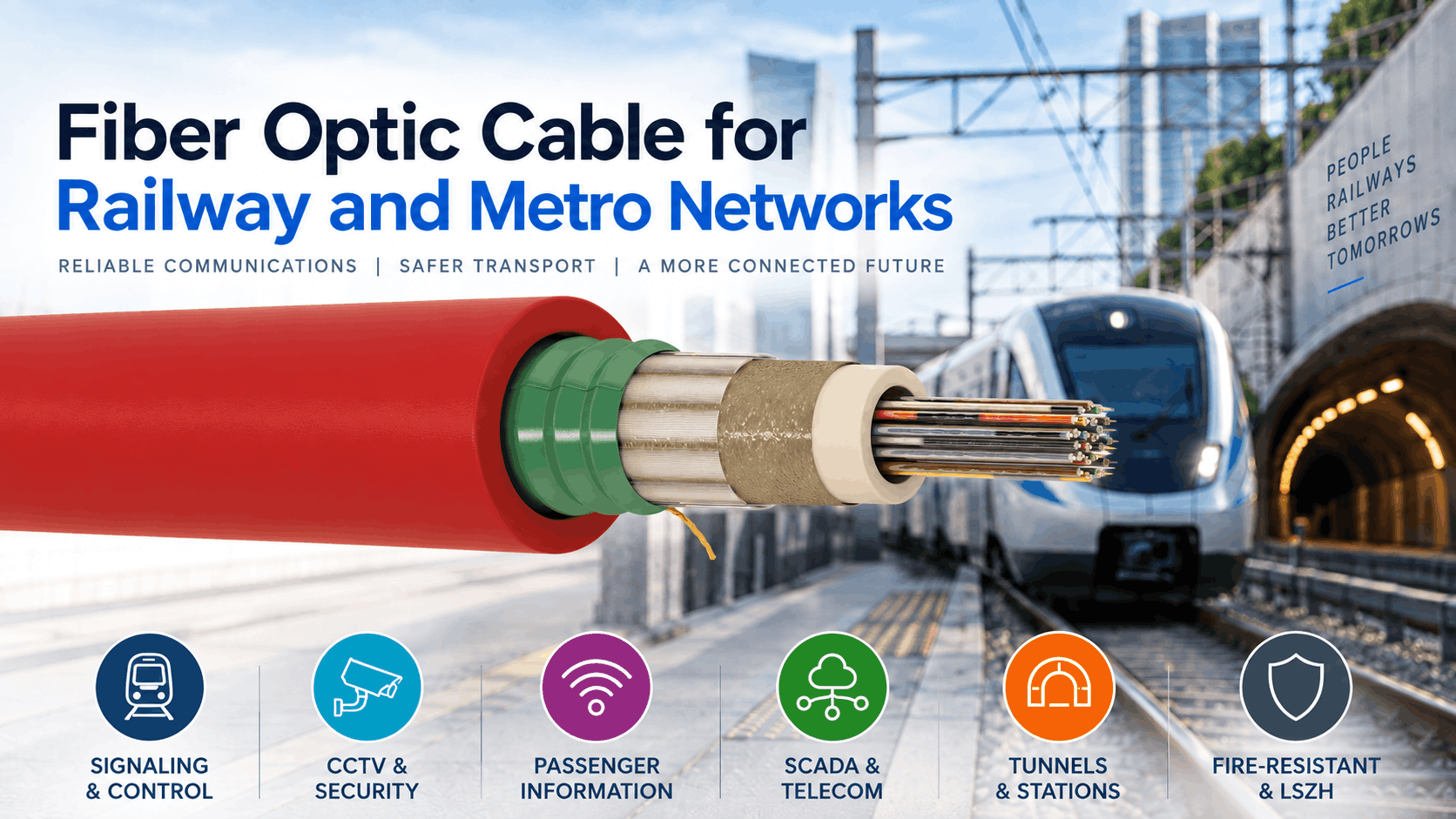
Fiber Optic Cable for Railway and Metro Networks
Reading Time: 17 minutes
A railway fiber optic cable forms part of the communications backbone that connects stations, signaling locations, control centers, CCTV systems, passenger information systems, radio infrastructure, SCADA networks and other digital services across railway and metro networks.
However, railway routes create very different cable environments. A fiber cable installed inside a protected station may need a halogen-free fire-performance construction, while a trackside cable can require UV resistance, water blocking and rodent protection. Meanwhile, tunnel routes can place much greater emphasis on low smoke, flame propagation and continued network operation during fire.
Therefore, there is no single fiber optic cable construction that is ideal for every railway application. Engineers must select the fiber type, fiber count, loose-tube architecture, water blocking, armour, sheath material, fire performance and installation method according to the specific section of the network.
Railway electrification also creates another important consideration. The optical fibers themselves are dielectric and do not carry electrical current. Nevertheless, metallic armour introduces conductive components into the complete cable. Consequently, all-dielectric fiber optic cables can be particularly attractive where electrical isolation is an important project requirement.
Quick answer: Use compact duct or microduct fiber cables for protected railway pathways, suitable armored constructions for mechanically exposed or buried routes, all-dielectric designs where conductive metal is undesirable, and dedicated halogen-free or fire-resistant fiber optic cables in tunnels, stations and other safety-critical areas. For most railway backbone applications, single-mode fiber such as G.652.D or suitable G.657 variants provides the greatest transmission-distance flexibility.
Railway Fiber Optic Cable at a Glance
| Railway Environment | Cable Construction to Consider | Main Requirement |
|---|---|---|
| Trackside duct | Duct fiber optic cable | Water blocking, compact size, pulling/blowing performance |
| Direct burial | Armored direct-burial fiber cable | Crush, impact, moisture and rodent protection |
| Railway tunnel | LSZH / fire-resistant fiber optic cable | Smoke, flame, corrosive gases and network continuity |
| Metro station | Halogen-free indoor or indoor/outdoor cable | Fire safety and structured routing |
| Electrified railway | Non-metallic armored or all-dielectric cable | Electrical isolation |
| High mechanical exposure | CST or SWA armored cable | Impact, crush and rodent protection |
| Aerial railway route | ADSS or suitable aerial cable | Tensile, wind, UV and span requirements |
| High-density backbone | Multi loose-tube cable | High fiber count and organized branching |
| Expandable urban corridor | Microduct fiber optic cable | Future capacity and pathway efficiency |
Consequently, the installation environment should be defined before the cable product code is selected.
Why Railway and Metro Networks Use Fiber Optic Cable
Modern rail infrastructure depends on large volumes of digital information moving between distributed field equipment and centralized systems.
Fiber provides several important advantages for these networks:
- High transmission capacity
- Long transmission distances
- Low optical attenuation
- Immunity of the optical signal to electromagnetic interference
- Electrical isolation through dielectric fiber
- Support for large numbers of network services
- Scalability through spare fibers
- Compatibility with ring and redundant architectures
In addition, railway corridors can extend for tens or hundreds of kilometers. Copper-based data links become increasingly difficult over such distances, whereas single-mode fiber can support long network sections with appropriate optical equipment.
What Systems Use Railway Fiber Optic Cable?
A railway fiber optic cable can carry communications supporting many independent railway systems.
Typical applications include:
- Signaling communication networks
- Centralized traffic-control systems
- SCADA networks
- CCTV
- Passenger information systems
- Public-address network infrastructure
- Station LANs
- Radio-system backhaul
- Emergency communications
- Ticketing and access-control systems
- Operational telephony
- Equipment monitoring
- Maintenance networks
However, the fiber network itself does not define the functional-safety level of the connected railway system.
Therefore, signaling and safety-critical applications must still follow the system integrator’s complete railway safety, redundancy and equipment requirements.
Railway Backbone vs Local Station Fiber Networks
Not every railway fiber route performs the same network function.
A backbone connection can carry traffic between:
- Stations
- Control centers
- Telecommunication rooms
- Wayside cabinets
- Depots
- Maintenance facilities
By contrast, a local station cable may connect nearby equipment within one building or platform area.
Consequently, backbone links usually place greater emphasis on single-mode transmission, spare fiber capacity and network redundancy, whereas shorter station links can prioritize fire performance, compact routing and termination accessibility.
Railway Fiber Optic Cable for Trackside Routes
Trackside environments can expose cable infrastructure to:
- Rain
- Groundwater
- UV radiation
- Temperature cycling
- Rodents
- Mechanical impact
- Construction activity
- Vibration
- Contamination
Therefore, outdoor railway cable should be selected from the complete mechanical and environmental specification rather than simply from fiber count.
Depending on the route, a PE or HDPE sheath, water blocking and mechanical reinforcement can become important.
Duct Fiber Optic Cable for Railway Networks
A protected duct route is one of the most common ways to install fiber along railway infrastructure.
A suitable duct fiber optic cable can use:
- Central loose-tube construction
- Multi loose-tube construction
- Dry or gel-filled water blocking
- Non-metallic strength members
- PE or HDPE outer jacket
Because the external duct already provides substantial physical protection, the optical cable may not require heavy steel armour in every installation.
As a result, compact non-metallic constructions can reduce cable weight and improve pulling or blowing efficiency.
Direct Burial Railway Fiber Cable
Where the cable is placed directly into the ground without a protective duct, mechanical design becomes more important.
A direct-burial fiber optic cable can require:
- Longitudinal water blocking
- Radial moisture protection
- Rodent resistance
- Impact resistance
- Crush resistance
- Durable outer sheath
- Metallic or non-metallic armour
Consequently, direct burial should never be inferred merely because an outdoor fiber cable has a black PE jacket.
Corrugated Steel Tape for Railway Fiber Optic Cable
Corrugated steel tape can provide a compact metallic armour layer around the optical cable core.
It can be particularly useful where the route requires:
- Rodent protection
- Radial mechanical protection
- Impact resistance
- Compact armored construction
Compared with heavier steel-wire designs, CST can often provide strong protection without adding the same level of cable weight and diameter.
Therefore, corrugated steel tape can be attractive for underground railway ducts, troughs and protected trackside routes.
Steel Wire Armored Fiber Cable for Railway Routes
Steel Wire Armour provides a heavier mechanical architecture.
SWA can become useful where the cable faces substantial:
- Tensile loading
- Mechanical handling
- Crushing
- Impact
- Severe exposed installation conditions
However, SWA also increases cable diameter, weight and bending requirements.
Consequently, engineers should not automatically specify SWA simply because the cable is installed beside a railway.
CST vs SWA for Rail Infrastructure
| Characteristic | Corrugated Steel Tape | Steel Wire Armour |
|---|---|---|
| Radial protection | Strong | Strong |
| Rodent resistance | Strong | Strong |
| Tensile reinforcement | Moderate / design-dependent | Higher in suitable constructions |
| Cable weight | Generally lower | Generally higher |
| Outside diameter | Generally more compact | Generally larger |
| Typical railway consideration | Compact mechanical protection | Heavy mechanical or tensile conditions |
Therefore, the correct armour should follow the actual mechanical load rather than a simple preference for the heaviest construction.
Non-Metallic Armored Fiber for Electrified Railways
A non-metallic armored fiber cable can use dielectric materials such as:
- Glass yarn
- Aramid yarn
- FRP strength members
Because these materials do not create a continuous metallic conductor along the cable route, they can provide useful electrical isolation.
This can be particularly relevant near:
- Traction-power systems
- Electrified railway infrastructure
- Substations
- High-voltage equipment
- Areas with strict dielectric requirements
Nevertheless, non-metallic construction must still provide sufficient tensile, crush and rodent performance for the route.
Does Fiber Optic Cable Suffer from EMI?
The optical signal inside a glass fiber is not affected by electromagnetic interference in the way an electrical copper signal can be.
This provides an important advantage around traction-power equipment, motors, transformers and other electrically noisy railway systems.
However, a fiber cable can still contain metallic components such as:
- Steel tape
- Steel wire armour
- Metallic messenger wire
- Copper conductors in hybrid cables
Therefore, “fiber optic” does not automatically mean that the complete cable is all-dielectric.
Railway Fiber Optic Cable for Tunnels
Tunnels create one of the most demanding cable environments in a railway or metro system.
Besides optical transmission, project specifications can emphasize:
- Low smoke emission
- Halogen-free materials
- Low corrosive-gas emission
- Limited flame propagation
- Reaction-to-fire classification
- Continued operation during fire where required
Consequently, a conventional PE outdoor cable should not automatically be extended through railway tunnels without reviewing the applicable fire requirements.
LSZH Fiber Cable for Metro Networks
Low Smoke Zero Halogen cable materials can be important in enclosed railway areas such as:
- Metro tunnels
- Stations
- Underground technical rooms
- Escape routes
- Equipment rooms
- Control centers
In a fire, suitable halogen-free constructions are designed to reduce corrosive halogen-containing combustion products.
Meanwhile, low-smoke performance can help preserve visibility according to the applicable test requirements.
Therefore, LSZH material selection can become part of the overall life-safety strategy.
Flame-Retardant vs Fire-Resistant Railway Fiber Cable
These terms should not be used interchangeably.
A flame-retardant cable is designed to limit flame propagation under specified test conditions.
By contrast, a fire-resistant fiber optic cable is designed to maintain optical circuit integrity for a defined period during a fire test.
Consequently, a cable can provide excellent flame-retardant and low-smoke performance without necessarily maintaining data transmission during prolonged fire exposure.
When Is Fire-Resistant Fiber Optic Cable Required?
Some railway and metro communication systems may need to continue operating during an emergency.
Depending on the project’s fire strategy, this can include selected:
- Emergency communication networks
- CCTV backbones
- Operational communication systems
- Emergency control networks
- Life-safety communications
However, circuit-integrity requirements should come from the project’s fire engineering and railway-system specification.
Therefore, FE180 or PH-rated fiber cable should not be applied indiscriminately to every railway optical link.
FE180 Fiber Optic Cable for Rail Tunnels
FE180 describes a circuit-integrity performance under the applicable fire test for a defined duration.
A dedicated fiber construction can combine:
- Halogen-free PBT tube
- Dry water blocking
- Glass-yarn strength members
- Mica fire barrier
- Mechanical armour
- Halogen-free outer sheath
As a result, the cable can integrate optical, mechanical and fire-performance requirements within one construction.
PH120 and Mechanical Shock During Fire
Some fire-performance systems also evaluate continued operation when mechanical shock is applied during fire exposure.
This represents a different requirement from simple flame propagation.
Therefore, buyers should distinguish between:
- Reaction to fire
- Flame propagation
- Fire resistance
- Circuit integrity with mechanical shock
Each requirement should appear separately in the technical specification.
CPR B2ca Fiber Optic Cable for Railway Infrastructure
European fixed-installation projects can also require CPR reaction-to-fire classification under EN 50575.
B2ca is a high-performance CPR class that limits characteristics such as heat release and flame propagation under the relevant classification system.
Additional classifications can address:
- Smoke
- Flaming droplets
- Acidity
However, CPR classification and circuit integrity remain separate concepts.
Consequently, a B2ca cable is not automatically an FE180 fire-resistant cable, and an FE180 construction does not automatically have a particular CPR class unless tested and declared accordingly.
EN 45545: An Important Distinction
Railway specifications sometimes refer broadly to EN 45545 when discussing cable fire performance.
However, EN 45545 primarily addresses fire protection for railway vehicles and rolling stock.
Fixed infrastructure such as stations, tunnels and trackside buildings can fall under different construction and project requirements.
Therefore, engineers should not automatically apply a rolling-stock cable requirement to fixed railway fiber infrastructure without checking the actual scope of the project specification.
Single-Mode Railway Fiber Optic Cable
Most long railway and metro backbone routes strongly favor single-mode fiber.
Common options include:
- G.652.D
- G.657.A1
- G.657.A2
G.652.D provides a widely established option for long-distance telecommunications infrastructure.
Meanwhile, G.657 variants can provide improved macrobending performance where fibers pass through compact cabinets, closures and indoor station pathways.
Therefore, fiber specification should follow both transmission distance and physical route requirements.
G.652.D vs G.657 for Railway Networks
G.652.D is commonly associated with long-haul and outdoor telecom backbone infrastructure.
G.657.A1 and G.657.A2 are bend-insensitive single-mode fibers.
As a result, G.657 can provide useful additional margin around:
- Station cabinets
- Fiber distribution frames
- Tight closures
- Equipment rooms
- Urban metro infrastructure
However, compatibility with the complete network and customer specification should govern the final choice.
Can Multimode Fiber Be Used in Railway Networks?
Yes, for suitable short-distance applications.
OM3, OM4 or other multimode fibers can support local network links inside:
- Stations
- Control rooms
- Depots
- Equipment buildings
Nevertheless, long railway corridors generally favor single-mode fiber because of its significantly greater distance capability.
Consequently, a project can use multimode locally while maintaining a single-mode railway backbone.
Railway Fiber Optic Cable and Fiber Count
A railway fiber optic cable can contain anything from a small number of fibers to several hundred optical fibers.
Typical counts can include:
- 12 fibers
- 24 fibers
- 48 fibers
- 96 fibers
- 144 fibers
- 288 fibers
However, fiber count should reflect network architecture rather than simply choosing the largest cable available.
Engineers should consider active circuits, redundancy, spare capacity, future expansion and branching locations.
12 and 24 Fiber Railway Cable
Lower counts can work well for:
- Local station connections
- Wayside cabinets
- CCTV branches
- Small signaling locations
- Depot connections
For example, a 24-fiber cable can provide multiple active links while preserving spare fibers for future equipment.
Therefore, smaller routes do not automatically require high-count backbone cables.
48 and 96 Fiber Railway Backbone
Medium counts can provide useful capacity where several station or trackside networks converge.
Potential applications include:
- Metro distribution
- Regional railway backbones
- Station aggregation
- Operational telecom networks
- Large depot networks
As a result, 48 or 96 fibers can provide a practical balance between current utilization and future growth.
144 and 288 Fiber Rail Networks
High-count fiber becomes more attractive where a common railway corridor carries several network services over long distances.
A 144- or 288-fiber backbone can reserve separate fibers for:
- Railway operations
- Telecommunications
- Security
- Commercial services
- Future systems
- Dark-fiber capacity
However, one very high-count cable also concentrates many services into one physical asset.
Therefore, route diversity should remain part of network resilience planning.
Fiber Count Does Not Equal Bandwidth
A 144-fiber cable is not automatically faster than a 24-fiber cable.
Network bandwidth also depends on:
- Optical transceivers
- Ethernet technology
- Wavelengths
- CWDM or DWDM
- Network topology
Consequently, fiber count primarily determines the number of available physical optical paths and future capacity.
Central Loose Tube for Railway Fiber Cable
A central loose-tube design places the optical fibers inside one primary tube.
This construction can provide:
- Compact diameter
- Simple cable architecture
- Efficient low-to-medium fiber counts
- Strong outdoor environmental protection
Therefore, central loose tube can work well for local railway distribution and smaller backbone routes.
Multi Loose Tube for Railway Backbones
A multi loose-tube cable divides the optical fibers into several PBT tubes stranded around a central strength member.
This provides convenient organization for higher fiber counts.
Additionally, individual tubes can be allocated to different:
- Stations
- Network services
- Track sections
- Future branches
Consequently, multi loose-tube construction becomes increasingly attractive for 96-, 144-, 288-fiber and other high-capacity railway backbones.
Dry Core vs Gel-Filled Railway Fiber Cable
Outdoor railway fiber cables need protection against longitudinal water migration.
Water blocking can use:
- Thixotropic gel
- Water-swellable yarn
- Water-swellable tape
- Dry tube technology
- Hybrid dry/gel systems
A dry-core cable can make field access cleaner, while gel-filled loose tubes provide an established water-protection architecture.
However, dry core does not necessarily mean completely gel-free.
Therefore, the cable construction table should identify exactly where each water-blocking element is used.
Water Blocking Along Railway Routes
Trackside ducts and underground chambers can experience persistent moisture.
As a result, longitudinal water penetration can create long-term cable reliability risks.
A strong railway specification should therefore define the required water-penetration performance rather than merely requesting a “waterproof” cable.
Actual finished-cable testing provides a more meaningful requirement than generic marketing terminology.
Microduct Fiber Optic Cable for Railway Networks
A microduct fiber optic cable can provide an efficient expansion strategy along protected railway corridors.
Instead of filling the complete pathway during initial construction, operators can install multiple microducts and populate additional pathways later.
This can support:
- Future stations
- Additional CCTV
- 5G infrastructure
- Operational networks
- Commercial telecom services
- Future signaling-system upgrades
Consequently, microduct infrastructure can extend the useful life of expensive railway civil works.
Railway Fiber Optic Cable for Metro Stations
Metro stations create a different environment from open railway routes.
Cables can pass through:
- Public areas
- Technical rooms
- Equipment shafts
- Platform areas
- Cable trays
- Tunnels
Therefore, fire performance, smoke, halogen content and routing can become more important than heavy mechanical armour.
A suitable indoor or indoor/outdoor halogen-free cable can provide an efficient station-network solution.
Railway Fiber Cable for Bridges and Viaducts
Bridges and viaducts can expose fiber cable to:
- UV radiation
- Wind
- Temperature variation
- Vibration
- Structural movement
- Mechanical impact
Consequently, the installation method and mechanical design should account for both environmental exposure and movement of the supporting structure.
Suitable tray, duct or aerial constructions can be considered according to the route.
ADSS Fiber Optic Cable Along Railway Routes
ADSS cable can provide an all-dielectric aerial solution where a railway project requires self-supporting optical connectivity.
The design uses dielectric strength members instead of a metallic messenger wire.
Therefore, ADSS can provide:
- Electrical isolation
- Self-supporting aerial installation
- Outdoor UV resistance
- Longitudinal optical connectivity
However, span length, sag, wind, ice and maximum operating tension must be engineered for the specific aerial route.
Hybrid Fiber Cable for Rail Infrastructure
Some railway applications can require optical fibers and copper conductors inside one composite cable.
A hybrid design can carry:
- Optical communications
- Low-voltage power
- Control circuits
- Auxiliary electrical connections
Such designs can reduce the number of separate cables along certain routes.
However, once metallic conductors are added, the complete cable is no longer all-dielectric.
Consequently, electrical, voltage and grounding requirements must be reviewed separately.
Network Redundancy in Railway Fiber Systems
Railway networks often require high availability.
Adding spare fibers helps, but spare fibers inside the same cable do not protect against complete cable failure.
True physical resilience can require:
- Two separate cables
- Separate ducts
- Opposite sides of the railway
- Geographically diverse routes
- Ring topology
Therefore, fiber-count redundancy and route redundancy should not be confused.
Ring Topology for Metro Fiber Networks
Ring architectures are commonly attractive in distributed infrastructure because network nodes can potentially communicate in more than one direction.
If one fiber route is interrupted, the network architecture may allow traffic to use the alternate direction, depending on the active equipment and protocol design.
Consequently, the physical cable layout should support the intended network-resilience architecture.
Mid-Span Access Along Railway Backbones
Long railway cables often pass multiple stations or cabinets before reaching the final destination.
Mid-span access allows technicians to open the cable and access selected fibers or loose tubes without cutting every fiber.
This can be particularly useful in:
- Metro networks
- Station chains
- Long rail corridors
- Multi loose-tube backbones
As a result, cable construction and tube organization can influence future maintenance efficiency.
Rodent Protection for Railway Fiber Cable
Rodents can damage trackside cable installations, particularly in outdoor, underground and semi-protected environments.
Possible protection methods include:
- Corrugated steel tape
- Steel Wire Armour
- Glass yarn
- Other project-specific non-metallic protection
However, each approach provides a different balance of weight, diameter and protection.
Therefore, rodent exposure should be specified separately from water blocking and tensile requirements.
Temperature Requirements
Railway fiber cable can experience substantial temperature variation.
For example, one route may pass through an air-conditioned station, an outdoor trackside duct and an exposed bridge.
Consequently, engineers should check:
- Transport temperature
- Storage temperature
- Installation temperature
- Operating temperature
Furthermore, temperature cycling should not produce unacceptable optical attenuation or fiber strain.
Mechanical Testing Under IEC 60794
The IEC 60794 family provides widely used construction, mechanical and environmental test frameworks for optical fiber cables.
Depending on cable design, tests can include:
- Tensile performance
- Crush resistance
- Impact
- Bending
- Torsion
- Temperature cycling
- Water penetration
IEC 60794-3 specifically addresses outdoor optical cables, including duct, direct-burial and aerial applications.
Therefore, railway cable specifications can use the appropriate IEC 60794 requirements together with project-specific railway conditions.
Installation Tension
Long railway routes can require substantial pulling or blowing distances.
As a result, maximum installation tension becomes important.
Excessive tensile load can produce:
- Fiber strain
- Tube deformation
- Permanent optical loss
- Cable damage
Therefore, installers should follow the manufacturer’s maximum installation tension and approved pulling or blowing procedure.
Bending Radius in Stations and Tunnels
Trackside routes can be relatively straight, but station and tunnel environments often require repeated direction changes.
Excessive bending can increase optical attenuation and mechanically stress the cable.
Consequently, cable trays, cabinets and closures should preserve the specified minimum bending radius.
Common Mistakes When Selecting Railway Fiber Optic Cable
1. Specifying Only “Railway Fiber Cable”
The phrase does not define fibre count, armour, fire performance or installation method.
2. Using the Same Cable Throughout the Entire Railway
Tunnels, stations, duct routes and direct-burial sections can require different constructions.
3. Assuming Every Railway Cable Needs SWA
Protected ducts or electrical-isolation requirements can favor lighter or non-metallic designs.
4. Assuming All Fiber Cable Is All-Dielectric
Metallic armour or hybrid copper conductors can introduce conductive elements.
5. Ignoring Fire Requirements in Tunnels
Conventional outdoor PE cable may not meet the applicable tunnel fire specification.
6. Assuming LSZH Means Fire Resistant
Halogen-free material performance and circuit integrity are separate characteristics.
7. Assuming B2ca Means FE180
CPR reaction to fire and fire-resistant circuit integrity are different requirements.
8. Assuming FE180 Means B2ca
Fire resistance does not automatically establish a CPR Euroclass.
9. Applying Rolling-Stock Standards Automatically to Fixed Infrastructure
The scope of each railway standard should be verified before it is specified.
10. Ignoring Rodent Risk
Trackside and underground cable can require dedicated mechanical protection.
11. Ignoring Water Penetration
Railway ducts and chambers can experience long-term moisture exposure.
12. Choosing Fiber Count Only for Today’s Network
Rail systems can operate for decades and accumulate new digital services over time.
13. Assuming More Fibers Create Redundancy
Many spare fibers inside one cable still share one physical failure point.
14. Ignoring Mid-Span Access
Long railway routes can require repeated branching at stations and field locations.
15. Using Multimode for a Long Backbone Without Checking Reach
Single-mode is generally better suited to long railway corridors.
16. Ignoring Cable Diameter
Duct, trough and tray capacity can limit the available cable space.
17. Ignoring Bending Radius
Stations and technical rooms can create tight pathways.
18. Selecting Armour Without Considering Electrification
All-dielectric construction can be preferable where conductive metal is undesirable.
How to Select a Railway Fiber Optic Cable
A structured selection process can prevent both over-specification and under-specification.
1. Define the Network Function
Determine whether the cable supports backbone, station, signaling communications, CCTV, SCADA or another system.
2. Define the Installation Environment
Identify duct, direct burial, tunnel, station, aerial, bridge or other route conditions.
3. Select the Fiber Type
Choose G.652.D, G.657 or suitable multimode fiber according to transmission requirements.
4. Determine Fiber Count
Include active services, spare fibers, future expansion and redundancy.
5. Select Central or Multi Loose Tube
Use the cable architecture that best supports the required count and branching strategy.
6. Define Water Blocking
Select dry, gel-filled or hybrid technology according to outdoor requirements.
7. Determine Mechanical Protection
Choose non-metallic reinforcement, corrugated steel tape or SWA according to route risk.
8. Define Fire Performance
Specify LSZH, flame propagation, CPR and fire resistance independently where required.
9. Review Electrical Isolation
Consider whether an all-dielectric construction provides advantages near electrified infrastructure.
10. Confirm Mechanical Tests
Review tensile, crush, impact, bend and temperature requirements.
11. Plan Network Redundancy
Decide whether separate physical routes are required.
12. Verify Installation Method
Confirm pulling, blowing, aerial or direct-burial requirements before production.
What Should Buyers Include in a Railway Fiber Cable RFQ?
An RFQ requesting only “fiber optic cable for metro project” leaves too many engineering variables undefined.
A professional specification should include:
- Fiber count
- Fiber type
- G.652.D / G.657.A1 / G.657.A2 where applicable
- Multimode type where applicable
- Central loose tube or multi loose tube
- Fibers per tube
- Water-blocking system
- Duct / direct burial / tunnel / station / aerial application
- All-dielectric requirement where applicable
- Non-metallic armour requirement
- Corrugated steel tape requirement
- Steel Wire Armour requirement
- Rodent protection requirement
- Outer sheath material
- PE / HDPE / LSZH requirement
- UV resistance
- Halogen-free requirement
- Smoke-density requirement
- Flame-propagation requirement
- CPR classification where applicable
- Fire-resistance requirement where applicable
- FE180 requirement where applicable
- PH requirement where applicable
- Water-penetration requirement
- Maximum installation tension
- Maximum operating tension
- Crush resistance
- Impact resistance
- Minimum bending radius
- Installation temperature
- Operating temperature
- Maximum outside diameter where relevant
- Maximum cable weight where relevant
- IEC 60794 requirements
- Route redundancy requirement
- Fiber identification
- Tube identification
- Cable marking
- Drum length
- Optical test reports
- Mechanical test reports
- Fire-test documentation where applicable
As a result, the manufacturer can propose the actual railway cable construction rather than interpreting a broad project description.
ETK Kablo Railway and Metro Fiber Optic Cable Solutions
ETK Kablo manufactures railway fiber optic cable solutions for railways, metro systems, tunnels, stations, transportation infrastructure and other critical communication networks.
The portfolio allows railway projects to select the fiber architecture independently from the installation environment.
For protected outdoor pathways, ETK manufactures duct-type central and multi loose-tube fiber cables with suitable water blocking and PE or HDPE jackets.
Meanwhile, metallic armored constructions can use corrugated steel tape or steel-wire protection where the route requires greater mechanical and rodent resistance.
For projects where conductive metallic components are undesirable, ETK also manufactures non-metallic armored and all-dielectric fiber optic constructions using glass yarn, aramid and FRP elements.
In addition, ETK’s special fiber optic cable portfolio is developed for demanding infrastructure environments including railway applications.
For tunnels, stations and other safety-critical infrastructure, ETK manufactures dedicated fire-resistant fiber optic cables with halogen-free materials and mechanical protection.
One published ETK construction, U-D(ZN)(SR)H FE180, combines a halogen-free PBT tube, dry water-blocking yarn, water-swellable glass yarn, two layers of mica fire barrier, corrugated steel tape and a UV-resistant halogen-free outer sheath.
The same published cable is tested for FE180 circuit integrity and PH120 circuit integrity with shock, while also providing smoke-density, halogen-free, corrosive-gas and flame-retardancy performance.
ETK also offers B2ca-classified fire-resistant fiber constructions for projects requiring high CPR reaction-to-fire performance.
Single-mode options include G.652.D and G.657.A1/A2, while suitable products can also use multimode fibers according to project requirements.
Therefore, ETK can engineer railway fiber solutions around the route itself: duct, direct burial, tunnel, station, aerial, non-metallic, armored or fire-resistant.
Frequently Asked Questions
What fiber optic cable is used in railway networks?
Railway networks can use duct, direct-burial, armored, non-metallic, aerial and fire-resistant fiber cables depending on the installation environment.
What is railway fiber optic cable used for?
It can provide communications infrastructure for signaling networks, CCTV, SCADA, passenger information, station LANs, radio systems and other railway services.
Is single-mode fiber best for railway networks?
Single-mode fiber is generally preferred for long railway backbone routes because of its low attenuation and long transmission capability.
Can G.652.D be used for railway cable?
Yes. G.652.D is widely suitable for long-distance single-mode telecom and infrastructure networks when the complete cable construction meets the railway project requirements.
Can G.657.A2 be used in metro networks?
Yes. Bend-insensitive G.657 fiber can provide advantages in compact station, closure and equipment-room environments when compatible with the project specification.
Can multimode fiber be used in a railway?
Yes, particularly for short local links. Long railway backbones generally favor single-mode fiber.
Does railway fiber cable need armour?
Not always. Protected ducts can use non-armored or non-metallic constructions, while exposed or buried routes can require greater mechanical protection.
Which is better for railways, CST or SWA?
CST provides compact radial and rodent protection, while SWA can provide heavier mechanical and tensile reinforcement. The route conditions should determine the choice.
Can non-metallic fiber cable be used beside electrified railways?
Yes. All-dielectric constructions can provide valuable electrical isolation where conductive metallic cable components are undesirable.
Does fiber optic cable suffer from electromagnetic interference?
The optical transmission inside the glass fiber is immune to electromagnetic interference. However, the complete cable can still contain metallic armour or conductors.
What cable is used in railway tunnels?
Tunnel specifications often favor halogen-free, low-smoke and flame-retardant fiber constructions, while critical systems can additionally require fire-resistant circuit integrity.
Does LSZH mean fire resistant?
No. LSZH concerns smoke and halogen-related material characteristics. Fire resistance concerns continued circuit operation during defined fire exposure.
What is FE180 fiber optic cable?
FE180 refers to a cable designed and tested to maintain circuit integrity for the defined fire-test duration under the applicable standard.
What is PH120?
PH120 identifies circuit-integrity performance under fire with mechanical shock for the applicable test duration and test method.
Is B2ca the same as FE180?
No. B2ca is a CPR reaction-to-fire classification, whereas FE180 addresses circuit integrity during fire.
Is EN 45545 required for railway fiber cable?
EN 45545 primarily applies to fire protection on railway vehicles. Fixed trackside, station and tunnel infrastructure should follow the standards and fire requirements applicable to that installation.
Can microduct cable be used along railways?
Yes. Microduct systems can provide an expandable protected pathway where future fiber capacity is expected to grow.
Can railway fiber cable be directly buried?
Yes, when the complete construction provides the required water, crush, impact, rodent and environmental protection for direct burial.
Can ADSS cable be used in railway projects?
Yes, for suitable aerial routes. Span length, wind, tension, sag and environmental requirements must be engineered for the specific installation.
How many fibers does a railway cable need?
The count depends on active network services, spare capacity, branching, redundancy and expected future expansion. Common projects can use 12, 24, 48, 96, 144, 288 or other fiber counts.
Should railway fiber networks use redundant routes?
Critical systems can benefit from geographically diverse routes because spare fibers within one cable do not protect against complete physical cable failure.
Which railway fiber optic cable should I specify?
Define the network function and route first. Then select fiber count, fiber type, loose-tube construction, water blocking, armour, sheath, fire performance and mechanical requirements.
Conclusion
Selecting a railway fiber optic cable begins with understanding that rail and metro infrastructure contains several fundamentally different cable environments.
A protected trackside duct can use a relatively compact outdoor fiber cable, while direct burial can require substantial mechanical and rodent protection.
Meanwhile, electrified railway routes can benefit from all-dielectric and non-metallic constructions where conductive metal is undesirable.
Tunnels and metro stations create another set of requirements. In these areas, halogen-free materials, low smoke, flame propagation and CPR reaction-to-fire performance can become critical.
Where emergency communication must remain operational during fire, dedicated fire-resistant fiber optic cables can add circuit-integrity performance beyond ordinary flame retardancy.
Fiber type should also match network topology. G.652.D remains a strong single-mode choice for long railway backbones, while G.657.A1 and G.657.A2 can provide additional bending flexibility in compact network locations.
Fiber count should reflect the expected service life of the railway network. Small local routes can use 12 or 24 fibers, while regional and metropolitan backbones can justify 48, 96, 144, 288 or higher fiber counts.
However, additional fibers are not a substitute for physical redundancy. Critical railway networks can require separate cables, ducts or geographically diverse routes.
Likewise, the heaviest armour is not automatically the best construction. Corrugated steel tape, SWA and non-metallic reinforcement solve different mechanical and electrical requirements.
Therefore, engineers should define the installation environment first, fiber architecture second, mechanical protection third, fire requirements fourth and network-resilience strategy fifth.
The best railway fiber cable is not one universal product. It is the construction that provides reliable optical transmission, appropriate mechanical and environmental protection, required fire performance and enough spare capacity for the railway or metro network to evolve over decades of service.
Benzer yazılar
Railway Cables for Reliable Signalling and Communication Networks
Modern railway infrastructure depends on far more than tracks, rolling stock and electrical power. Behind every safe and efficient rail...


