





 President’s Message
Blog
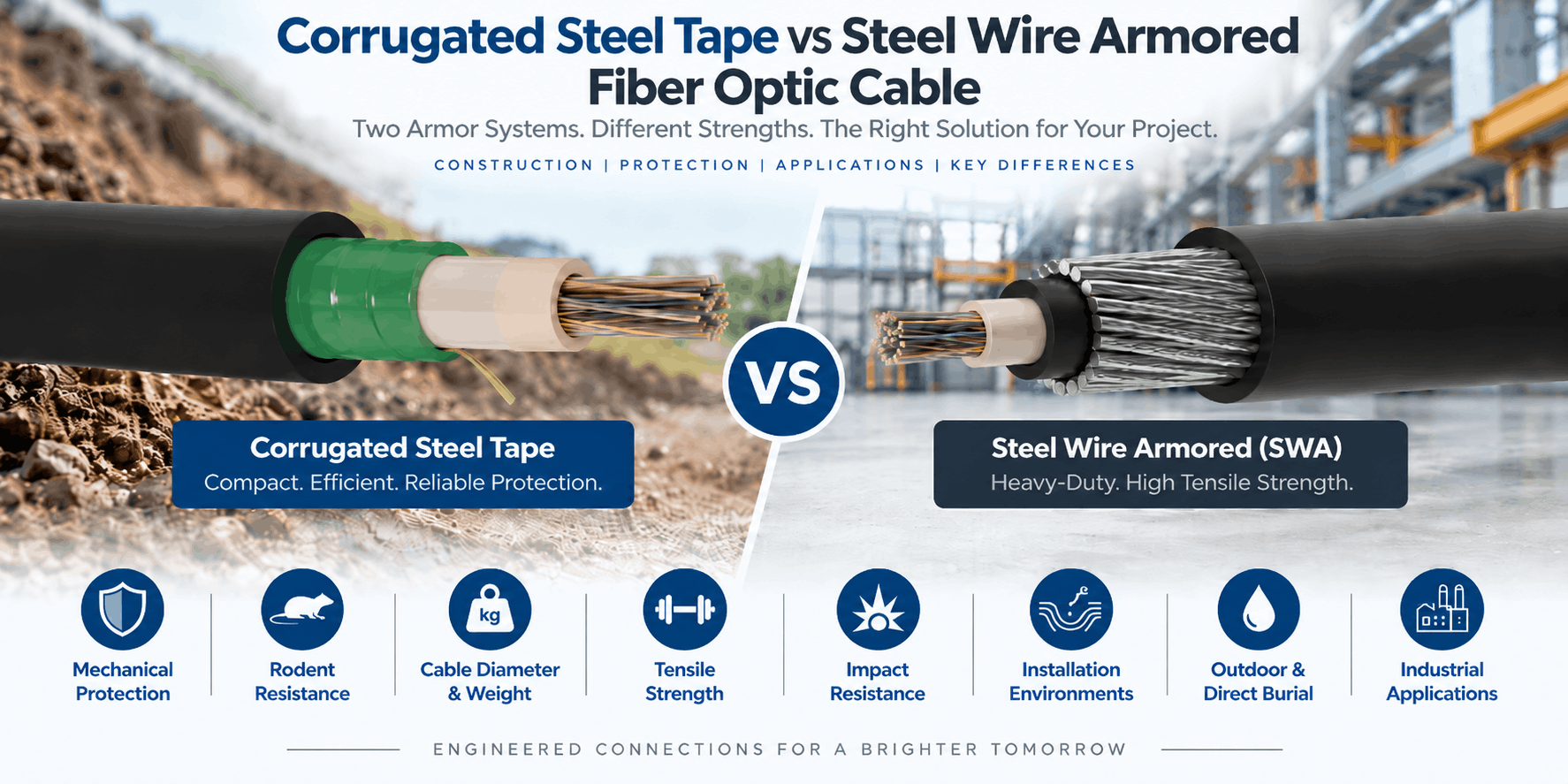
Corrugated Steel Tape vs Steel Wire Armored Fiber Optic Cable
Reading Time: 14 minutes
Choosing between corrugated steel tape vs SWA fiber optic cable requires more than asking which armor is stronger. Both constructions add metallic mechanical protection around the optical cable core, but they do so in different ways.
Corrugated steel tape, often abbreviated as CST, forms a continuous metallic barrier around the cable core. This construction can provide effective crush, impact and rodent protection while keeping the cable relatively compact. By contrast, Steel Wire Armour uses galvanized steel wires around the cable, creating a heavier and often more tensile-oriented mechanical structure.
Therefore, neither armor type is universally better. Corrugated steel tape can be particularly attractive where compact dimensions, rodent resistance and radial protection matter. Meanwhile, SWA can become more suitable where the route involves severe mechanical exposure, demanding pulling conditions or higher tensile loads.
Quick answer: Choose corrugated steel tape when the project needs strong mechanical and rodent protection in a relatively compact armored fiber cable. Choose SWA when the route requires heavier mechanical reinforcement and potentially greater tensile capability. However, direct-burial suitability, water blocking, sheath material, fiber count, bending radius and actual IEC 60794 mechanical test values should always be specified separately.
Corrugated Steel Tape and SWA at a Glance
| Characteristic | Corrugated Steel Tape | Steel Wire Armour |
|---|---|---|
| Armor structure | Continuous corrugated steel tape around cable core | Galvanized steel wires around cable construction |
| Common abbreviation | CST | SWA |
| Primary strength | Compact radial mechanical protection | Heavy mechanical and tensile reinforcement |
| Crush protection | Strong | Strong, depending on construction |
| Impact protection | Strong | Strong |
| Rodent resistance | Very good physical barrier | Very good physical barrier |
| Tensile reinforcement | Limited compared with dedicated wire armor | Generally stronger potential |
| Cable diameter | Generally more compact | Generally larger |
| Weight | Generally lower | Generally higher |
| Flexibility | Often better | Often lower |
| Typical use | Duct, outdoor, underground and direct-burial routes | Heavy-duty underground and industrial routes |
These are general construction tendencies rather than guaranteed performance levels. Therefore, the final selection should use the mechanical data of the specific cable.
What Is Corrugated Steel Tape Fiber Optic Cable?
A corrugated steel tape fiber optic cable includes a metallic steel-tape layer around the optical cable core.
The steel tape has a corrugated profile rather than remaining completely flat. As a result, it can follow the cable geometry while creating a strong physical barrier around the fibers.
A typical construction can include:
- Single-mode or multimode optical fibers
- Central loose tube or multiple loose tubes
- Gel or dry water blocking
- FRP or other strength members
- Glass yarn where required
- Corrugated steel tape
- PE, HDPE or project-specific outer sheath
Consequently, the steel tape becomes one layer within a complete outdoor fiber optic cable rather than defining the entire product.
What Is SWA Fiber Optic Cable?
SWA fiber optic cable uses galvanized steel wires as the mechanical armor around the internal fiber cable construction.
A typical SWA design can include:
- Optical fibers
- Loose tubes
- Central strength member
- Water-blocking materials
- Inner sheath or bedding
- Galvanized steel wire armour
- PE, HDPE or LSZH outer sheath
The steel wires form a robust mechanical layer around the cable. Therefore, SWA can be particularly useful where the installation places substantial physical loads on the cable.
Corrugated Steel Tape vs SWA: What Is the Main Difference?
The primary difference is the geometry of the metallic armor.
CST uses a continuous steel-tape barrier.
SWA uses multiple galvanized steel wires.
This difference affects cable weight, diameter, flexibility, tensile performance and how the cable responds to external mechanical loads.
In practice, corrugated steel tape tends to provide an efficient protective shell around the cable core. Meanwhile, SWA creates a heavier structural armor system that can contribute more substantially to longitudinal mechanical strength.
How Corrugated Steel Tape Protects Fiber Optic Cable
The tape surrounds the cable core and creates a hard metallic barrier between the optical elements and the outside environment.
This can help protect the cable against:
- Crushing
- Localized impact
- Rodent attack
- Soil movement
- Construction-related damage
- External pressure
Moreover, corrugation helps the metallic layer conform to the cable structure without behaving like a completely rigid tube.
Therefore, CST can provide substantial protection while maintaining relatively manageable dimensions.
How Steel Wire Armour Protects Fiber Optic Cable
SWA surrounds the cable with a layer of steel wires.
These wires can absorb and distribute mechanical loads around the cable structure.
Consequently, SWA can help protect against:
- High tensile stress
- Impact
- Crushing
- Rodents
- Pulling forces
- Industrial handling damage
However, the additional steel also increases cable mass and stiffness.
Therefore, SWA should solve a defined mechanical requirement rather than serve as an automatic upgrade from CST.
Corrugated Steel Tape vs SWA for Crush Resistance
Importantly, both armor systems can provide strong crush resistance.
Corrugated steel tape creates a continuous barrier around the cable core, which makes it particularly effective against localized radial pressure.
SWA also provides substantial mechanical protection, although its performance depends on wire diameter, armor geometry, bedding and overall cable architecture.
Therefore, engineers should compare actual crush-test values rather than assuming one armor material always performs better.
For optical cables, crush testing is commonly evaluated using the applicable IEC 60794 mechanical test framework.
Corrugated Steel Tape vs SWA for Impact Protection
Similarly, both can perform well against impact.
CST distributes impact through its continuous steel layer.
Meanwhile, SWA uses multiple steel wires to absorb mechanical force around the cable circumference.
However, impact resistance also depends on:
- Outer sheath thickness
- Inner sheath
- Cable diameter
- Armor thickness
- Loose-tube configuration
- Strength-member arrangement
Consequently, the cable datasheet and impact-test result provide a better comparison than the armor acronym alone.
Corrugated Steel Tape vs SWA for Tensile Strength
This is where the two armor systems can differ more significantly.
Corrugated steel tape primarily creates a protective barrier around the cable core. Although it contributes mechanical strength, it is not normally the main longitudinal tensile member.
By contrast, steel wires can contribute substantially to longitudinal mechanical reinforcement.
Therefore, SWA can become particularly attractive for:
- Long pulling sections
- High installation tension
- Steep routes
- Heavy industrial installation
- Mechanically demanding underground sections
Nevertheless, aramid yarn, glass yarn, FRP and other internal strength members also influence tensile performance.
For this reason, actual maximum installation and operating tension should determine the choice.
Corrugated Steel Tape vs SWA for Rodent Resistance
In addition, rodents represent a serious threat to outdoor fiber optic networks because damage to the outer jacket can eventually expose or break optical fibers.
Both CST and SWA provide strong physical barriers.
Corrugated steel tape creates a continuous metallic layer that is difficult for rodents to penetrate.
Meanwhile, steel wire armour creates a dense metallic structure around the cable.
Therefore, either can provide a substantial improvement over an ordinary unarmored cable in severe rodent environments.
The final choice should also consider route conditions, cable diameter and mechanical requirements beyond rodent resistance alone.
Corrugated Steel Tape vs SWA: Cable Diameter
Corrugated steel tape generally has an advantage in compact construction.
The tape can form a relatively thin armor layer directly around the cable core or underlying protective structure.
SWA normally requires:
- A suitable inner structure
- Bedding or inner sheath in many designs
- Steel-wire layer
- Outer sheath
As a result, SWA can create a larger overall diameter.
Therefore, CST can be particularly attractive where duct capacity is limited.
Why Outside Diameter Matters
Cable diameter affects much more than material cost.
It can influence:
- Duct filling ratio
- Cable pulling
- Minimum bending radius
- Gland dimensions
- Drum capacity
- Storage
- Transport
Consequently, unnecessary armor can create installation problems even when it improves mechanical strength.
Corrugated Steel Tape vs SWA: Weight Comparison
CST is generally lighter than a comparable heavy SWA construction.
Steel wire armour contains significantly more steel when a full wire layer surrounds the cable.
Higher weight can affect:
- Drum weight
- Transport cost
- Manual handling
- Pulling force
- Cable-tray loading
Therefore, where CST already satisfies the required mechanical tests, adding SWA may create unnecessary installation burden.
Corrugated Steel Tape vs SWA and Flexibility
CST can generally maintain a more compact and flexible construction than heavy steel-wire armor.
However, flexibility depends on the complete cable design.
Important variables include:
- Outside diameter
- Number of jackets
- Loose-tube architecture
- Wire size
- Tape thickness
- Strength members
- Outer-sheath material
Therefore, minimum bending radius should always be taken from the actual cable datasheet.
Does SWA Always Have a Larger Bending Radius?
Not as an absolute rule.
However, heavier armor and larger cable diameter often increase the physical space required for bending.
For this reason, SWA can become more difficult to route through:
- Tight chambers
- Narrow ducts
- Compact equipment areas
- Sharp route transitions
Consequently, route geometry should influence armor selection before procurement.
Corrugated Steel Tape vs SWA for Direct Burial
Both armor systems can be used in direct-burial fiber optic cable constructions when the complete cable is designed for that environment.
CST can be particularly effective where the main risks involve:
- Soil pressure
- Rodents
- Crushing
- Localized impact
- Normal underground mechanical exposure
Meanwhile, SWA can be attractive where the same route also includes unusually demanding tensile or mechanical conditions.
However, armor alone does not make a cable suitable for direct burial.
Armor Does Not Replace Water Blocking
This is one of the most important specification points.
Neither CST nor SWA automatically prevents longitudinal water migration through the cable.
Water protection can require:
- Thixotropic gel
- Water-swellable yarn
- Water-swellable tape
- Dry water-blocking systems
- Sealed loose tubes
Therefore, direct-burial specifications should define armor and water blocking separately.
Corrugated Steel Tape vs SWA for Duct Installation
A duct already provides significant mechanical protection around the cable.
Therefore, a compact CST construction may be sufficient where extra rodent and crush protection is required inside the duct.
SWA can still be justified where:
- Duct conditions are poor
- Pulling tension is high
- The route includes exposed sections
- Severe mechanical risks remain
However, heavy SWA can reduce duct capacity because of its larger diameter.
Consequently, engineers should avoid specifying the heaviest armor without considering the pathway.
Corrugated Steel Tape vs SWA for Railway Networks
Railway fiber routes can face demanding conditions including:
- Rodents
- Vibration
- Ballast
- Maintenance equipment
- Trackside construction
- Long underground sections
CST can provide an effective compact barrier against rodents and radial mechanical stress.
Meanwhile, SWA can become attractive for heavily exposed routes requiring stronger tensile and physical reinforcement.
Therefore, railway networks can legitimately use both armor types in different sections.
CST vs SWA for Oil and Gas Projects
Oil and gas infrastructure can include:
- Refineries
- Tank farms
- Pipeline facilities
- Compressor stations
- Industrial process plants
- Outdoor telecom networks
In these environments, fiber cable may face both environmental and mechanical hazards.
Corrugated steel tape can provide efficient protection for many underground and ducted routes.
By contrast, SWA may be preferred where the route creates severe pulling, crushing or industrial mechanical loads.
Additionally, sheath resistance to oil, chemicals, UV and temperature should be specified independently.
Corrugated Steel Tape vs SWA for Tunnels
Tunnel installations can combine mechanical risk with fire-performance requirements.
Therefore, armor and sheath material should be treated as separate decisions.
A project may require:
- CST or SWA mechanical protection
- LSZH outer sheath
- Flame retardancy
- Low-smoke performance
- Halogen-free materials
Consequently, a metallic armored cable does not automatically meet tunnel fire requirements.
Corrugated Steel Tape vs SWA for Power Infrastructure
Fiber optic cables are frequently used for communications around power plants, substations and utility networks.
Both CST and SWA are metallic constructions.
Therefore, engineers should consider whether a metallic cable is appropriate near high-voltage systems.
Where electrical isolation is a major requirement, an all-dielectric non-metallic armored fiber optic cable may provide a better alternative.
Both CST and SWA Are Metallic
This distinction matters when comparing these designs with all-dielectric fiber optic cables.
Both armor systems introduce conductive steel into the cable.
Consequently, metallic components can create:
- Grounding considerations
- Bonding requirements
- Electrical potential concerns
- Additional planning near power infrastructure
Therefore, non-metallic armor should be considered where the project specifically requires an all-dielectric construction.
Grounding and Bonding Considerations
The correct treatment of metallic cable armor depends on the installation and applicable electrical rules.
Projects should consider:
- Building entry
- Equipment rooms
- Ground potential differences
- Armour continuity
- Local electrical regulations
- Utility requirements
However, optical fibers themselves do not carry electrical current.
Therefore, grounding requirements relate to the metallic cable components rather than to the optical transmission medium.
Does Metallic Armour Improve Optical Performance?
No.
The armor system protects the fiber mechanically but does not increase bandwidth or reduce the intrinsic attenuation of the optical fiber.
Transmission performance depends on factors such as:
- Fiber type
- Wavelength
- Attenuation
- Chromatic dispersion
- Splice quality
- Connector quality
- Transceiver technology
Therefore, the same G.652.D fiber can provide equivalent optical transmission whether installed inside a CST or SWA construction, assuming both cables protect the fiber properly.
Single-Mode and Multimode Options
Both armor systems can be combined with different optical fiber types.
Single-mode options can include:
- G.652.D
- G.657.A1
- G.657.A2
Meanwhile, multimode options can include:
- OM1
- OM2
- OM3
- OM4
- OM5
Consequently, armor selection and optical-fiber selection should remain separate engineering decisions.
Central Loose Tube with Corrugated Steel Tape
CST works particularly well with compact central loose-tube constructions.
A typical design can include:
- 2 to 48 optical fibers
- Gel-filled PBT central loose tube
- Glass yarn or other strength elements
- Corrugated steel tape
- PE outer sheath
This architecture can provide a relatively compact armored cable for outdoor, underground and duct networks.
Multi Loose Tube with Corrugated Steel Tape
Higher fiber-count backbone cables can also use CST.
A typical construction can combine:
- Central FRP strength member
- Multiple PBT loose tubes
- Water-blocking materials
- Inner protection where required
- Corrugated steel tape
- PE or HDPE outer sheath
Therefore, CST is not limited to low fiber counts.
Central and Multi Loose Tube SWA Fiber Cable
SWA can likewise be used with several optical-core architectures.
The fiber cable core can use either a central tube or a multi loose-tube configuration before the manufacturer applies the required bedding and steel-wire armor.
Consequently, SWA selection does not determine fiber count or loose-tube arrangement.
PE, HDPE and LSZH Outer Sheaths
The outer jacket protects the metallic armor from the external environment.
PE and HDPE are common for outdoor and underground fiber networks because suitable compounds provide strong weather and moisture resistance.
Meanwhile, LSZH materials can become important where cable routes enter occupied or fire-sensitive environments.
Therefore:
CST does not automatically mean PE.
SWA does not automatically mean LSZH.
The project should specify the sheath separately.
Corrosion Considerations
Both armor systems contain steel.
Therefore, keeping the metallic layer protected from long-term moisture and aggressive chemicals is important.
The outer sheath provides the main environmental barrier.
However, if the jacket suffers serious damage, metallic armor can become exposed.
For this reason, corrosive installations should consider:
- Outer-sheath material
- Chemical exposure
- Salt exposure
- Water
- Installation damage
Where eliminating steel-corrosion risk is important, non-metallic armor can provide another option.
Corrugated Steel Tape vs SWA and Cable Cost
Armor affects both cable price and installation cost.
CST generally requires less steel than a full heavy SWA layer.
Consequently, CST can often provide an efficient balance of protection, weight and material use.
SWA can cost more because of:
- Additional steel
- Larger diameter
- Higher weight
- Additional bedding
- More demanding handling
However, where the route genuinely requires higher mechanical strength, using insufficient armor can create far greater repair costs.
Therefore, total lifecycle cost matters more than cable price alone.
Corrugated Steel Tape vs SWA: Installation Cost and Handling
A heavier SWA cable can also increase:
- Drum size
- Forklift requirements
- Transport weight
- Pulling equipment
- Installation labour
By contrast, a more compact CST cable can simplify logistics on long projects.
Consequently, procurement teams should compare both cable price and installed cost.
IEC 60794 Mechanical Tests
Armor should ultimately be judged by measured cable performance.
Relevant mechanical and environmental tests can include:
- Tensile performance
- Crush resistance
- Impact resistance
- Torsion
- Repeated bending
- Temperature cycling
- Water penetration
Therefore, an engineering comparison should request actual test results rather than relying only on the words “CST” or “SWA.”
Why Crush Test Values Matter
Two CST cables can have different crush performance.
Likewise, two SWA constructions can produce different results.
Variables include:
- Steel thickness
- Wire diameter
- Cable diameter
- Inner sheath
- Strength members
- Core architecture
Therefore, armor material alone cannot define a universal crush rating.
Why Tensile Test Values Matter
Tensile performance becomes especially important during cable installation.
Excessive pulling force can strain optical fibers even when the outer cable appears undamaged.
Therefore, buyers should verify:
- Maximum installation tension
- Maximum operating tension
- Permitted fiber strain
- Required pulling method
In demanding routes, this data can be more important than the armor name itself.
Which Armor Should You Choose?
| Project Condition | Construction to Consider | Reason |
|---|---|---|
| Compact armored cable required | Corrugated steel tape | Relatively thin metallic barrier |
| Strong rodent protection | CST or SWA | Both create robust metallic barriers |
| High radial crush exposure | CST or tested SWA design | Use actual crush-test values |
| High tensile requirement | SWA often considered first | Steel wires can contribute longitudinal strength |
| Restricted duct diameter | CST often advantageous | Typically more compact |
| Heavy industrial route | SWA | Robust mechanical architecture |
| Standard underground telecom route | CST often efficient | Good balance of size and protection |
| Long difficult cable pull | Evaluate SWA | Tensile capability may be important |
| High-voltage electrical isolation required | Neither | Consider non-metallic armor |
| Severe water exposure | Either + proper water blocking | Armor does not replace moisture protection |
Common Mistakes When Comparing CST and SWA Fiber Cable
1. Assuming SWA Is Always Better
Heavier construction can add unnecessary diameter, weight and cost where CST already satisfies the mechanical requirement.
2. Assuming CST Is Weak Armour
Corrugated steel tape can provide substantial crush, impact and rodent protection.
3. Assuming CST and SWA Have the Same Tensile Function
Steel wires can contribute more directly to longitudinal strength.
4. Choosing Armour Without Checking Test Values
Mechanical performance depends on the complete cable construction.
5. Assuming Armour Provides Water Blocking
Moisture protection requires separate cable elements.
6. Assuming Armour Changes Optical Bandwidth
Armor protects the cable mechanically but does not increase fiber transmission capacity.
7. Ignoring Cable Diameter
A larger SWA design can significantly reduce available duct capacity.
8. Ignoring Cable Weight
Steel-wire armor can materially increase drum and installation loads.
9. Assuming Every Direct-Burial Cable Needs SWA
CST can provide an effective direct-burial construction where the complete cable meets route requirements.
10. Assuming CST Automatically Means Direct Burial
The complete water, sheath and mechanical design must still support burial.
11. Ignoring Metallic Grounding Considerations
Both CST and SWA contain conductive steel.
12. Using Metallic Armour Near High Voltage Without Review
An all-dielectric construction can be more appropriate where electrical isolation matters.
13. Assuming SWA Is More Rodent Resistant in Every Case
Both steel tape and wire armor can provide strong physical rodent barriers.
14. Ignoring Bending Radius
Heavier armor can affect routing and installation space.
15. Choosing Only by Initial Price
The correct comparison should include transport, installation and lifecycle reliability.
What Should Buyers Include in an Armored Fiber RFQ?
An RFQ that states only “armored fiber optic cable” leaves the armor architecture unresolved.
A useful specification should include:
- Fiber count
- Fiber type
- G.652.D, G.657.A1 or G.657.A2 where required
- Multimode type where applicable
- Central or multi loose-tube construction
- Installation method
- Duct or direct burial
- Corrugated steel tape or SWA preference
- Required crush strength
- Required impact resistance
- Maximum installation tension
- Maximum operating tension
- Rodent exposure
- Water-blocking requirement
- Gel or dry construction
- Inner sheath where required
- PE, HDPE or LSZH outer jacket
- UV resistance
- Chemical resistance
- Operating temperature
- Installation temperature
- Minimum bending radius
- Maximum outside diameter
- Applicable IEC 60794 requirements
- Cable marking
- Drum length
- Mechanical test reports
- Optical test documentation
As a result, the manufacturer can select the lightest and most efficient armor system that still satisfies the actual route conditions.
ETK Kablo Corrugated Steel Tape Fiber Optic Cables
ETK Kablo manufactures corrugated steel tape armored fiber optic cables for telecom, railway, industrial, infrastructure, outdoor, duct and underground networks.
A-D(ZN)(SR)2Y is one example of ETK’s metallic armored central loose-tube portfolio.
The construction combines a gel-filled PBT loose tube, non-metallic strength elements, corrugated steel tape and a UV-resistant PE outer sheath.
Depending on the specific design, this architecture can provide strong crush, impact, rodent and environmental protection while maintaining a compact cable structure.
ETK offers these constructions with single-mode G.652.D and G.657 fiber options as well as suitable multimode fibers according to project requirements.
ETK Kablo Steel Wire Armored Fiber Optic Cables
ETK Kablo also manufactures SWA fiber optic cable constructions for demanding underground, outdoor and industrial applications.
Steel wire armor can be combined with loose-tube fiber architectures and suitable PE or halogen-free sheath systems.
Therefore, SWA can provide an alternative where the installation requires a heavier mechanical structure or increased tensile performance.
In addition, ETK can manufacture customized armored fiber designs according to fiber count, armor construction, sheath material, water blocking and project-specific mechanical requirements.
Frequently Asked Questions
What is corrugated steel tape fiber optic cable?
It is an armored optical cable that uses a corrugated steel-tape layer around the cable core to provide additional crush, impact and rodent protection.
What is SWA fiber optic cable?
SWA fiber optic cable uses galvanized steel wires as mechanical armor around the internal optical cable construction.
What is the difference between corrugated steel tape and SWA?
Corrugated steel tape forms a continuous metallic barrier, while SWA uses multiple steel wires. CST is generally more compact, while SWA can provide a heavier and more tensile-oriented structure.
Which is stronger, CST or SWA?
It depends on the mechanical parameter. SWA can provide strong tensile reinforcement, while CST can provide excellent radial crush and rodent protection. Actual test values should determine the comparison.
Which is better for direct burial?
Both can be suitable when the complete cable is designed for direct burial. CST is often an efficient compact solution, while SWA can suit more severe mechanical or tensile conditions.
Which is better for rodents?
Both create strong metallic barriers. The exact level of rodent resistance depends on the complete cable design.
Which cable is lighter?
Corrugated steel tape constructions are generally lighter than comparable heavy SWA cables because they use less steel.
Which cable has a smaller diameter?
CST is generally more compact than SWA, although actual dimensions depend on the complete construction.
Does SWA provide better tensile strength?
Steel wire armor can contribute significantly to longitudinal tensile strength. However, internal strength members and complete cable design also affect the final rating.
Does corrugated steel tape provide crush protection?
Yes. Its continuous metallic barrier can provide strong radial crush and impact protection.
Is CST suitable for duct installation?
Yes. Its compact construction can be particularly attractive where additional mechanical or rodent protection is required inside a duct.
Can SWA fiber cable be installed in ducts?
Yes, provided the duct dimensions, pulling tension and bending radius accommodate the larger and heavier cable.
Does armor make fiber optic cable waterproof?
No. Water blocking requires separate gel, water-swellable yarn, tape or other moisture-protection systems.
Does metallic armor improve fiber bandwidth?
No. CST and SWA protect the fiber mechanically but do not change its intrinsic optical bandwidth.
Can both use G.652.D fiber?
Yes. Both armor types can be combined with G.652.D, G.657.A1, G.657.A2 and suitable multimode fibers.
Are CST and SWA electrically conductive?
Yes. Both contain metallic steel components and may therefore require grounding or bonding consideration depending on the installation.
Which should be used near high-voltage systems?
Where maintaining an all-dielectric cable is important, a non-metallic armored design may be more appropriate than either CST or SWA.
Which IEC tests should be checked?
Relevant IEC 60794 mechanical and environmental tests can include tensile, crush, impact, bending, torsion, temperature cycling and water penetration.
Which armor is cheaper?
CST often uses less steel and can provide a more compact construction, but actual price depends on fiber count, cable architecture, material prices and order quantity.
Which armor should I specify?
Specify CST when compact radial mechanical protection meets the route requirements. Consider SWA where the project requires a heavier mechanical and tensile structure. In both cases, compare the actual IEC 60794 test values before making the final decision.
Conclusion
The choice between corrugated steel tape vs SWA fiber optic cable is fundamentally a question of how much mechanical protection the route needs and what type of mechanical load the cable will experience.
Corrugated steel tape creates a continuous protective layer around the cable core. Therefore, it can provide strong crush, impact and rodent protection in a relatively compact and lightweight construction.
SWA takes a different approach by surrounding the cable with galvanized steel wires. As a result, it can create a heavier mechanical structure with significant potential for tensile reinforcement.
However, heavier does not automatically mean better.
For normal underground telecommunications, duct, railway and infrastructure routes, CST can provide an efficient balance between protection, cable diameter, weight and installation cost.
Meanwhile, severe industrial routes, difficult pulling sections or applications with demanding tensile requirements can justify SWA.
Neither armor type determines the fiber count, optical standard, water blocking, sheath material or fire performance. These should remain separate specification decisions.
Most importantly, engineers should compare actual maximum installation tension, operating tension, crush resistance, impact resistance and bending-radius values rather than selecting solely from the armor name.
For purchasing teams, the most effective approach is therefore to define the mechanical hazards first, establish the required IEC 60794 performance second, and then select the lightest and most compact armor system that reliably satisfies the complete project requirement.
Benzer yazılar

SWA Instrumentation Cable for Oil, Gas and Petrochemical Projects
An SWA instrumentation cable combines low-level signal transmission with Steel Wire Armour to provide additional mechanical protection ...
Non-Metallic vs Metallic Armored Fiber Optic Cable
Choosing between metallic vs non-metallic fiber cable protection requires more than comparing steel with aramid or glass yarn. Both con...
SWA Fiber Optic Cable: Construction, Applications & Selection Guide
SWA fiber optic cable combines optical fibers with a Steel Wire Armour layer that provides additional mechanical reinforcement around t...

What Is a Fiber Optic Cable? Types, Structure & Selection Guide
A fiber optic cable carries information as light through one or more optical fibers. Instead of transmitting electrical signals through...


