





 President’s Message
Cat 3 U/UTP Data Cable
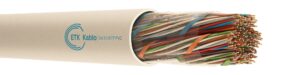
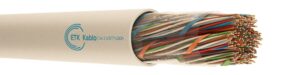
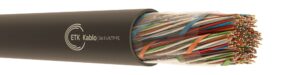
Cat 3 U/UTP Cable for Multipair Data and Telephone Networks
Cat 3 U/UTP Cable provides unshielded multipair copper connectivity for telephone systems, switchboards, subscriber distribution, legacy data networks and low-frequency signal transmission. ETK Kablo manufactures Cat 3 U/UTP cables with 24 AWG solid copper conductors and PVC, LSOH or PE outer jackets in constructions ranging from 2 pairs to 100 pairs.
The current ETK Kablo Cat 3 U/UTP range uses 0.51 mm solid copper conductors with solid polyethylene insulation. The twisted pairs are stranded in layers, while higher pair-count constructions use grouped stranding with identification tapes. Polyester tape wraps the cable core before the selected outer jacket.
Unlike modern Cat 5e, Cat 6 and Cat 6A Ethernet cables, Cat 3 is primarily a legacy voice and low-frequency data category. ETK Kablo publishes Cat 3 transmission characteristics through 16 MHz and applications including 10BASE-T, 100VG-AnyLAN, Token Ring, ATM, telephone switchboards and subscriber distribution.
What Is Cat 3 U/UTP Cable?
Cat 3 U/UTP is an unshielded balanced multipair copper cable designed for Category 3 voice and data applications.
The designation means:
- Cat 3 – Category 3 transmission performance
- U – no overall metallic screen
- UTP – individually unshielded twisted pairs
The cable therefore contains no dedicated foil or metallic braid around the overall cable core and no individual metallic screens around the twisted pairs.
Twisting the insulated conductors into balanced pairs provides the basic transmission architecture.
ETK Kablo Cat 3 U/UTP Cable Range
| Product | Outer Jacket | Main Selection Direction |
|---|---|---|
| Cat 3 U/UTP PVC | PVC | General fixed indoor data and telephone installations where PVC is permitted |
| Cat 3 U/UTP LSOH | Halogen-free / low-smoke material | Projects requiring defined smoke and halogen characteristics |
| Cat 3 U/UTP PE | Polyethylene | Outdoor-oriented routes requiring a PE outer jacket |
All three products use the same basic unshielded Cat 3 multipair transmission architecture. The primary difference is the outer-jacket material.
Cat 3 U/UTP Cable Construction
| Component | Current ETK Kablo Construction |
|---|---|
| Conductor | Electrolytic solid copper |
| Conductor Diameter | 0.51 mm |
| Conductor Size | 24 AWG |
| Insulation | Solid polyethylene |
| Pair Construction | Twisted pairs |
| Overall Screen | None |
| Individual Pair Screens | None |
| Wrapping | Polyester tape |
| Outer Jacket | PVC, LSOH or PE according to product |
24 AWG Solid Copper Cat 3 Cable
The current ETK Kablo Cat 3 U/UTP products use 0.51 mm solid copper conductors, published as a 24 AWG construction.
Solid copper provides stable conductor resistance and predictable electrical characteristics for fixed communication infrastructure.
The current ETK Kablo product documentation publishes a maximum conductor resistance of 94 Ω/km at 20°C.
Professional buyers should distinguish solid-copper communication cable from copper-clad alternatives when conductor resistance, legacy network performance and project specifications are important.
Cat 3 U/UTP Is a Multipair Cable Family
One of the most important differences between Cat 3 and modern LAN cable families is the available pair count.
Modern Cat 5e, Cat 6 and Cat 6A Ethernet cables typically use four twisted pairs. The current ETK Kablo Cat 3 U/UTP family instead includes many multipair configurations.
Published pair counts include:
- 2 pairs
- 3 pairs
- 4 pairs
- 6 pairs
- 8 pairs
- 10 pairs
- 12 pairs
- 16 pairs
- 20 pairs
- 24 pairs
- 25 pairs
- 30 pairs
- 32 pairs
- 48 pairs
- 50 pairs
- 64 pairs
- 75 pairs
- 100 pairs
This makes the Cat 3 U/UTP range relevant to telephone distribution, PBX infrastructure and legacy multipair communication systems where a single cable must carry many balanced circuits.
How High-Pair-Count Cat 3 Cable Is Stranded
ETK Kablo strands smaller Cat 3 configurations in layers up to 10 pairs.
For larger constructions, 20-pair to 100-pair cables use 10-pair groups. Polypropylene identification tape identifies the individual groups before the complete cable core receives its polyester wrapping.
This grouped architecture helps installers and technicians identify circuits within large multipair cables during termination and maintenance.
What Does U/UTP Mean in Cat 3 Cable?
U/UTP identifies a completely unshielded data-cable architecture.
The cable has:
- No overall metallic foil
- No overall metallic braid
- No individual pair foil
- No dedicated electromagnetic-screen termination system
The twisted-pair geometry itself provides balanced transmission characteristics.
Where a project requires an overall foil screen, ETK Kablo also provides a separate Cat 3 F/UTP cable family.
Cat 3 U/UTP vs Cat 3 F/UTP
| Feature | Cat 3 U/UTP | Cat 3 F/UTP |
|---|---|---|
| Overall Metallic Screen | No | Yes, foil |
| Individual Pair Screens | No | No |
| Main Difference | Unshielded architecture | Overall foil-screened architecture |
| Category | Cat 3 | Cat 3 |
| Primary Selection Factor | Standard electromagnetic environment | Additional overall EMI screening requirement |
Both families address Category 3 communication requirements, but F/UTP adds one overall metallic foil around the multipair cable core.
Cat 3 Frequency Range
ETK Kablo publishes transmission-performance data for the current Cat 3 U/UTP products through 16 MHz.
The published transmission table includes measurements at frequencies such as:
- 0.772 MHz
- 1 MHz
- 4 MHz
- 8 MHz
- 10 MHz
- 16 MHz
Relevant performance parameters include insertion loss, near-end crosstalk, return loss, structural return loss and propagation delay.
Cat 3 Is Not a Modern Gigabit Ethernet Category
Cat 3 is not an alternative to Cat 5e, Cat 6 or Cat 6A for modern high-speed LAN installations.
Its 16 MHz transmission range reflects a legacy network category designed for voice systems and earlier data technologies.
For new Gigabit Ethernet infrastructure, Cat 5e or higher categories provide the appropriate modern transmission architecture.
For 10 Gigabit Ethernet, project designers should evaluate Cat 6A or other suitable high-performance network systems.
Cat 3 U/UTP for 10BASE-T
The current ETK Kablo Cat 3 U/UTP datasheets explicitly list 10BASE-T according to IEEE 802.3 among the cable applications.
10BASE-T represents an early twisted-pair Ethernet architecture operating at 10 Mbps.
Cat 3 can therefore remain relevant where legacy Ethernet equipment or installed systems require Category 3 cabling.
However, new professional LAN projects should generally evaluate modern Ethernet categories rather than designing new networks around 10BASE-T.
Cat 3 U/UTP for 100VG-AnyLAN
ETK Kablo also lists 100VG-AnyLAN according to IEEE 802.12 among the applications of the current Cat 3 U/UTP products.
This is a legacy network technology and should be treated as historical or installed-base infrastructure rather than a modern Ethernet design target.
The presence of this application in the technical documentation demonstrates the broad legacy-data role of the Cat 3 family.
Cat 3 U/UTP for Token Ring Networks
The current Cat 3 datasheets also reference 4/16 Mbps Token Ring according to IEEE 802.5.
Token Ring belongs to an earlier generation of local-area-network technology.
Cat 3 U/UTP can therefore remain relevant to maintenance, replacement and expansion work involving legacy communication infrastructure.
Cat 3 U/UTP for ATM Applications
ETK Kablo currently references 52 Mbps ATM among the Cat 3 U/UTP applications.
As with Token Ring and 100VG-AnyLAN, this represents legacy network infrastructure rather than a current mainstream enterprise-LAN architecture.
Project engineers working with existing systems should verify the exact transmission requirement before selecting a replacement cable.
Cat 3 U/UTP for Telephone Systems
Telephone infrastructure remains one of the most natural applications for multipair Cat 3 cable.
The current ETK Kablo documentation specifically references:
- Telephone switchboards
- Subscriber distribution
- Indoor communication installations
- Signal transmission
- Data transmission
The availability of up to 100 twisted pairs makes Cat 3 U/UTP particularly relevant where many telephone or low-frequency communication circuits must travel within one cable.
Cat 3 U/UTP for PBX Systems
Private Branch Exchange systems can require multipair copper connections between distribution points, equipment and subscriber circuits.
Cat 3 U/UTP can provide multiple balanced copper pairs within one common cable construction.
Pair count should follow the required number of circuits together with any project-specific allowance for spare capacity.
Cat 3 U/UTP for Subscriber Distribution
Large multipair configurations allow one Cat 3 cable to distribute many individual communication pairs from a central point.
High-pair-count versions use grouped stranding with identification tapes, which assists circuit identification during installation and maintenance.
Projects should specify the required pair count, conductor diameter, jacket material and route conditions during quotation.
Cat 3 U/UTP PVC Cable
Cat 3 U/UTP PVC Cable combines the unshielded Category 3 multipair architecture with a UV-resistant PVC outer jacket.
The current ETK Kablo PVC range uses 0.51 mm / 24 AWG solid copper conductors and is available from 2 pairs to 100 pairs.
The cable uses solid PE conductor insulation, layered or grouped pair stranding and polyester wrapping before the PVC jacket.
PVC provides a conventional jacket system for fixed communication installations where PVC materials are permitted.
Cat 3 U/UTP LSOH Cable
Cat 3 U/UTP LSOH Cable combines the same 24 AWG multipair Category 3 architecture with a UV-resistant halogen-free outer jacket.
The current product documentation publishes testing for:
- Smoke density
- Single-cable flame retardancy
- Corrosive-gas characteristics
- Halogen content
LSOH or LSZH describes the reaction-to-fire and material characteristics of the jacket. It does not mean that the cable provides defined fire-resistant circuit integrity.
Cat 3 U/UTP PE Cable
Cat 3 U/UTP PE Cable uses a UV-resistant polyethylene outer jacket around the same basic unshielded multipair cable core.
The current ETK Kablo PE family uses 0.51 mm / 24 AWG solid copper conductors and is available from 2 pairs to 100 pairs.
The PE outer jacket provides an outdoor-oriented material option where environmental exposure differs from conventional indoor cabling.
However, a PE jacket should not automatically be interpreted as mechanical armor, water blocking or universal direct-burial qualification.
PVC vs LSOH vs PE Cat 3 U/UTP
| Jacket | Main Selection Consideration |
|---|---|
| PVC | General fixed communication installations where PVC is permitted |
| LSOH / LSZH | Projects requiring defined low-smoke and halogen-related characteristics |
| PE | Outdoor-oriented routes requiring a polyethylene outer jacket |
The jacket material changes the environmental and reaction-to-fire characteristics. It does not change the underlying Category 3 U/UTP transmission architecture.
Cat 3 U/UTP Pair Count Selection
Pair count is one of the most important specification parameters for a multipair Cat 3 cable.
| Typical Requirement | Selection Consideration |
|---|---|
| Small communication link | Low pair-count construction such as 2, 3 or 4 pairs |
| PBX or local distribution | Intermediate multipair construction according to required circuits |
| Large subscriber distribution | High-pair-count cable such as 25, 50, 75 or 100 pairs |
The exact pair count should follow the number of active circuits, spare-pair requirements and distribution architecture.
Cat 3 U/UTP Cable Diameter Varies with Pair Count
Because the current family ranges from 2 pairs to 100 pairs, overall cable diameter varies substantially.
For example, ETK Kablo publishes approximately:
- 3.9 mm for a 2-pair construction
- 5.3 mm for a 4-pair construction
- 7.8 mm for a 10-pair construction
- 13.7 mm for a 25-pair construction
- 15.1 mm for a 50-pair construction
- 25.6 mm for a 100-pair construction
The exact outside diameter can also depend on the selected jacket material and product construction.
Cat 3 U/UTP vs Cat 5e U/UTP Cable
| Characteristic | Cat 3 U/UTP | Cat 5e U/UTP |
|---|---|---|
| Primary Frequency Range | Up to 16 MHz | Up to 100 MHz |
| Typical Architecture | Multipair, 2–100 pairs | Four twisted pairs |
| Primary Positioning | Telephone and legacy data | Gigabit Ethernet |
| Current ETK Conductor Diameter | 0.51 mm | 0.51 mm |
| Metallic Screen | None | None |
Although both current ETK families use 0.51 mm solid copper and U/UTP screening notation, they address very different transmission requirements.
Cat 5e should be selected for modern Gigabit Ethernet. Cat 3 remains relevant to telephone systems and legacy communication infrastructure.
Cat 3 U/UTP vs Cat 6 U/UTP Cable
| Characteristic | Cat 3 U/UTP | Cat 6 U/UTP |
|---|---|---|
| Frequency | 16 MHz | 250 MHz |
| Primary Application | Legacy data / telephone | Modern professional Ethernet |
| Typical Pair Structure | Multipair | Four pairs |
| Current ETK Conductor Diameter | 0.51 mm | 0.57 mm |
Cat 3 serves legacy and voice-oriented systems, while Cat 6 addresses higher-performance modern LAN infrastructure.
Cat 3 U/UTP vs Modern Structured Cabling
Cat 3 remains useful where an existing project or communication system specifically calls for Category 3 cable.
For new enterprise Ethernet, however, project engineers should usually evaluate Cat 5e, Cat 6 or Cat 6A according to the required data rate and lifecycle expectations.
This distinction separates legacy multipair voice/data applications from modern Ethernet requirements.
Does Cat 3 U/UTP Support Power over Ethernet?
Cat 3 is not intended as a standard solution for modern Power over Ethernet infrastructure.
Contemporary PoE networks normally use modern four-pair Ethernet cabling selected according to the required data rate, conductor characteristics, channel design and PoE power level.
Projects involving remote powering over legacy Category 3 infrastructure require application-specific engineering review rather than a blanket category-level claim.
Cat 3 U/UTP Electrical Characteristics
The current ETK Kablo product documentation publishes several common electrical values across the PVC, LSOH and PE constructions.
| Parameter | Published Value |
|---|---|
| Conductor Resistance at 20°C | Max. 94 Ω/km |
| Insulation Resistance | 5000 MΩ/km |
| Propagation Velocity | 67–69% |
| Characteristic Impedance | Nominal 100 Ω |
| Operating Voltage | 230 V DC |
| Test Voltage | 1200 V DC for 1 minute |
Buyers should confirm the exact approved datasheet when mutual capacitance, unbalance, impedance tolerance or mechanical limits form part of a contractual specification.
Cat 3 U/UTP Mechanical Characteristics
Current published product data confirms:
- 0.51 mm / 24 AWG solid copper conductors
- Pair counts from 2 to 100
- 100 m, 500 m and 1000 m published packing lengths
- Operating temperature data according to the exact product documentation
- Bending-radius requirements according to the approved product datasheet
Because cable diameter changes substantially with pair count, installers should always use the exact selected construction for pathway, gland, tray and termination planning.
Cat 3 U/UTP Cable Standards
The current ETK Kablo Cat 3 U/UTP product documentation references:
- ANSI/TIA-568-C.2
- IEC 61156-5
- IEC 11801
The published electrical-performance tables extend through 16 MHz.
Project specifications can require different standard editions or additional documentation, so procurement teams should verify the requirements for the exact supplied construction.
LSOH Cat 3 U/UTP Fire and Material Tests
The current Cat 3 U/UTP LSOH product documentation publishes:
- IEC 61034-2 for smoke density
- IEC 60332-1-2 for flame retardancy
- IEC 60754-2 for corrosive-gas characteristics
- IEC 60754-1 for halogen content
These tests describe smoke, flame and material behavior. They do not establish defined circuit integrity during fire.
Therefore, Cat 3 U/UTP LSOH should not be described as equivalent to ETK Kablo's FE180 or PH-rated fire-resistant cable families.
How to Specify Cat 3 U/UTP Cable
A complete RFQ should define the pair count, jacket material, application and installation requirements.
| Specification Item | Information to Provide |
|---|---|
| Category | Cat 3 |
| Screening | U/UTP – unshielded overall and unshielded pairs |
| Conductor | 0.51 mm / 24 AWG solid copper |
| Pair Count | 2–100 pairs according to project requirement |
| Transmission Requirement | Legacy data, telephone or specified Category 3 application |
| Jacket | PVC, LSOH or PE |
| Installation Environment | Indoor or outdoor-oriented route according to jacket selection |
| Fire Requirement | Required smoke, flame, halogen or CPR documentation where applicable |
| Packing Length | 100 m, 500 m or 1000 m according to current published range |
| Documentation | Datasheet and project-specific documentation |
Why Choose ETK Kablo for Cat 3 U/UTP Cable?
ETK Kablo manufactures Cat 3 U/UTP multipair cables for telephone, legacy data, switchboard and communication-distribution projects.
The current range uses 0.51 mm / 24 AWG solid copper conductors and offers configurations from 2 pairs up to 100 pairs with PVC, LSOH or PE outer jackets.
This broad pair-count range allows distributors, telecommunications contractors, system integrators and infrastructure projects to select one common Cat 3 cable family for small communication links or large multipair distribution systems.
ETK Kablo can evaluate pair count, jacket material, installation environment, packing length and project documentation during the quotation process.
Frequently Asked Questions About Cat 3 U/UTP Cable
What is Cat 3 U/UTP cable?
Cat 3 U/UTP is an unshielded balanced copper communication cable designed for Category 3 telephone and legacy data applications.
What does U/UTP mean?
U/UTP means the cable has no overall metallic screen and the individual twisted pairs also have no metallic screens.
What frequency does Cat 3 support?
The current ETK Kablo Cat 3 U/UTP products publish transmission-performance data through 16 MHz.
What conductor size does ETK Kablo Cat 3 U/UTP use?
The current PVC, LSOH and PE products use 0.51 mm / 24 AWG solid copper conductors.
How many pairs are available?
The current ETK Kablo range includes configurations from 2 pairs up to 100 pairs.
Is Cat 3 always a four-pair Ethernet cable?
No. ETK Kablo's Cat 3 U/UTP range is a multipair family and includes many pair counts beyond four pairs.
Can Cat 3 U/UTP support 10BASE-T?
Yes. ETK Kablo's current Cat 3 datasheets list 10BASE-T according to IEEE 802.3 among the applications.
Can Cat 3 support Gigabit Ethernet?
Cat 3 should not be selected as a modern Gigabit Ethernet cable. ETK Kablo's Cat 5e and higher categories are the appropriate families for contemporary high-speed Ethernet infrastructure.
Can Cat 3 U/UTP be used for telephone systems?
Yes. Telephone switchboards, subscriber distribution and multipair communication infrastructure are among the natural applications of Cat 3 cable.
What is the difference between Cat 3 U/UTP and F/UTP?
U/UTP has no metallic screening. F/UTP adds one overall foil screen around the unshielded twisted-pair core.
Does ETK Kablo manufacture PVC Cat 3 U/UTP?
Yes. The current range includes a Cat 3 U/UTP PVC construction.
Does ETK Kablo manufacture LSZH Cat 3 U/UTP?
Yes. The current range includes a Cat 3 U/UTP LSOH construction with defined smoke, flame and halogen-related test references.
Does ETK Kablo manufacture PE Cat 3 U/UTP?
Yes. The current range includes a Cat 3 U/UTP PE construction with a UV-resistant polyethylene outer jacket.
Can Cat 3 U/UTP PE be used outdoors?
The PE construction provides an outdoor-oriented jacket material. The complete route conditions should still be evaluated separately, particularly for buried or water-exposed installations.
Is Cat 3 U/UTP LSOH fire resistant?
Not automatically. LSOH and flame-retardancy tests describe material and reaction-to-fire behavior. They do not establish defined fire-resistant circuit integrity.
What packing lengths are available?
The current Cat 3 U/UTP PVC, LSOH and PE product tables publish 100 m, 500 m and 1000 m packing lengths.
What information should I provide when requesting a quotation?
Provide the Cat 3 U/UTP requirement, required pair count, PVC/LSOH/PE jacket, installation environment, quantity, packing length and required project documentation.


