





 President’s Message
Blog

Signal Cable Types: Applications, Screening & Selection Guide
Reading Time: 15 minutes
Signal cable types carry low-voltage analogue or digital signals between sensors, controllers, electronic equipment and automation devices. However, no single signal cable construction suits every circuit.
Engineers can choose screened or unscreened cables, conventional multicore or twisted-pair designs, PVC or halogen-free materials and several mechanical-protection systems. In addition, different screen architectures solve different electromagnetic-interference problems.
For example, LIYY provides an unscreened PVC construction for relatively low-noise environments. LIYCY adds an overall tinned-copper braid. LIHH provides an unscreened halogen-free option, while LIHCH combines halogen-free materials with copper-braid screening.
More specialized designs can use overall foil, foil plus braid, twisted pairs or triads, individually screened PiMF/TiMF elements, steel wire braid or steel wire armour.
Therefore, the correct selection should start with the signal and installation environment rather than the product code alone.
ETK Kablo manufactures a broad signal and control cable portfolio for industrial automation, machinery, HVAC, building systems, monitoring equipment and low-voltage electronic circuits.
Quick answer: The main signal cable types differ by conductor arrangement, electromagnetic screening, insulation and sheath material, mechanical protection and electrical characteristics. Choose the signal architecture first. Then evaluate EMI, conductor size, capacitance, voltage, fire requirements and installation conditions.
Signal Cable Types at a Glance
| Classification | Main Options | What It Defines |
|---|---|---|
| Screening | Unscreened, foil, braid, foil + braid | Protection against electromagnetic interference |
| Core arrangement | Multicore, twisted pair, twisted triad | Relationship between signal conductors |
| Individual screening | PiMF, TiMF | Electrical separation between individual circuits |
| Material system | PVC, halogen-free, PE-based variants | Electrical, environmental and fire-related characteristics |
| Mechanical protection | Unarmored, SWB, SWA | Protection against physical stress |
| Conductor | Different Class 5 copper sizes | Resistance, current and installation flexibility |
| Fire performance | Flame retardant, LSZH/HFFR, CPR-specific constructions | Different fire-related requirements |
| Application | Automation, monitoring, BMS, machinery, measurement | System-specific selection priorities |
As a result, two products called “signal cable” can have substantially different structures and electrical behaviour.
What Is a Signal Cable?
A signal cable transfers electrical information between compatible devices.
Typical applications include:
- Sensor connections
- PLC input and output circuits
- Actuator feedback
- Electronic-control equipment
- Monitoring systems
- Analogue measurement circuits
- Low-voltage digital signals
- Building-management systems
- Machine interfaces
- Audio and electronic equipment
The signal can represent a measurement, status, command or another low-voltage electrical function.
However, “digital signal” does not automatically mean Ethernet or another high-speed communication standard. The cable must meet the electrical requirements of the actual protocol.
How Are Signal Cables Constructed?
A typical flexible signal cable starts with fine-stranded copper conductors.
Manufacturers then apply insulation and arrange the cores according to the required architecture.
The complete construction can contain:
- Class 5 stranded copper conductors
- PVC or halogen-free insulation
- Individual cores
- Twisted pairs or triads
- Polyester separators
- Al/PET foil screen
- Tinned-copper braid screen
- Drain or earth wire
- Individual pair or triad screens
- Inner sheath
- Steel wire braid
- Steel wire armour
- PVC or halogen-free outer sheath
Therefore, cable construction should reflect both the electrical circuit and the physical installation.
Signal Cable Types by Screening
Electromagnetic screening represents one of the main differences between signal cable families.
The principal options include:
- No metallic screen
- Overall foil
- Overall copper braid
- Overall foil plus copper braid
- Individual pair or triad screens
- Individual screens plus an overall screen
However, more metallic layers do not automatically create the best cable.
Every added screen increases cable diameter, material content, termination work and cost. Therefore, the electrical environment should determine the required architecture.
Unscreened Signal Cable
An unscreened cable has no dedicated metallic EMI screen around the signal cores.
This structure can provide an efficient solution where electrical interference remains limited.
Typical applications can include protected control cabinets, short machine connections and general low-level circuits away from strong noise sources.
However, route design still matters. An unscreened cable installed directly beside a high-power drive cable can experience very different conditions from the same product in a protected control panel.
Foil-Screened Signal Cable
A foil-screened cable normally uses an aluminium/polyester tape around the cable core.
The foil provides broad metallic coverage while keeping the construction relatively compact.
In addition, many foil-screen designs include a drain or earth wire to simplify electrical termination.
Foil screening can suit low-voltage signal circuits that require overall EMI protection without the larger metal content of some braid constructions.
Braid-Screened Signal Cable
A braid-screened cable uses interwoven conductive wires around the cable core.
ETK LIYCY and LIHCH constructions use tinned-copper braid screening.
The braid provides flexible overall electromagnetic protection. Therefore, these designs commonly serve industrial automation and equipment wiring where EMI presents a real concern.
Nevertheless, braid coverage and electrical performance should come from the exact product specification rather than a generic product-family assumption.
Foil + Braid Screened Signal Cable
Some constructions combine an overall foil with an overall copper braid.
The two layers can complement each other because they use different geometries.
However, “double screened” should not be interpreted as universally superior.
A simpler screen can provide sufficient performance in one installation. By contrast, another project may justify combined screening because of signal sensitivity and the surrounding electromagnetic environment.
LIYY, LIYCY, LIHH and LIHCH Signal Cable Types
Four widely used ETK product families illustrate the relationship between screening and material selection.
| Product | Material System | Screen | General Selection Direction |
|---|---|---|---|
| LIYY | PVC | Unscreened | General low-level signals in relatively low-EMI environments |
| LIYCY | PVC | Tinned-copper braid | Screened signal circuits where external EMI matters |
| LIHH | Halogen-free | Unscreened | Low-smoke / halogen-free projects without additional screening requirement |
| LIHCH | Halogen-free | Tinned-copper braid | Halogen-free projects that also require EMI screening |
Therefore, the comparison can often begin with two questions:
- Does the circuit require a metallic screen?
- Does the project require PVC or halogen-free materials?
For the full comparison, see our LIYCY, LIYY, LIHCH and LIHH guide.
LIYY: Unscreened PVC Signal Cable
LIYY uses PVC insulation and PVC outer sheath without a dedicated metallic screen.
As a result, the construction remains relatively simple and can reduce diameter, weight and termination work compared with screened alternatives.
LIYY can suit general low-voltage signal circuits where electromagnetic noise remains controlled.
However, engineers should not choose it only because the route is indoors. Motors, inverters and power circuits can create significant EMI inside industrial buildings.
LIYCY: Braid-Screened PVC Signal Cable
LIYCY adds an overall tinned-copper braid around the cable core.
ETK’s LIYCY construction uses Class 5 stranded copper conductors, PVC insulation, polyester wrapping, tinned-copper braid and a PVC outer jacket.
Consequently, the cable combines installation flexibility with overall electromagnetic screening.
However, standard LIYCY uses conventional multicore construction. The product name alone does not indicate twisted pairs.
LIHH: Unscreened Halogen-Free Signal Cable
LIHH provides the halogen-free counterpart to the general unscreened signal-cable concept.
It uses halogen-free insulation and outer-sheath materials without adding a dedicated metallic signal screen.
Therefore, LIHH can suit projects where smoke and halogen-related combustion characteristics matter but additional EMI screening does not.
However, halogen-free construction does not mean that the cable is fire resistant.
LIHCH: Braid-Screened Halogen-Free Signal Cable
LIHCH combines a halogen-free material system with overall tinned-copper braid screening.
ETK’s LIHCH product therefore addresses two independent requirements: EMI protection and halogen-free material performance.
This distinction is important.
The copper braid manages electromagnetic interference. Meanwhile, the insulation and sheath system determine the halogen-free and smoke-related characteristics.
Signal Cable Types by Core Arrangement
Screening and conductor arrangement are separate design choices.
A cable can use conventional multicore construction or organize related conductors into pairs or triads.
The main architectures include:
- Multicore
- Twisted pair
- Twisted triad
- Multi-pair
- Multi-triad
Multicore Signal Cable
A conventional multicore cable strands individual insulated conductors together in layers.
This architecture works well when the circuits do not require defined conductor pairs.
For example, relay contacts, status signals and various low-voltage control functions can use individual cores within one overall cable.
Twisted-Pair Signal Cable
A twisted-pair construction first twists two related conductors together.
The paired geometry helps the two conductors experience a similar electromagnetic environment.
Therefore, twisted pairs can improve electrical balance for suitable two-conductor circuits.
However, pair twisting alone does not create a defined characteristic impedance or communication-protocol approval.
Twisted-Triad Signal Cable
A triad groups three related conductors.
This architecture can suit circuits that naturally require three conductors to remain together.
Again, the electrical circuit should determine whether pairs or triads are appropriate.
LIYCY vs LIYCY-TP
Standard LIYCY and LIYCY-TP can use similar PVC insulation, copper-braid screening and outer sheath.
The main difference lies inside the cable.
Standard LIYCY strands the individual cores in layers. LIYCY-TP first organizes the conductors into defined pairs.
ETK’s LIYCY-TP/TT construction can organize the conductors as pairs or triads before assembling the complete screened cable.
As a result, TP/TT provides another design option rather than a higher “grade” of LIYCY.
For a detailed analysis, see our LIYCY vs LIYCY-TP comparison.
TP Does Not Mean Individually Screened Pair
This point causes frequent specification errors.
TP means twisted pair.
It describes conductor geometry, not metallic screening around each pair.
For example, a conventional LIYCY-TP construction can contain several twisted pairs underneath one common overall braid.
Therefore, projects that require a separate metallic screen around every pair must specify that requirement explicitly.
PiMF and TiMF Signal Cables
PiMF means Pair in Metal Foil.
TiMF means Triad in Metal Foil.
Unlike a conventional TP or TT construction, each pair or triad receives its own metallic screen.
This architecture can improve electrical separation between neighbouring sensitive circuits.
In addition, some products combine individual screens with another overall cable screen.
However, individual screening increases cable complexity, diameter and termination work.
Therefore, projects should use PiMF/TiMF where circuit separation justifies the additional construction.
Overall Screening vs Individual Screening
| Screen Architecture | Main Purpose |
|---|---|
| Overall foil | Protect the complete cable core from external EMI |
| Overall braid | Provide flexible overall electromagnetic screening |
| Foil + braid | Combine two overall screening geometries |
| PiMF / TiMF | Increase separation between individual signal circuits |
| Individual + overall | Address circuit-to-circuit separation and external EMI together |
Consequently, the phrase “shielded signal cable” is often too broad for a demanding specification.
Signal Cable Types and Electromagnetic Interference
Industrial environments can contain strong electromagnetic-noise sources.
Typical examples include:
- Variable-frequency drives
- Servo drives
- Electric motors
- Transformers
- Switchgear
- High-current power circuits
- Power converters
- Welding equipment
In these environments, screening can reduce the influence of external electrical noise.
However, screen selection represents only one part of good EMC design.
Routing, separation from power cables, grounding, bonding and termination also influence signal quality.
Is a More Heavily Screened Cable Always Better?
No.
A more complex screen adds copper or aluminium, increases diameter and requires more termination work.
In addition, incorrect screen bonding can reduce the expected EMC benefit.
Therefore, engineers should match the screen architecture to signal sensitivity and the actual electromagnetic environment.
A low-noise control cabinet can legitimately use an unscreened cable. By contrast, a sensitive signal routed near VFDs may justify copper braid or combined screening.
Class 5 Copper Conductors
Many ETK signal-control constructions use flexible Class 5 stranded copper conductors.
Class 5 conductors contain multiple fine copper wires. Therefore, they provide greater installation flexibility than solid conductors of the same general size.
ETK LIYCY, for example, references IEC 60228 Class 5 in its product construction.
The current IEC 60228:2023 standard defines conductor classes, sizes and resistance requirements for applicable insulated cable conductors.
However, Class 5 does not automatically mean continuous-flex operation.
Flexible Signal Cable Is Not Automatically Drag-Chain Cable
Flexible stranded conductors simplify installation and routing.
However, repeated movement creates a different mechanical duty.
Applications such as these require dedicated evaluation:
- Drag chains
- Robotics
- Repeated flexing
- Torsional movement
- Moving machine axes
- High-cycle automation
Therefore, buyers should not infer dynamic-cycle capability from the term “flexible signal cable” alone.
PVC Signal Cable Types
PVC remains a widely used material for signal-control cable insulation and outer sheaths.
It can provide a practical combination of flexibility, durability and cost efficiency.
LIYY and LIYCY represent two common PVC-based architectures.
However, PVC does not automatically mean outdoor cable.
Likewise, a UV-resistant outer sheath does not automatically establish direct-burial, permanent-water or every-weather suitability.
The complete product specification must match the installation environment.
LSZH Signal Cable Types
LSZH and HFFR signal cables use halogen-free material systems for projects that place emphasis on smoke and corrosive combustion gases.
ETK’s LSZH range includes:
- Unscreened constructions
- Foil-screened constructions
- Braid-screened constructions
- Foil + braid screened constructions
- TP/TT variants
- PiMF/TiMF variants
- Steel wire braided constructions
- Steel wire armored constructions
Therefore, LSZH does not define the screening architecture.
A halogen-free cable can be screened or unscreened.
For the broader material distinction, see our LSZH vs PVC cable guide.
LSZH Does Not Mean Fire Resistant
This distinction remains important in public and infrastructure projects.
LSZH describes material behaviour related to smoke and halogen content.
Flame retardancy describes flame propagation under a specified test.
Fire resistance addresses circuit integrity during defined fire exposure.
Therefore, none of these properties should automatically be inferred from another.
The project should specify each required fire characteristic separately.
Signal Cable Types With SWA and SWB
Some installations need mechanical protection in addition to electromagnetic screening.
ETK offers signal-control constructions with Steel Wire Armour and Steel Wire Braid.
However, these steel layers should not be confused with the copper-braid electromagnetic screen.
Steel Wire Armour
SWA uses galvanized steel wires to add mechanical reinforcement around the cable.
It can provide additional protection where the route faces significant physical risk.
However, SWA increases diameter, weight and stiffness.
Steel Wire Braid
Steel Wire Braid uses a braided steel reinforcement layer.
The geometry can provide a different flexibility profile from conventional SWA.
Nevertheless, its primary selection reason is mechanical protection rather than signal screening.
Electrical Screen vs Mechanical Protection
| Layer | Primary Purpose |
|---|---|
| Al/PET foil | Electromagnetic screening |
| Tinned-copper braid | Electromagnetic screening |
| Foil + copper braid | Combined electromagnetic screening |
| Individual pair/triad foil | Circuit-to-circuit separation |
| Steel wire braid | Mechanical reinforcement |
| Steel wire armour | Mechanical reinforcement |
As a result, an RFQ should define EMI screening and mechanical protection independently.
Signal Cable Types by Conductor Size
Signal cables are available with several conductor cross-sections.
ETK LIYCY products, for example, include small signal sizes and larger sections within the same product family.
Conductor size influences:
- DC resistance
- Voltage drop
- Cable diameter
- Copper weight
- Termination compatibility
- Current capability
Therefore, the smallest available conductor is not automatically the most economical engineering choice.
Long routes and circuits carrying more current can require a larger cross-section.
Signal Cable Voltage Ratings
A product-family name does not define one universal operating voltage.
For example, ETK LIYCY technical data uses different operating-voltage values depending on conductor size.
Small signal sizes can use lower voltage ratings, while larger cross-sections can use 300/500 V constructions.
Therefore, buyers should verify the exact part number and datasheet rather than assuming that every LIYCY, LIYY or related cable has the same voltage rating.
Why Cable Capacitance Matters
Signal circuits can be sensitive to cable capacitance.
Every metre of cable adds capacitance to the connected circuit.
Therefore, total capacitance rises as cable length increases.
High capacitance can affect signal rise time, transmitter loading and communication margin in suitable circuits.
For this reason, long analogue or digital links require more than a simple conductor-size check.
Engineers should compare actual capacitance data with the connected equipment requirements.
Why Conductor Resistance Matters
Conductors also create electrical resistance.
As route length increases, the complete loop resistance grows.
This can influence:
- Voltage drop
- Sensor supply voltage
- Current-loop headroom
- Relay or actuator operation
- Signal-system margins
Therefore, conductor resistance and cable length should be considered together.
Can Signal Cable Be Used for 4–20 mA?
Potentially, yes.
A suitable two-conductor or twisted-pair signal cable can carry a 4–20 mA loop when its conductor resistance, capacitance, voltage rating and installation characteristics meet the system requirements.
However, industrial process instrumentation can have additional requirements for pair organization, individual screening and project standards.
For those applications, see our instrumentation cable selection guide.
Can Signal Cable Be Used for RS-485?
Only after electrical verification.
RS-485 normally uses balanced differential signalling and benefits from twisted-pair geometry.
However, a generic twisted-pair signal cable does not automatically provide the required characteristic impedance.
Designers should verify:
- Characteristic impedance
- Capacitance
- Conductor resistance
- Pair balance
- Screening
- Network length
- Data rate
- Termination
Therefore, “TP” alone does not prove RS-485 suitability.
Can Signal Cable Be Used for Modbus RTU?
Modbus RTU commonly operates over an RS-485 physical layer.
As a result, the same caution applies.
A twisted-pair signal cable may have appropriate physical geometry. However, engineers must still verify its impedance and other electrical parameters against the network design.
Can Signal Cable Be Used for CAN Bus?
Again, not automatically.
CAN uses differential communication and commonly relies on defined transmission-line characteristics.
A generic screened twisted-pair cable may look suitable physically but still have the wrong impedance or capacitance.
Therefore, use a cable confirmed for the required CAN network rather than selecting only by the presence of twisted pairs.
Signal Cable Is Not Ethernet Cable
Ethernet cables follow defined Category transmission requirements.
These requirements can include:
- Characteristic impedance
- Insertion loss
- NEXT
- Return loss
- Frequency bandwidth
- Propagation characteristics
Generic LIYCY or LIYCY-TP does not automatically meet Cat 5e, Cat 6 or Cat 6A performance.
Therefore, high-speed Ethernet networks should use a suitable Data/LAN cable rather than a general signal-control cable.
Signal Cable vs Control Cable
Signal and control cables can overlap in real automation systems.
However, their priorities often differ.
Signal cables commonly focus on low-level electrical information, electrical parameters and EMI performance.
Control cables commonly handle commands, interlocks, relay circuits and machine-control functions across broader conductor-size ranges.
Therefore, the circuit should determine the family.
For industrial control architecture, see our control cable guide.
Signal Cable vs Instrumentation Cable
Instrumentation cable represents a more specialized process-measurement family.
It often uses:
- Defined pairs or triads
- Overall screening
- Individual pair or triad screening
- Specific capacitance limits
- Project-specific electrical requirements
Signal cable is a broader concept and can cover many electronic and automation connections.
Therefore, the terms should not automatically be treated as interchangeable in oil, gas or process-control projects.
Signal Cable Types for Industrial Automation
Industrial automation combines many different low-voltage circuits.
Typical equipment includes:
- PLCs
- Sensors
- Actuators
- Control panels
- Data-acquisition equipment
- Position devices
- Machine interfaces
- Monitoring equipment
As a result, one production line can legitimately use several signal cable types.
An unscreened cable can serve a low-noise status circuit. Meanwhile, a braid-screened cable can protect a sensitive analogue signal routed near electrical equipment.
Signal Cable Types for HVAC and Building Systems
HVAC and building-control systems contain sensors, controllers, actuators and monitoring circuits.
Signal cables can connect:
- Temperature sensors
- Pressure sensors
- Damper actuators
- Valve controls
- Room-control equipment
- Building-management interfaces
However, protocol-specific building buses can require dedicated bus cables.
Therefore, a generic signal cable should not replace a KNX, Ethernet or other specified communication cable without technical verification.
Signal Cable Types for Machinery
Machine builders often need compact and flexible low-voltage wiring.
Signal cables can connect switches, indicators, sensors and electronic modules.
In addition, screened constructions can become useful where motors and drives generate electrical noise.
Nevertheless, ordinary Class 5 signal cable should not automatically enter continuous-moving drag chains.
Signal Cable Types for Public and Commercial Buildings
Public buildings can place additional emphasis on smoke and halogen performance.
Therefore, LIHH, LIHCH and other halogen-free families can become relevant.
However, the project must still determine whether the circuit requires screening.
Likewise, LSZH material choice does not automatically establish a specific CPR classification or fire-resistance rating.
Indoor, Outdoor and Exposed Routes
The installation environment affects the final cable construction.
Indoor routes can still contain humidity, chemicals, EMI and mechanical risks.
Outdoor routes add further factors such as:
- UV exposure
- Water
- Temperature changes
- Mechanical impact
- Rodents
- Installation tension
Therefore, do not assume that PVC automatically means indoor or that a UV-resistant sheath automatically means direct burial.
The exact product specification should confirm environmental suitability.
How to Choose Signal Cable Types
1. Identify the Signal
First, determine whether the circuit carries analogue, discrete, differential or another electrical signal.
2. Define the Conductor Arrangement
Choose conventional multicore, pair or triad geometry according to the circuit.
3. Evaluate EMI
Review nearby drives, motors, power circuits and other electrical-noise sources.
4. Choose the Screen Architecture
Select unscreened, foil, braid, foil + braid or individual screening according to the actual EMC requirement.
5. Select the Conductor Size
Use route length, resistance, voltage drop and connected-equipment requirements.
6. Check Electrical Parameters
Review capacitance, operating voltage and protocol-specific characteristics where relevant.
7. Select PVC or Halogen-Free Materials
Match the material system to the building, industrial and fire strategy.
8. Define Mechanical Protection
Add SWB, SWA or another protection system only when the route creates a mechanical risk.
9. Define the Installation Duty
Separate fixed installation, occasional movement and continuous dynamic motion.
10. Verify the Exact Datasheet
Finally, confirm product dimensions, electrical values, temperature, bending radius and test requirements.
Signal Cable Selection Matrix
| Project Requirement | Good Starting Direction |
|---|---|
| Low EMI, PVC acceptable | LIYY-type unscreened PVC cable |
| EMI present, PVC acceptable | LIYCY-type braid-screened cable |
| Low EMI, halogen-free required | LIHH-type construction |
| EMI present, halogen-free required | LIHCH-type construction |
| Compact overall screen required | Foil-screened cable |
| Two overall screening geometries required | Foil + braid construction |
| Natural two-conductor circuits | Twisted-pair construction |
| Sensitive circuits need individual separation | PiMF / TiMF construction |
| High mechanical risk | Evaluate SWA or SWB |
| Ethernet network | Use an appropriate Category-rated Data/LAN cable |
| Protocol-specific serial bus | Verify impedance and electrical parameters |
| Continuous motion | Use a purpose-designed dynamic cable |
This matrix provides a starting point. The complete circuit and project specification should make the final decision.
Common Signal Cable Selection Mistakes
Assuming Every Signal Cable Needs a Screen
Low-noise circuits can use unscreened constructions successfully.
Assuming More Screening Is Always Better
Additional screens increase size, cost and termination complexity.
Confusing Twisted Pair With Individual Screening
TP defines conductor geometry. PiMF defines an individual metallic pair screen.
Using Generic TP Cable for RS-485 or CAN
Twisting does not guarantee the required impedance or capacitance.
Using Signal Cable for Ethernet
Ethernet requires Category-specific transmission performance.
Assuming LSZH Means Fire Resistant
Material behaviour and circuit integrity represent different requirements.
Assuming UV Resistance Means Direct Burial
Direct burial also introduces water and mechanical requirements.
Confusing Copper Braid With Steel Wire Braid
Tinned-copper braid primarily provides EMI screening. Steel wire braid primarily provides mechanical reinforcement.
Ignoring Capacitance on Long Runs
Total capacitance increases with cable length and can affect sensitive circuits.
Using Flexible Cable in Continuous Motion
Installation flexibility does not prove drag-chain or robotic duty.
What Should a Signal Cable RFQ Include?
A professional RFQ should describe the actual circuit rather than request only “screened signal cable.”
Include at least:
- Signal or circuit type
- Number of cores, pairs or triads
- Conductor cross-section
- Required conductor class
- Overall screen requirement
- Foil or braid requirement
- Combined foil + braid where required
- PiMF / TiMF requirement where applicable
- PVC or halogen-free insulation
- Outer-sheath material
- Operating voltage
- Conductor-resistance requirement
- Capacitance requirement
- Protocol impedance where applicable
- Mechanical protection
- Indoor, outdoor or exposed installation
- Fixed or dynamic duty
- Fire-performance requirement
- CPR classification where applicable
- Operating temperature
- Cable marking
- Packing length
- Test reports and documentation
As a result, manufacturers can quote comparable constructions. Moreover, procurement teams avoid comparing products that share a generic name but have different electrical designs.
ETK Kablo Signal Cable Types
ETK Kablo manufactures signal and control cables for industrial automation, machinery, HVAC, building technology, monitoring and process-related applications.
The portfolio includes:
- LIYY unscreened PVC cables
- LIYCY braid-screened PVC cables
- LIHH unscreened halogen-free cables
- LIHCH braid-screened halogen-free cables
- Overall foil-screened constructions
- Foil + braid screened constructions
- TP / TT pair and triad variants
- PiMF / TiMF individual-screen variants
- Steel wire braided constructions
- Steel wire armored constructions
Therefore, engineers can select conductor arrangement, electromagnetic screening, material system and mechanical protection independently.
This modular approach allows the cable to follow the actual signal architecture rather than forcing every low-voltage circuit into one standard product.
Frequently Asked Questions About Signal Cable Types
What are the main signal cable types?
Signal cable types include unscreened, foil-screened, braid-screened and foil + braid designs. They can also use multicore, twisted-pair, triad, PiMF/TiMF, PVC, halogen-free, SWB or SWA constructions.
What is LIYY cable?
LIYY is an unscreened PVC signal-control cable family for suitable low-voltage circuits in relatively low-EMI environments.
What is LIYCY cable?
LIYCY uses PVC insulation and sheath together with an overall tinned-copper braid screen.
What is LIHH cable?
LIHH is an unscreened halogen-free signal-control cable.
What is LIHCH cable?
LIHCH combines halogen-free materials with overall tinned-copper braid screening.
What is the difference between foil and braid screening?
Foil provides broad metallic coverage in a compact structure. Copper braid uses woven conductive wires and provides a flexible overall screen.
Is foil + braid always better?
No. Combined screening can suit demanding EMI environments, but simpler screening can provide sufficient performance for many circuits.
What does TP mean?
TP means twisted pair. It does not mean individually screened pair.
What does TT mean?
TT identifies a twisted-triad construction in applicable ETK signal-cable families.
What does PiMF mean?
PiMF means Pair in Metal Foil. Each pair receives an individual metallic foil screen.
What does TiMF mean?
TiMF means Triad in Metal Foil. Each triad receives an individual foil screen.
Can LIYCY-TP be used for RS-485?
Only when the exact cable meets the network’s impedance, capacitance, resistance and other physical-layer requirements.
Can signal cable be used for Ethernet?
Generic signal cable should not replace Category-rated Ethernet cable. Ethernet requires defined high-frequency transmission parameters.
Is LIHCH fire resistant?
Halogen-free and flame-related material performance does not automatically demonstrate fire-resistant circuit integrity.
Can signal cable be installed outdoors?
Only when the exact product construction matches UV, moisture, temperature and mechanical conditions of the route.
Does a signal cable need armour?
Only when the route requires additional mechanical protection.
Is a Class 5 signal cable suitable for drag chains?
Not automatically. Continuous dynamic movement requires a cable specifically designed and tested for that duty.
Which signal cable should I choose?
Start with the signal and conductor arrangement. Then define EMI screening, electrical parameters, material system, mechanical protection and installation conditions.
Conclusion: How Should You Choose Signal Cable Types?
Signal cable types should be selected from the electrical circuit outward.
First, determine whether the circuit needs individual cores, twisted pairs or triads. This decision establishes the basic conductor architecture.
Next, evaluate electromagnetic interference. An unscreened cable can suit a controlled environment. By contrast, foil, braid or combined screens can protect sensitive circuits in noisier installations.
Then define material requirements. PVC provides a practical solution for many industrial applications, while halogen-free families address projects with different smoke and halogen requirements.
Afterwards, review conductor resistance, capacitance, voltage and protocol-specific electrical characteristics. This step becomes especially important on long routes and communication buses.
Finally, evaluate mechanical protection and installation duty. SWA and SWB should follow real physical risks, while continuous movement requires a purpose-designed dynamic cable.
The correct signal cable is therefore not simply the most heavily screened or mechanically protected option. It is the construction that matches the signal, electromagnetic environment, electrical parameters and installation conditions without unnecessary complexity.
Benzer yazılar
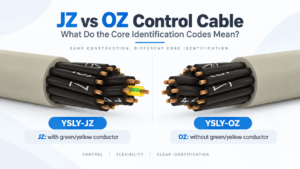
JZ vs OZ Control Cable: What Do the Core Identification Codes Mean?
JZ vs OZ control cable is a common comparison when specifying flexible multicore cables for industrial machinery, control panels, autom...
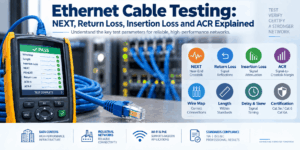
Ethernet Cable Testing: NEXT, Return Loss, Insertion Loss and ACR Explained
Ethernet cable testing verifies whether a twisted-pair copper cabling system can transmit data within the electrical performance limits...
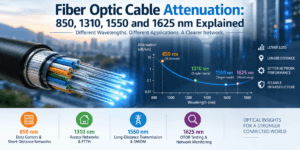
Fiber Optic Cable Attenuation: 850, 1310, 1550 and 1625 nm Explained
Fiber optic cable attenuation describes the reduction in optical power as light travels through an optical fiber. It is normally expres...
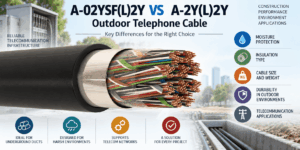
A-02YSF(L)2Y vs A-2Y(L)2Y Outdoor Telephone Cable
A-02YSF(L)2Y vs A-2Y(L)2Y is an important comparison when selecting copper outdoor telephone cable for telecommunications networks, und...
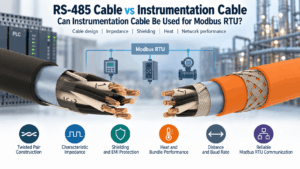
RS-485 Cable vs Instrumentation Cable: Can Instrumentation Cable Be Used for Modbus RTU?
A Modbus RTU cable must do more than carry a low-voltage digital signal from one device to another. Modbus RTU commonly uses an RS-485 ...
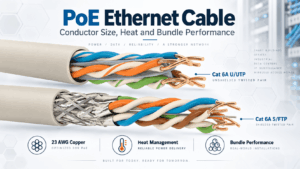
Ethernet Cable for PoE: Conductor Size, Heat and Bundle Performance
A PoE Ethernet cable carries data and electrical power over the same balanced twisted-pair cabling system. This capability simplifies t...
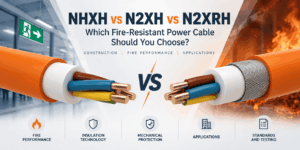
NHXH vs N2XH vs N2XRH: Which Fire-Resistant Power Cable Should You Choose?
NHXH vs N2XH vs N2XRH is an important comparison when specifying 0.6/1 kV power cables for emergency and life-safety systems. Although ...
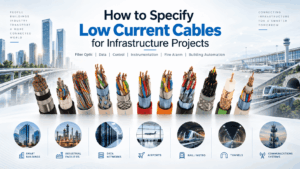
How to Specify Low Current Cables for Infrastructure Projects
A professional low current cable specification should define much more than a cable name, conductor count or sheath colour. Infrastruct...

Fire Resistant Cables for Hospitals and High-Rise Buildings
Fire resistant cable for hospitals and high-rise buildings supports electrical, communication and control systems that may need to rema...
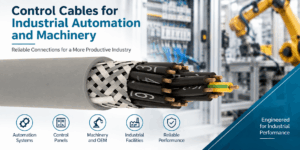
Industrial Control Cable Selection for Automation and Machinery
Industrial control cable selection should begin with the function of the circuit and the mechanical conditions of the machine rather th...
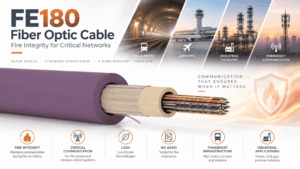
FE180 Fiber Optic Cable: Fire Integrity, Applications and Selection
An FE180 fiber optic cable is designed for optical communication routes where continued transmission during fire can form part of the p...
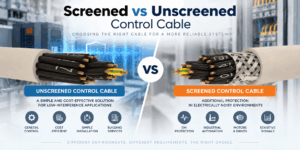
Screened vs Unscreened Control Cable: What Is the Difference?
Control cable shielding is one of the most important design decisions when selecting cable for industrial automation, machinery, buildi...


