





 President’s Message
Blog
What Are Instrumentation Cables?
Reading Time: 3 minutes
In industrial automation, process control, and measurement systems, the reliable transmission of signals is critical. One of the key components ensuring this reliability is instrumentation cables. These specialized cables are designed to transmit low-voltage analog and digital signals from devices that measure physical parameters—such as temperature, pressure, flow, and level—to control systems without distortion or interference.
Instrumentation cables are manufactured with screened structures to provide high resistance against electromagnetic interference (EMI). In industrial environments, where motors, inverters, and power cables often create noise and signal distortion, instrumentation cables ensure signal integrity.
Common configurations include RE-2X(St)H, RE-2X(St)YSWAY, and RE-2X(St)HSWAH-PiMF/TiMF. These designations define characteristics such as insulation type, screen construction, outer sheath material, armor type, and fire resistance rating. For example, RE-2X(St)YSWAY includes steel wire armor (SWA), providing mechanical protection alongside EMI shielding.
Where Are Instrumentation Cables Used?
Instrumentation cables are essential in any sector that requires precise and reliable signal transmission. The most common applications include petrochemical plants, refineries, natural gas terminals, power generation facilities, cement factories, mining operations, water treatment plants, and tunnel infrastructures.
Petrochemical and refinery facilities present harsh environments with high temperatures, EMI, and exposure to chemical vapors. Here, steel wire armored (SWA) or steel wire braided (SWB) instrumentation cables ensure signal continuity and mechanical protection.
In tunnel infrastructure and metro systems, long-distance signal transmission without loss is crucial. Double-screened, halogen-free cables are often preferred, providing fire safety by reducing smoke and toxic gas emissions during fire incidents.
In the mining industry, cables are exposed to extreme mechanical loads and potentially explosive environments. Steel wire armored cables offer critical resistance to crushing, impact, and environmental stress, making them ideal for these conditions.
Power plants and energy infrastructure require instrumentation cables that are not only EMI-resistant but also flame retardant. Models like RE-2X(St)HSWAH-PiMF/TiMF—with individual pair shielding—are particularly suitable for these high-demand applications.
Key Considerations When Selecting Instrumentation Cables
Choosing the right instrumentation cable involves much more than price and delivery time. Long-term performance, compliance with standards, and environmental suitability are all key to making the right decision.
1. Screening Type (St / PiMF / TiMF)
The screen plays a key role in protecting signals from interference. While overall screens (St) offer general EMI shielding, PiMF (Pair in Metal Foil) and TiMF (Triad in Metal Foil) constructions shield each pair or triad individually, ideal for high-precision and noise-sensitive environments.
2. Armoring (SWA / SWB / Steel Wire Armor)
In applications with mechanical stress—such as underground or outdoor installations—steel wire armor (SWA) or steel wire braiding (SWB) is critical for long-lasting protection against impact, pressure, and rodent damage.
3. Outer Sheath Material
Environmental conditions determine sheath selection. PVC may suffice for indoor use, while UV-resistant PE is preferred outdoors. For areas requiring fire safety, halogen-free (LSZH or HFFR) sheaths are mandatory.
4. Fire Performance (LSZH, Flame Retardant)
In enclosed areas like tunnels, mines, and public buildings, excessive smoke and toxic gas pose severe risks. Therefore, flame retardant, halogen-free instrumentation cables are essential for ensuring safe evacuation and limiting fire damage.
5. Standards and Certifications
Instrumentation cables should comply with international standards such as EN 50288-7, IEC 60332, and VDE. Certification ensures consistent performance and regulatory compliance.
6. Core Construction (Pair / Triad / Multi-pair)
Depending on signal requirements, cables may be structured in 1x2x0.75 mm², 2x2x1.5 mm², or similar configurations. Proper shielding becomes increasingly important in multi-pair designs.
The Importance of Halogen-Free Instrumentation Cables
Halogen-free instrumentation cables are crucial in environments where fire safety and human health are priorities. LSZH (Low Smoke Zero Halogen) cables release minimal smoke and no toxic halogens during combustion, helping to prevent harm during fires.
These cables are now a standard in tunnels, hospitals, public buildings, and underground systems, where fast evacuation is critical. Halogen-free instrumentation cables not only reduce the spread of toxic smoke but also protect equipment by minimizing corrosive gas damage—facilitating quicker recovery and system restart after a fire.
At ETK Kablo, we offer halogen-free outer sheath options across our entire instrumentation cable range, combining technical safety with environmental responsibility.
ETK Kablo’s Instrumentation Cable Solutions
ETK Kablo is one of Turkey’s leading manufacturers in the instrumentation cable segment. Our products, engineered to the highest technical standards, are trusted in demanding industrial environments and exported to many countries worldwide.
The RE-2X(St)H series is an ideal, cost-effective solution for general industrial applications. RE-2X(St)YSWAY features steel wire armor, offering excellent mechanical protection in underground and outdoor installations. For high-EMI environments like petrochemical plants and power stations, the RE-2X(St)HSWAH–PiMF/TiMF model offers both individual pair shielding and steel wire armor, ensuring optimal signal integrity and mechanical resilience.
All ETK Kablo instrumentation cables comply with:
- IEC 60332-1 / IEC 60332-3 flame retardancy standards
- EN 50288-7 structural and performance specifications
- VDE-certified quality control and production processes
We also provide project-specific customizations such as conductor size, outer sheath color, length, and screening configuration.
Instrumentation cables are critical to the reliability of control systems in industrial automation and process management. Choosing the correct cable ensures signal accuracy, system stability, fire safety, and long-term durability.
Solutions that feature SWA or SWB armor, halogen-free sheaths, individual pair shielding, and standardized designs such as RE-2X(St)H and RE-2X(St)YSWAY, provide both technical and regulatory advantages.
ETK Kablo meets the demands of the most challenging industries with its wide product range, engineering support, and proven quality. From tunnels to petrochemical facilities, from mining to energy, we deliver safe, durable, and efficient instrumentation cable solutions for every application.
Benzer yazılar
LSZH vs PVC Cable: Which Should You Specify?
Choosing between LSZH vs PVC cable is primarily a material and fire-safety decision rather than a simple question of which cable is “be...
Cat6A Cable for Data Centers: U/FTP, F/FTP or S/FTP?
Choosing the right Cat6A cable for data centers involves more than specifying 10 Gigabit Ethernet and 500 MHz performance. U/FTP, F/FTP...
Instrumentation Cable Shielding: Individual Screen vs Overall Screen
Instrumentation cable shielding plays a critical role in protecting low-level analogue and digital signals from electromagnetic interfe...
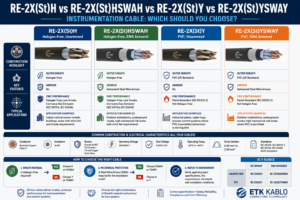
RE-2X(St)H vs RE-2X(St)HSWAH vs RE-2X(St)Y vs RE-2X(St)YSWAY: Which Should You Choose?
Choosing the right RE-2X(St) instrumentation cable is not simply a matter of comparing four similar product codes. RE-2X(St)H, RE-2X(St...
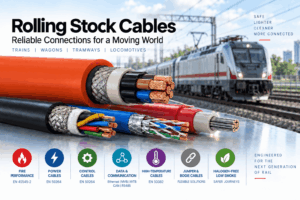
Rolling Stock Cables: Standards, Types and Applications
Rolling stock cables are specialized electrical and communication cables designed for installation onboard railway vehicles such as tra...
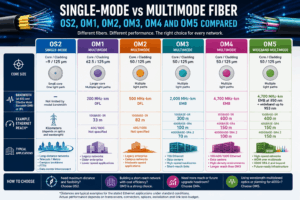
Single-Mode vs Multimode Fiber: OS2, OM1, OM2, OM3, OM4 and OM5 Compared
Choosing single-mode vs multimode fiber is one of the most important decisions when designing a fiber optic network. OS2, OM1, OM2, OM3...
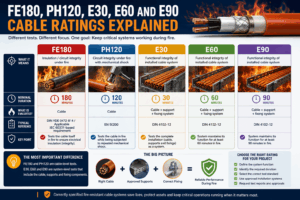
FE180, PH120, E30, E60 and E90 Cable Ratings Explained
Understanding FE180, PH120, E30, E60 and E90 cable ratings is essential when specifying fire-resistant cables for emergency, life-safet...
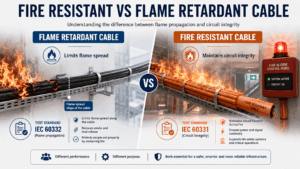
Fire Resistant vs Flame Retardant Cable: What Is the Difference?
The difference between a fire resistant vs flame retardant cable is one of the most important distinctions in cable fire performance. A...
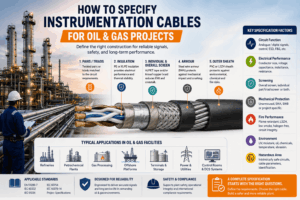
How to Specify Instrumentation Cables for Oil & Gas Projects
Selecting oil and gas instrumentation cables requires much more than choosing a conductor size and adding a screen. Refineries, petroch...
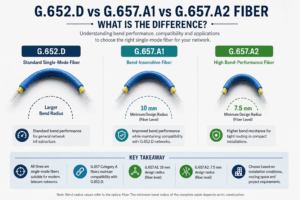
G.652.D vs G.657.A1 vs G.657.A2 Fiber: What Is the Difference?
Choosing between G.652.D, G.657.A1 and G.657.A2 fiber is primarily a question of how the optical fiber will behave when the network is ...
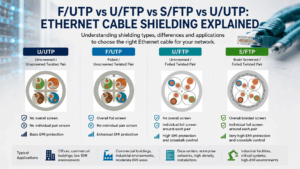
F/UTP vs U/FTP vs S/FTP vs U/UTP: Ethernet Cable Shielding Explained
Ethernet cable shielding can have a major influence on how reliably a network performs in environments affected by electromagnetic inte...
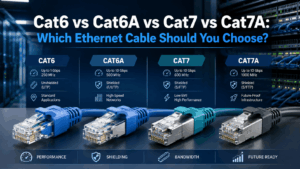
Cat6 vs Cat6A vs Cat7 vs Cat7A: Which Ethernet Cable Should You Choose?
Choosing between Cat6 vs Cat6A vs Cat7 vs Cat7A is not simply a matter of selecting the highest cable category available. Each Ethernet...


