





 President’s Message
Blog
What is a Fiber Optic Cable?
Reading Time: 3 minutes
A fiber optic cable is a high-speed cable type designed for data transmission via light signals. These cables contain very thin fiber cores made from glass or plastic. Data is transmitted through internal reflections of light along these cores. Compared to traditional copper cables, fiber optic cables offer much higher transmission speeds and are immune to electromagnetic interference.
Fiber cables are generally available in single loose tube or multi loose tube constructions. Single-tube cables are often preferred in small-scale installations, while multi-tube fiber cables are used in large-scale infrastructure projects. When considering the performance-to-price ratio of fiber optic cables, especially in extensive network projects, they provide significant cost advantages in the long term.
Where are Fiber Optic Cables Used?
Fiber optic cables are used in a wide range of applications. These include internet infrastructure, data centers, FTTH (Fiber To The Home) projects, industrial automation systems, government institutions, and military communication systems.
In recent years, the use of fiber cables in in-building network infrastructures has also increased. B2ca-rated fiber optic cables with halogen-free, low smoke outer sheaths are preferred in large commercial buildings, malls, hospitals, hotels, and government facilities due to their compliance with CPR regulations.
Outdoor fiber optic cables are typically manufactured with steel wire armor to withstand rodents, impacts, and physical stress. For aerial installations, fiber cables with messenger wire are commonly used.
How to Choose a Fiber Optic Cable?
Several technical factors must be considered when selecting a fiber optic cable. The most important are:
1. Cable Structure
Depending on the application, single-tube or multi-tube configurations may be preferred. Different mechanical protections are required for indoor versus underground applications. For example, armored fiber cables are often used for underground installations, while smaller, more flexible types are ideal for indoor routing.
2. Core Types (Fiber Types)
Fiber optic cables are available in two main types based on the type of light transmission and use case: multimode and singlemode.
Multimode Core Types (OM1, OM2, OM3, OM4, OM5):
Multimode fiber cables are typically used for short-range in-building networks. Their larger core diameters support multiple light modes.
- OM1: 62.5/125 µm core, operates at 850 nm wavelength. Supports up to 300 meters.
- OM2: 50/125 µm core, 850 nm. Supports up to 500 meters.
- OM3: Laser-optimized, supports 10 Gbps over 300 meters.
- OM4: Improved attenuation, supports 10 Gbps over 550 meters.
- OM5: Wideband multimode fiber for 100 Gbps transmission across 850–950 nm wavelengths.
Singlemode Core Types (G.652.D, G.655, G.657.A1, G.657.A2):
Singlemode fiber cables have thinner cores and support long-distance, low-loss data transmission. They are widely used in outdoor backbones, Metro Ethernet, and FTTH projects.
- G.652.D: The most common SM fiber type, widely used in telecom networks.
- G.655: Non-Zero Dispersion Shifted Fiber, ideal for long-distance DWDM applications.
- G.657.A1: Fully compatible with G.652.D, offers better bend performance. Used in FTTH and indoor wiring.
- G.657.A2: Ultra-flexible, preferred in tight spaces like wall outlets and in-building terminations.
Core type directly affects fiber optic cable price. For example, G.657.A2 cables require higher precision manufacturing, thus are more expensive but provide superior performance in tight spaces.
3. CPR Classification
In EU-compliant construction projects, cables must meet CPR (Construction Product Regulation) standards. Classes like B2ca, Cca, and Dca define fire resistance levels. B2ca fiber optic cables provide the highest level of fire safety by minimizing smoke and toxic gas emissions during a fire.
4. Sheath Material
Sheathing materials vary, including PVC, PE, LSOH (LSZH), and PUR. LSOH jackets are preferred in areas with high human occupancy, while PE jackets are favored for outdoor applications due to their weather resistance.
5. Cable Armor
To enhance physical durability and protection from external factors, fiber optic cables often include armor layers. This is critical for environments with rodent threats, excavation activity, or demanding outdoor use.
Armor types include:
- Steel Wire Armor (SWA): Galvanized steel wires around the cable offer robust protection for outdoor installation.
- Steel Wire Braid (SWB): More flexible, ideal for confined spaces and moving environments.
- Corrugated Steel Tape: Spiral steel tape around the cable for both mechanical protection and rodent resistance.
- Galvanized Steel Tape: Flat steel tape for a more compact armor alternative.
- Non-Metallic Armor (Aramid Yarn): Common in ADSS (All-Dielectric Self Supporting) cables used near power lines, offering tensile strength without conductivity.
The choice of armor depends on environmental risks, installation method, and cable routing. For tunnels or direct burial, SWA or corrugated steel tape is preferred. For aerial installations, aramid-reinforced ADSS is ideal.
What is the Data Transmission Speed of Fiber Optic Cables?
Fiber optic cables offer significantly higher data transmission speeds compared to copper cables. Since transmission is achieved via light, they are unaffected by electromagnetic interference—an essential advantage in industrial environments. Singlemode (e.g., G.652.D) cables are suitable for data rates between 10 Gbps and 100 Gbps over long distances. Multimode cables like OM3 and OM4 can be used in data centers for 40 Gbps and 100 Gbps speeds over shorter distances. Distance also plays a key role. While singlemode cables support transmission across kilometers, multimode cables are optimized for shorter ranges. Additionally, data transmission speed depends not only on the fiber cable itself but also on the transceivers and equipment connected at both ends. Even the best cable can underperform if paired with low-quality devices. ETK Kablo is a leading fiber optic cable manufacturer.
Benzer yazılar
LSZH vs PVC Cable: Which Should You Specify?
Choosing between LSZH vs PVC cable is primarily a material and fire-safety decision rather than a simple question of which cable is “be...
Cat6A Cable for Data Centers: U/FTP, F/FTP or S/FTP?
Choosing the right Cat6A cable for data centers involves more than specifying 10 Gigabit Ethernet and 500 MHz performance. U/FTP, F/FTP...
Instrumentation Cable Shielding: Individual Screen vs Overall Screen
Instrumentation cable shielding plays a critical role in protecting low-level analogue and digital signals from electromagnetic interfe...
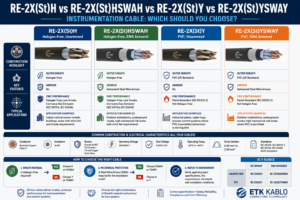
RE-2X(St)H vs RE-2X(St)HSWAH vs RE-2X(St)Y vs RE-2X(St)YSWAY: Which Should You Choose?
Choosing the right RE-2X(St) instrumentation cable is not simply a matter of comparing four similar product codes. RE-2X(St)H, RE-2X(St...
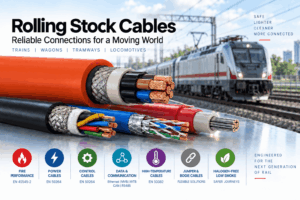
Rolling Stock Cables: Standards, Types and Applications
Rolling stock cables are specialized electrical and communication cables designed for installation onboard railway vehicles such as tra...
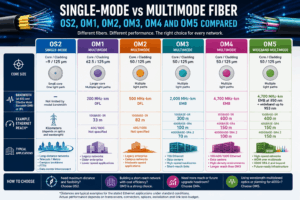
Single-Mode vs Multimode Fiber: OS2, OM1, OM2, OM3, OM4 and OM5 Compared
Choosing single-mode vs multimode fiber is one of the most important decisions when designing a fiber optic network. OS2, OM1, OM2, OM3...
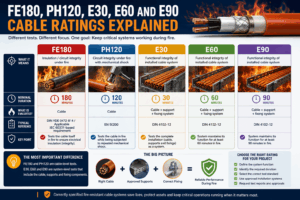
FE180, PH120, E30, E60 and E90 Cable Ratings Explained
Understanding FE180, PH120, E30, E60 and E90 cable ratings is essential when specifying fire-resistant cables for emergency, life-safet...
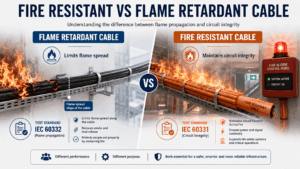
Fire Resistant vs Flame Retardant Cable: What Is the Difference?
The difference between a fire resistant vs flame retardant cable is one of the most important distinctions in cable fire performance. A...
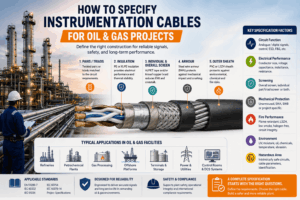
How to Specify Instrumentation Cables for Oil & Gas Projects
Selecting oil and gas instrumentation cables requires much more than choosing a conductor size and adding a screen. Refineries, petroch...
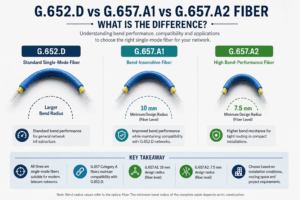
G.652.D vs G.657.A1 vs G.657.A2 Fiber: What Is the Difference?
Choosing between G.652.D, G.657.A1 and G.657.A2 fiber is primarily a question of how the optical fiber will behave when the network is ...
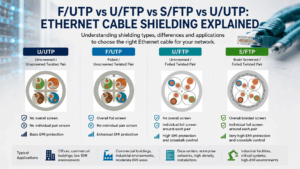
F/UTP vs U/FTP vs S/FTP vs U/UTP: Ethernet Cable Shielding Explained
Ethernet cable shielding can have a major influence on how reliably a network performs in environments affected by electromagnetic inte...
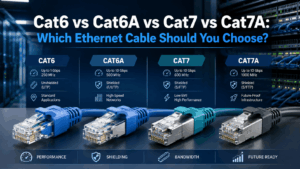
Cat6 vs Cat6A vs Cat7 vs Cat7A: Which Ethernet Cable Should You Choose?
Choosing between Cat6 vs Cat6A vs Cat7 vs Cat7A is not simply a matter of selecting the highest cable category available. Each Ethernet...


