





 President’s Message
Blog
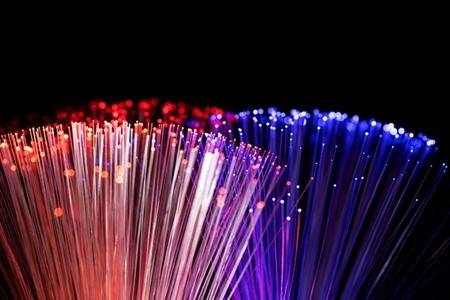
Fiber Optic Cable Types: Complete Selection Guide
Reading Time: 13 minutes
Fiber optic cable types differ according to optical fiber, cable construction, installation environment, mechanical protection, water blocking and fire performance. Understanding these classifications helps engineers choose the right cable for telecom, FTTH, data center, industrial and infrastructure networks.
Some classifications describe the optical fiber itself. For example, a project may use single-mode or multimode fiber. Other classifications describe the physical cable construction, such as tight buffer, central loose tube or multi loose tube.
In addition, engineers classify cables by installation method. Indoor, outdoor, duct, microduct, aerial and direct-burial routes create different requirements. Mechanical protection, water blocking and fire performance add further design choices.
Therefore, terms such as G.652.D, ADSS, SWA, dry core and 24 fiber do not describe the same characteristic. One cable can combine several of these features at the same time. For example, a cable can use G.652.D fiber, a multi loose-tube structure, dry-core water blocking, SWA and a PE outer sheath.
ETK Kablo manufactures a broad fiber optic cable portfolio for telecommunications, FTTH, data centers, industrial networks, railways, utilities, buildings and infrastructure projects.
Quick answer: The main fiber optic cable classifications include single-mode and multimode fiber; tight-buffered, central loose-tube and multi loose-tube constructions; indoor, outdoor, duct, microduct, aerial and direct-burial cables; metallic and non-metallic reinforcement; dry and gel-filled water blocking; FTTH designs; and special fire-performance cables. The correct combination depends on the complete network and installation environment.
Fiber Cable Classification at a Glance
| Classification | Main Options | What It Defines |
|---|---|---|
| Optical fiber | Single-mode, multimode | Optical transmission characteristics |
| Single-mode fiber | G.652.D, G.657.A1, G.657.A2 | Bending and optical characteristics |
| Multimode fiber | OM1, OM2, OM3, OM4, OM5 | Multimode bandwidth and application |
| Fiber protection | Tight buffer, loose tube | How the cable protects the optical fibers |
| Loose-tube architecture | Central loose tube, multi loose tube | How the tubes and fibers are organized |
| Installation | Indoor, outdoor, duct, aerial, direct burial | Physical route and environment |
| Mechanical protection | Unarmored, CST, SWA, SWB, non-metallic reinforcement | Protection against physical stress |
| Water blocking | Gel-filled, dry core, fully dry | Control of longitudinal water movement |
| Application | FTTH, telecom, data center, industrial, railway, utility | Network-specific priorities |
| Fire performance | LSZH, CPR-classified, fire-resistant | Reaction-to-fire or circuit-integrity requirements |
As a result, “fiber optic cable type” should not refer to only one design parameter. A professional specification normally combines several classifications.
Fiber Optic Cable Types: Single-Mode and Multimode
The first decision concerns the optical fiber that carries the light signal.
Single-mode and multimode fibers have different core structures. Therefore, they suit different network distances and optical systems.
Single-Mode Fiber
Single-mode fiber uses a relatively small optical core. It supports essentially one propagation mode.
As a result, single-mode systems reduce modal dispersion and support long-distance transmission particularly well.
Typical applications include:
- Telecommunications backbones
- FTTH networks
- Metropolitan networks
- Railway communications
- Utility networks
- Campus backbones
- Long-distance data center interconnects
Common single-mode fiber types include G.652.D, G.657.A1 and G.657.A2.
Multimode Fiber
Multimode fiber uses a larger optical core. It supports several propagation modes.
Therefore, multimode systems mainly serve shorter network links. Enterprise and data-center networks commonly use them with compatible short-reach optical transceivers.
Common multimode categories include OM1, OM2, OM3, OM4 and OM5.
Modern data centers frequently use OM3 and OM4. Meanwhile, OM1 and OM2 remain important in legacy systems. OM5 adds wideband multimode capability for compatible optical applications.
For more detail, see our single-mode vs multimode fiber guide.
G.652.D, G.657.A1 and G.657.A2
Single-mode networks require another selection step. Engineers must choose the specific optical fiber type.
| Fiber Type | Main Characteristic | Typical Application |
|---|---|---|
| G.652.D | Established general-purpose single-mode fiber | Telecom backbone, metro and infrastructure |
| G.657.A1 | Improved bending performance with strong compatibility | Access, FTTH and building networks |
| G.657.A2 | Stronger macrobending performance | Compact pathways and FTTH |
Importantly, G.657.A2 does not transmit data faster simply because it tolerates tighter bends.
Instead, engineers choose G.657 variants mainly when the route needs improved bend performance.
For a detailed comparison, see our G.652.D vs G.657.A1 vs G.657.A2 guide.
Fiber Optic Cable Types: Tight-Buffered and Loose-Tube
After selecting the optical fiber, engineers must decide how the cable will protect it.
The two main approaches are tight-buffered and loose-tube construction.
Tight-Buffered Cable
A tight-buffered cable places an additional protective layer directly around each coated optical fiber.
For example, many indoor designs use approximately 900 µm buffered fibers.
This structure makes individual fibers easier to handle. It also simplifies routing and termination.
Therefore, tight-buffered cables commonly serve:
- Indoor structured cabling
- Data centers
- Telecommunications rooms
- Building backbones
- Equipment areas
However, tight buffer does not automatically mean indoor-only. Manufacturers can create suitable indoor/outdoor constructions as well.
Likewise, tight-buffered construction does not automatically mean B2ca. The finished cable must earn its CPR classification through the applicable testing and certification.
ETK Kablo offers suitable constructions in its indoor fiber optic cable range.
Loose-Tube Cable
A loose-tube cable places coated optical fibers inside a larger protective tube. The tube leaves controlled internal space around the fibers.
As a result, the design isolates the fibers from much of the cable’s mechanical and thermal movement.
Loose-tube cables therefore work particularly well in outdoor and infrastructure applications.
Typical uses include duct networks, telecom backbones, FTTX feeder systems, aerial routes, railways and industrial backbones.
For a detailed comparison, see our tight-buffered vs loose-tube guide.
Central Loose Tube
A central loose-tube cable places several optical fibers inside one main tube near the center of the cable.
This simple architecture can provide a compact outside diameter. In addition, it can keep cable weight relatively low.
Central loose-tube designs often work well for lower and moderate fiber counts.
However, manufacturers use different tube capacities. Therefore, engineers should not assume one universal maximum fiber count.
Multi Loose Tube
A multi loose-tube cable divides the fibers across several tubes.
Manufacturers normally strand these tubes around a central strength member such as FRP.
This structure helps organize higher fiber counts into manageable groups. Consequently, technicians can handle large cables more systematically during splicing and maintenance.
Multi loose-tube designs commonly serve:
- High-capacity telecom networks
- Metro backbones
- FTTX feeder systems
- Railway networks
- Utility infrastructure
- High-fiber-count duct systems
However, multi loose tube does not automatically mean armored.
Manufacturers can combine the architecture with no armour, corrugated steel tape, SWA, SWB or non-metallic reinforcement.
Similarly, they can use gel-filled or dry water-blocking systems.
Our central vs multi loose-tube guide explains these differences in detail.
How Many Fibers Should a Cable Contain?
Fiber count creates another important classification.
Common capacities include 2, 4, 6, 8, 12, 24, 48, 96, 144 and 288 fibers. Selected ETK constructions can also reach higher capacities.
However, the highest available fiber count is not automatically the best choice.
Instead, project engineers should consider:
- Current active fiber demand
- Spare fibers
- Future expansion
- Network branching
- Route redundancy
- Splice-closure capacity
- Tube organization
- Duct space
For practical sizing, see our 12, 24, 48, 96, 144 and 288 fiber comparison.
Indoor Fiber Optic Cable Types
Indoor installations prioritize fire performance, compact routing and convenient termination.
Typical constructions include simplex, duplex, distribution and breakout cables.
In addition, many building projects specify LSZH or HFFR compounds.
However, LSZH does not define a CPR Euroclass. Therefore, buyers must verify the exact fire classification separately.
Indoor/Outdoor Designs
Some cable routes move directly from an outdoor environment into a building.
In these cases, an indoor/outdoor fiber optic cable can combine environmental resistance with suitable building-related performance.
Nevertheless, engineers should verify the actual product requirements. UV resistance, moisture protection, jacket material and fire classification still matter.
Duct Fiber Cables
A duct cable runs inside a protective underground pathway.
Because the duct already protects the cable from many physical risks, the cable may not need heavy metallic armour.
Instead, designers often prioritize low weight, manageable outside diameter and strong pulling performance.
Water blocking also remains important. In addition, many projects use PE or HDPE outer jackets.
ETK Kablo offers several options in its duct fiber optic cable range.
Microduct Fiber Cables
Microduct cable represents a specialized form of duct cable.
Manufacturers optimize these cables for small outside diameter and controlled stiffness. They also focus on low weight and air-blown installation.
As a result, operators can install more fiber capacity within limited duct space.
Typical applications include FTTH, metro networks, smart cities and telecom upgrades.
However, microduct cable is not simply a smaller conventional cable. Its friction, stiffness and blowing performance require careful design.
Direct-Burial Cables
Direct-burial cable goes into the ground without a continuous protective duct around the route.
Therefore, the cable itself must handle more environmental and mechanical stress.
Project engineers should evaluate soil pressure, crush, impact, rodents, water and installation tension.
However, direct burial does not automatically require SWA.
Depending on the route, engineers can choose corrugated steel tape, SWA, another metallic armour or suitable non-metallic reinforcement.
Aerial Fiber Optic Cable Types
Aerial fiber cables run between poles, towers or other support points.
The main aerial designs include ADSS, figure-8 cables and other supported loose-tube constructions.
Therefore, “aerial fiber cable” does not describe one mechanical architecture.
ETK Kablo offers different options in its aerial fiber optic cable range.
ADSS Cable
ADSS stands for All-Dielectric Self-Supporting.
The cable supports its own mechanical load between support points. Therefore, it does not require a separate metallic messenger.
ADSS designs commonly use dielectric strength members such as aramid yarn.
However, aramid yarn alone does not make every fiber cable an ADSS cable.
The complete design must support the required aerial span.
Engineers should therefore define:
- Span length
- Maximum tensile load
- Sag
- Wind loading
- Ice loading where applicable
- Temperature range
- Attachment hardware
For more detail, see our ADSS fiber optic cable guide.
Figure-8 Cable
A figure-8 cable combines the communication cable and a supporting messenger within one connected profile.
The messenger carries much of the aerial mechanical load. Meanwhile, the optical section protects the fibers.
This construction can suit telecom pole routes that accept an integrated support member.
However, figure-8 and ADSS represent different mechanical concepts.
Armored Fiber Optic Cable Types
Metallic armour adds physical protection around the internal optical construction.
Common systems include corrugated steel tape, Steel Wire Armour and Steel Wire Braid.
| Protection | Main Engineering Direction |
|---|---|
| Corrugated steel tape | Compact crush, impact and rodent protection |
| SWA | Heavy mechanical protection and tensile contribution |
| SWB | Flexible metallic reinforcement for selected designs |
Therefore, engineers should not describe SWA as universally “the strongest” or “the best.”
The correct armour depends on the actual mechanical requirement.
For example, corrugated steel tape can provide strong radial protection with a relatively compact construction. By contrast, SWA can offer greater tensile contribution in suitable designs.
Compare the two in our corrugated steel tape vs SWA guide.
You can also review ETK Kablo’s metallic armored fiber optic cable range.
Non-Metallic Reinforced Designs
Some projects avoid conventional steel armour.
Manufacturers can use FRP, glass yarn, aramid yarn or other dielectric elements instead.
These constructions can reduce weight and provide electrical isolation.
They can also suit routes near electrical infrastructure.
However, “non-metallic armored” and “fully dielectric” do not always mean exactly the same thing.
A cable becomes fully dielectric only when its relevant components contain no conductive metallic elements.
ETK Kablo offers suitable options in its non-metallic reinforced fiber range.
Dry Core, Fully Dry and Gel-Filled Designs
Outdoor fiber cables also differ in their water-blocking technology.
Gel-Filled Cable
Gel-filled designs use thixotropic filling compounds inside the loose tube, cable core or both.
The gel fills internal voids. Therefore, it helps limit water movement.
Dry-Core Cable
Dry-core designs replace flooding gel in the cable core with water-swellable yarns or tapes.
However, the loose tubes can still contain gel.
Fully Dry Cable
A fully dry cable removes conventional gel from both the tube and the surrounding cable core.
Instead, the manufacturer uses dry water-blocking materials throughout the construction.
As a result, technicians can often prepare these cables more cleanly in the field.
Nevertheless, neither dry nor gel-filled technology automatically provides superior water performance.
The tested finished cable should determine suitability.
See our dry core vs gel-filled fiber guide.
FTTH Cable Designs
FTTH networks normally use several cable constructions rather than one universal cable.
For example, the feeder section can use a high-fiber-count multi loose-tube cable. Meanwhile, the final subscriber drop may use one or two bend-insensitive fibers.
Typical FTTH cable roles include:
- Feeder cable
- Distribution cable
- Microduct cable
- Aerial distribution cable
- Drop cable
- Indoor subscriber cable
Therefore, “FTTH cable” describes a network role rather than one fixed physical design.
LSZH, CPR and Fire-Resistant Fiber Cables
Fire-related terminology requires careful separation.
LSZH, CPR reaction-to-fire class and fire resistance describe different characteristics.
LSZH Fiber Cable
LSZH or HFFR materials reduce smoke and halogen-related corrosive gases compared with conventional halogen-containing compounds.
However, LSZH alone does not define a CPR Euroclass.
B2ca Fiber Cable
B2ca describes reaction-to-fire performance under the European CPR framework.
Additional classifications can describe smoke, flaming droplets and acidity.
Therefore, B2ca should not be used as a synonym for fire resistance.
For more detail, see our B2ca fiber optic cable guide.
Fire-Resistant Fiber Cable
Fire-resistant fiber cable addresses a separate requirement.
It aims to maintain defined functionality during specified fire exposure.
ETK Kablo also offers fire-resistant fiber optic cable constructions for critical infrastructure.
Data Center Fiber Cabling
Data centers can use both single-mode and multimode fiber.
However, the physical priorities differ from outdoor telecom networks.
Data-center projects often focus on:
- High fiber density
- Compact routing
- Easy termination
- Building fire requirements
- OM3 or OM4 multimode
- OS2 single-mode
- High-density connector systems
Therefore, indoor tight-buffered or other high-density constructions often make more sense than heavy outdoor armour.
Fiber Cables for Telecom Networks
Telecom networks commonly use single-mode loose-tube cables.
However, the exact construction changes across the network.
For example, a backbone can use high-fiber-count multi loose tube. A metro route may use duct or microduct cable. Meanwhile, an aerial route may require ADSS.
Therefore, one telecommunications network can contain several cable families.
Industrial Fiber Cabling
Industrial networks benefit from fiber’s immunity to electromagnetic interference.
However, factories and process plants often create mechanical and environmental risks.
Therefore, project engineers may also require armour, oil-resistant materials, UV protection or increased crush performance.
As a result, optical fiber type and physical cable construction remain separate decisions.
Railway and Infrastructure Cables
Railways, tunnels, airports and transport networks often combine several requirements in one specification.
For example, one cable may need single-mode fiber, rodent protection, LSZH material and high CPR performance.
Another route may require fire resistance or non-metallic reinforcement.
Therefore, the complete environment should determine the cable construction.
IEC 60794 and Cable Performance
Professional fiber projects should compare measurable cable performance rather than commercial names alone.
The IEC 60794-1-1:2023 standard provides a general framework for geometrical, transmission, material, mechanical, ageing and environmental characteristics of optical fiber cables.
Project engineers should therefore evaluate parameters such as:
- Attenuation
- Tensile performance
- Crush resistance
- Impact performance
- Bending
- Temperature cycling
- Water penetration
- Cable diameter
- Cable weight
In practice, these test values often provide more useful information than broad terms such as “heavy-duty” or “high-strength.”
Selection Matrix
| Project Requirement | Good Starting Point |
|---|---|
| Long-distance telecom backbone | Single-mode multi loose tube |
| Moderate outdoor fiber count | Central loose tube |
| High fiber count | Multi loose tube |
| Indoor easy termination | Tight buffered |
| Data center short-reach multimode | OM3 / OM4 indoor cable |
| Protected underground duct | Duct cable |
| Small high-density pathway | Microduct cable |
| Direct burial | Mechanically protected outdoor cable |
| High rodent or crush risk | CST, SWA or suitable protected design |
| Metal-free requirement | Fully dielectric construction |
| Aerial self-supporting route | ADSS |
| Aerial route with messenger | Figure-8 or messenger-supported cable |
| FTTH subscriber connection | Compact G.657 drop cable |
| Frequent mid-span access | Multi loose tube with suitable dry-core design |
| High CPR requirement | Appropriately certified CPR construction |
| Fire circuit integrity | Special fire-resistant fiber cable |
Common Selection Mistakes
Treating Single-Mode as a Complete Cable Specification
Single-mode only describes the optical fiber family. The cable still needs a physical construction and installation specification.
Assuming Loose Tube Means Outdoor Only
Loose-tube designs strongly suit outdoor networks. However, manufacturers can also create specialized indoor/outdoor constructions.
Assuming Tight Buffer Automatically Means B2ca
The finished cable must achieve and document its CPR classification separately.
Assuming Multi Loose Tube Means Armored
Tube architecture and armour remain independent design choices.
Assuming Every Underground Cable Needs SWA
A protected duct can remove the need for heavy armour. Direct burial creates a different mechanical environment.
Calling Every Non-Metallic Cable ADSS
ADSS must support its own aerial span. A dielectric duct cable does not automatically meet that requirement.
Assuming G.657.A2 Is Faster Than G.652.D
Its main advantage lies in bend performance, not automatic data-rate improvement.
Choosing the Highest Fiber Count Automatically
Unused capacity increases size, splicing work and cost. Therefore, project teams should plan realistic future growth instead.
Confusing LSZH, B2ca and Fire Resistance
These terms describe different fire-related properties.
Choosing Armour Without Test Requirements
Compare actual tensile, crush and impact values. Do not judge the cable only by the armour name.
How to Choose the Right Cable Type
1. Define the Network
First, identify whether the project involves telecom, FTTH, data center, industrial, railway, utility or campus infrastructure.
2. Choose the Optical Fiber
Next, select single-mode or multimode. Then choose the exact fiber type.
3. Calculate Fiber Count
Include active demand, spare fibers and realistic future expansion.
4. Select the Internal Architecture
Choose tight buffer, central loose tube or multi loose tube according to the environment and fiber-management requirements.
5. Define the Installation Type
Specify indoor, outdoor, duct, microduct, aerial, ADSS or direct burial.
6. Define Water Protection
For outdoor routes, choose the appropriate dry or gel water-blocking system.
7. Determine Mechanical Protection
Use actual tensile, crush, impact and rodent risks to select unarmored, CST, SWA, SWB or non-metallic reinforcement.
8. Choose the Sheath
Match PE, HDPE, LSZH, PUR or another material to the environment and fire strategy.
9. Verify Fire Performance
Specify CPR reaction-to-fire and separate circuit-integrity requirements where necessary.
10. Check Finished Cable Data
Finally, verify attenuation, diameter, weight, bending radius, tensile load, crush performance, water penetration and test documentation.
What Should a Fiber Cable RFQ Include?
A professional inquiry should describe the complete cable construction.
- Fiber count
- Single-mode or multimode fiber
- G.652.D, G.657.A1/A2 or OM category
- Tight buffer, central loose tube or multi loose tube
- Fiber-per-tube configuration where relevant
- Dry-core, fully dry or gel-filled requirement
- Indoor, outdoor, duct, microduct, aerial or direct-burial installation
- ADSS span information where relevant
- Metallic or non-metallic protection
- Required tensile performance
- Required crush performance
- Water-penetration requirement
- PE, HDPE, LSZH or project-specific sheath
- CPR classification where applicable
- Fire resistance where applicable
- Maximum cable diameter
- Minimum bending radius
- Installation and operating temperatures
- Drum length
- Applicable IEC / ITU / project standards
- Testing and certification requirements
This level of detail helps suppliers quote comparable cable constructions. In addition, it reduces ambiguity during procurement.
ETK Kablo Fiber Solutions
ETK Kablo manufactures optical cables for telecom operators, distributors, EPC contractors, system integrators, industrial networks and infrastructure projects.
The current portfolio includes:
- Indoor tight-buffered fiber cable
- Indoor/outdoor constructions
- Central loose tube
- Multi loose tube
- Aerial cable
- ADSS
- FTTH and drop cable
- Duct cable
- Microduct cable
- Metallic armored cable
- Non-metallic reinforced cable
- Fire-resistant cable
- Special project-specific constructions
Depending on the project, engineers can combine different optical fibers, fiber counts, water-blocking systems, reinforcement methods and outer sheaths.
As a result, projects do not need to choose from only a few fixed constructions.
Frequently Asked Questions
What are the main fiber optic cable types?
The main classifications include single-mode and multimode; tight-buffered and loose-tube; central and multi loose tube; indoor, outdoor, duct, microduct, aerial and direct burial; armored and non-metallic; dry and gel-filled; FTTH and fire-performance cables.
What is the difference between single-mode and multimode?
Single-mode fiber uses a smaller optical core and suits long-distance transmission particularly well. Multimode fiber uses a larger core and commonly serves shorter enterprise and data-center links.
What is the difference between loose tube and tight buffer?
Tight buffer adds a protective layer directly around each fiber. Loose tube places coated fibers inside a larger protective tube.
What is central loose tube?
Central loose tube places the fibers together inside one main tube near the center of the cable.
What is multi loose tube?
Multi loose tube divides the fibers across several tubes. Manufacturers normally strand these tubes around a central strength member.
Which cable is best for outdoor networks?
There is no single best outdoor design. Duct, aerial, direct-burial and industrial routes create different mechanical and environmental requirements.
Which cable is best for data centers?
Data centers can use OM3 or OM4 multimode and OS2 single-mode depending on the optical link design. Indoor high-density constructions usually support routing and termination more efficiently.
Which cable is best for FTTH?
FTTH networks normally use several constructions. Feeder sections can use high-count loose-tube cables, while subscriber drops often use compact G.657 bend-insensitive fibers.
What is ADSS cable?
ADSS is an all-dielectric self-supporting aerial fiber cable. It carries its own mechanical load between support points.
What is armored fiber cable?
Armored cable adds metallic or another protective reinforcement to improve mechanical performance against defined physical risks.
Is SWA always the strongest option?
No. SWA provides heavy mechanical reinforcement, but the correct design depends on tensile, crush, impact, diameter, weight and installation requirements.
What is dry-core fiber cable?
Dry-core cable uses water-swellable materials instead of conventional flooding gel in the cable core. Its loose tubes can still contain gel.
What is B2ca fiber cable?
B2ca describes a European CPR reaction-to-fire class. It does not automatically mean the cable provides fire-resistant circuit integrity.
Can one cable belong to several classifications?
Yes. For example, one cable can use G.652.D fiber, a multi loose-tube design, dry-core water blocking, SWA and a PE outer sheath.
How do I choose the correct cable type?
Start with the network requirement. Then define optical fiber, fiber count, cable architecture, installation environment, water blocking, mechanical protection, outer sheath and fire performance.
Conclusion: Which Fiber Cable Should You Choose?
Fiber optic cable types should not be compared on only one dimension. Optical fiber, cable architecture, installation method and protection system each describe a different part of the finished cable.
First, choose single-mode or multimode according to network distance and optical equipment. Then select the exact fiber type, such as G.652.D, G.657.A1, G.657.A2 or an OM category.
Next, define the physical cable architecture. Tight-buffered designs simplify many indoor installations. By contrast, central and multi loose-tube constructions provide strong solutions for outdoor, telecom and high-capacity networks.
After that, match the cable to the route. Duct, microduct, direct-burial, aerial and ADSS cables face different mechanical conditions. Therefore, they should not share one universal construction.
Finally, specify water blocking, mechanical protection, outer sheath and fire performance separately. This approach reduces unnecessary overengineering while helping the cable meet the real optical, environmental and mechanical requirements of the project.
Benzer yazılar
JZ vs OZ Control Cable: What Do the Core Identification Codes Mean?
JZ vs OZ control cable is a common comparison when specifying flexible multicore cables for industrial machinery, control panels, autom...
Ethernet Cable Testing: NEXT, Return Loss, Insertion Loss and ACR Explained
Ethernet cable testing verifies whether a twisted-pair copper cabling system can transmit data within the electrical performance limits...

Fiber Optic Cable Attenuation: 850, 1310, 1550 and 1625 nm Explained
Fiber optic cable attenuation describes the reduction in optical power as light travels through an optical fiber. It is normally expres...
A-02YSF(L)2Y vs A-2Y(L)2Y Outdoor Telephone Cable
A-02YSF(L)2Y vs A-2Y(L)2Y is an important comparison when selecting copper outdoor telephone cable for telecommunications networks, und...
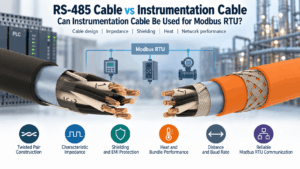
RS-485 Cable vs Instrumentation Cable: Can Instrumentation Cable Be Used for Modbus RTU?
A Modbus RTU cable must do more than carry a low-voltage digital signal from one device to another. Modbus RTU commonly uses an RS-485 ...

Ethernet Cable for PoE: Conductor Size, Heat and Bundle Performance
A PoE Ethernet cable carries data and electrical power over the same balanced twisted-pair cabling system. This capability simplifies t...
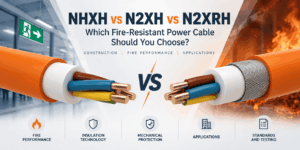
NHXH vs N2XH vs N2XRH: Which Fire-Resistant Power Cable Should You Choose?
NHXH vs N2XH vs N2XRH is an important comparison when specifying 0.6/1 kV power cables for emergency and life-safety systems. Although ...

How to Specify Low Current Cables for Infrastructure Projects
A professional low current cable specification should define much more than a cable name, conductor count or sheath colour. Infrastruct...

Fire Resistant Cables for Hospitals and High-Rise Buildings
Fire resistant cable for hospitals and high-rise buildings supports electrical, communication and control systems that may need to rema...

Industrial Control Cable Selection for Automation and Machinery
Industrial control cable selection should begin with the function of the circuit and the mechanical conditions of the machine rather th...
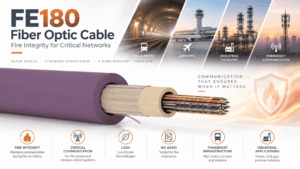
FE180 Fiber Optic Cable: Fire Integrity, Applications and Selection
An FE180 fiber optic cable is designed for optical communication routes where continued transmission during fire can form part of the p...

Screened vs Unscreened Control Cable: What Is the Difference?
Control cable shielding is one of the most important design decisions when selecting cable for industrial automation, machinery, buildi...


