





 President’s Message
Coaxial Cables
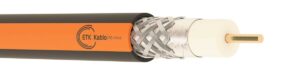
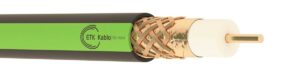
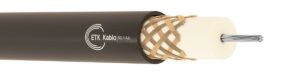
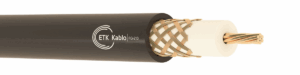
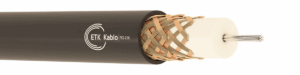
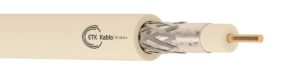
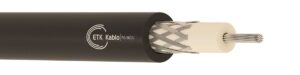
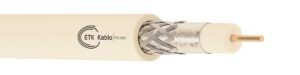
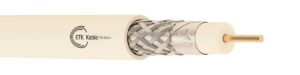
Coaxial Cable Manufacturer for CCTV, RF and Video Systems
Coaxial Cable provides controlled-impedance signal transmission for CCTV, broadcast, antenna, RF, video and communication systems. ETK Kablo manufactures a broad range of RG-series coaxial cables including RG-6, RG-8, RG-11, RG-58, RG-59, RG-213 and RG-216 constructions for different impedance, conductor, shielding and installation requirements.
The ETK Kablo portfolio includes solid and stranded copper conductors, tinned copper conductor options, solid or physically foamed polyethylene dielectric systems and several metallic-screen architectures. Depending on the exact RG construction, screening can use copper braid, tinned copper braid, aluminum braid, Al/PET foil or combinations of multiple screening layers.
Selecting the correct coaxial cable requires more than choosing an RG number. Characteristic impedance, attenuation, capacitance, conductor construction, dielectric type, screen architecture, cable diameter, operating frequency and installation environment should all form part of the specification.
What Is a Coaxial Cable?
A coaxial cable is a signal cable built around a central conductor surrounded concentrically by a dielectric insulation layer and one or more metallic screens.
The outer conductor or screen surrounds the inner conductor and helps control the electromagnetic field inside the cable. This geometry allows coaxial cable to maintain defined impedance while limiting external electromagnetic interference.
Coaxial cables are widely used for radio-frequency, video, antenna and broadband signal transmission where controlled electrical characteristics are important.
How Coaxial Cable Is Constructed
| Layer | Main Function |
|---|---|
| Inner Conductor | Carries the electrical signal |
| Dielectric | Maintains electrical separation and influences impedance, capacitance and propagation velocity |
| Metallic Screen | Provides the outer conductive path and electromagnetic shielding |
| Outer Jacket | Provides environmental and mechanical protection according to the exact construction |
Small changes in conductor diameter, dielectric geometry or screen construction can significantly affect the electrical behavior of a coaxial cable. For this reason, cables with similar outside dimensions should not automatically be treated as interchangeable.
ETK Kablo Coaxial Cable Range
| RG Family | General Construction Direction | Common Project Intent |
|---|---|---|
| RG-6 | Foil and braid screened designs, including Trishield variants | Video, CATV, satellite and compatible 75-ohm systems |
| RG-59 | Several solid-conductor and screen variants | CCTV and video signal transmission |
| RG-11 | Larger-diameter coaxial constructions | Longer signal routes according to the exact impedance specification |
| RG-58 | Compact RF coaxial constructions | 50-ohm RF and communication applications |
| RG-8 | Larger 50-ohm RF coaxial construction | Radio, antenna and RF connections |
| RG-213 | Stranded-copper 50-ohm coaxial construction | RF and radio-frequency signal applications |
| RG-216 | Double-braid screened coaxial construction | Applications requiring its specified 75-ohm electrical architecture |
The exact RG product datasheet should determine final application suitability because impedance and electrical characteristics can vary between individual RG variants.
50 Ohm vs 75 Ohm Coaxial Cable
Characteristic impedance is one of the most important parameters when selecting coaxial cable.
Many RF and radio systems use approximately 50-ohm coaxial cable, while many video, broadcast, CATV and CCTV systems use approximately 75-ohm coaxial cable.
| Nominal Impedance | Typical Application Direction | ETK Examples |
|---|---|---|
| 50 Ω | RF, radio, antenna and equipment interconnection | RG-58C/U, RG-8/U, RG-213 |
| 75 Ω | Video, CCTV and compatible broadcast systems | RG-6/U-4, RG-59/U, RG-216 |
The system impedance and cable impedance should match. Substituting a 50-ohm cable for a specified 75-ohm system, or vice versa, can create reflections and degrade signal performance.
ETK Kablo also offers RG constructions with impedance values outside these two simplified nominal groups. Therefore, buyers should verify the exact product value rather than assuming impedance solely from the RG family name.
RG-6 Coaxial Cable
RG-6 coaxial cable is widely associated with video, broadband, CATV and satellite signal distribution.
The ETK Kablo RG-6/U-4 construction uses a 1.0 mm solid copper center conductor, physically foamed polyethylene dielectric, an Al/PET foil screen and aluminum braiding.
The characteristic impedance is 75 ohms, while the physically foamed dielectric supports a relatively high signal-propagation velocity.
ETK Kablo also manufactures additional RG-6/U-4, RG-6/U-6 and Trishield versions for different shielding requirements.
RG-6 Trishield Coaxial Cable
ETK Kablo's portfolio includes dedicated RG-6 Trishield products.
Trishield construction adds additional metallic screening compared with a simpler coaxial architecture. The purpose is to improve isolation against external electromagnetic interference and unwanted signal ingress or egress.
The exact shield layers and electrical data should be checked from the applicable Trishield product datasheet.
RG-59 Coaxial Cable
RG-59 coaxial cable remains strongly associated with video and CCTV signal transmission.
The ETK Kablo RG-59/U construction uses a 0.83 mm solid copper conductor, physically foamed polyethylene insulation, Al/PET foil and tinned copper braiding.
The construction has a 75-ohm characteristic impedance.
The wider RG-59 portfolio also includes RG-59/U-4, RG-59/U-6 and RG-59B/U-2 variants, allowing buyers to select according to the exact conductor and shielding specification.
RG-6 vs RG-59 Coaxial Cable
RG-6 and RG-59 can both appear in 75-ohm video systems, but their physical and electrical constructions differ.
| Characteristic | RG-6 | RG-59 |
|---|---|---|
| General Cable Size | Typically larger | Typically more compact |
| Common Application Direction | CATV, satellite, broadband and video | CCTV and video |
| Attenuation | Should be checked by exact frequency and product | Should be checked by exact frequency and product |
| Impedance | 75 Ω on ETK RG-6/U-4 | 75 Ω on ETK RG-59/U |
Neither RG designation should be selected from application name alone. Cable length, frequency, attenuation and connector requirements should determine the correct product.
RG-11 Coaxial Cable
ETK Kablo manufactures several RG-11 constructions including RG-11/U-4, RG-11/U-6 and RG-11A/U.
These are physically larger coaxial cables than many RG-6 or RG-59 constructions and can be relevant where the electrical characteristics of the exact RG-11 version match a longer or more demanding signal route.
However, buyers should not assume that every ETK RG-11 product is automatically a standard 75-ohm CATV cable.
ETK Kablo technical data specify different characteristic-impedance values across its RG-11 variants. Therefore, the exact product code must form part of the RFQ.
RG-58 Coaxial Cable
RG-58 is a compact coaxial family commonly associated with 50-ohm RF and communication systems.
The ETK Kablo RG-58C/U construction uses a 19 x 0.18 mm stranded tinned copper conductor, solid polyethylene dielectric and tinned copper braid.
The characteristic impedance for RG-58C/U is 50 ohms.
The portfolio also includes RG-58/U-4, providing another construction option within the RG-58 family.
RG-8 Coaxial Cable
RG-8/U provides a larger 50-ohm RF coaxial construction.
The ETK Kablo RG-8/U uses a stranded copper inner conductor, solid polyethylene insulation and annealed copper-wire braiding.
Its datasheet specifies a characteristic impedance of 50 ohms and an operating-temperature range from -40°C to +70°C.
ETK Kablo also manufactures RG-8A/U as a separate RG-8-family construction.
RG-213 Coaxial Cable
RG-213 is another 50-ohm RF coaxial cable in the ETK Kablo portfolio.
The construction uses a 7 x 0.70 mm stranded copper conductor, solid polyethylene dielectric and electrolytic copper braid.
Its characteristic impedance is 50 ohms.
RG-213 can suit compatible RF, radio and equipment interconnection applications where its cable diameter, conductor construction and electrical characteristics match the system design.
RG-216 Coaxial Cable
RG-216 uses a stranded tinned copper conductor together with solid polyethylene insulation and two electrolytic copper-braid screens.
The ETK Kablo RG-216 construction has a 75-ohm characteristic impedance.
The double-braid screen distinguishes RG-216 from simpler single-braid designs and provides an option for projects requiring its specific electrical and shielding architecture.
Solid vs Stranded Coaxial Cable Conductor
ETK Kablo uses both solid and stranded center conductors across its coaxial portfolio.
A solid conductor can provide a stable geometry for fixed installation, while a stranded conductor offers a different flexibility profile.
Examples from the range include solid copper in RG-6/U-4 and RG-59/U, stranded tinned copper in RG-58C/U and RG-216, and stranded copper in RG-8/U and RG-213.
The center conductor should therefore be specified by the exact product rather than assuming one conductor type for every RG cable.
Bare Copper vs Tinned Copper Coaxial Cable
ETK Kablo also uses different copper conductor finishes according to the RG construction.
Tinned copper adds a metallic coating to the copper strands and appears in products such as RG-58C/U and RG-216.
Other products use bare electrolytic copper.
The conductor material can influence resistance, termination and environmental behavior, so procurement specifications should identify the exact conductor requirement where it matters.
Foil and Braid Screening in Coaxial Cable
Coaxial cable already uses its outer conductor as part of the signal-transmission geometry, but different products use different screen architectures.
ETK Kablo constructions include:
- Copper braid
- Tinned copper braid
- Aluminum braid
- Al/PET foil
- Foil + braid combinations
- Double-braid constructions
- Trishield variants
Additional screening can improve immunity against external electromagnetic interference, but the required architecture should follow the actual system and installation environment.
Foamed PE vs Solid PE Dielectric
Polyethylene dielectric construction directly affects important coaxial parameters such as capacitance and propagation velocity.
Some ETK Kablo products, including RG-6/U-4 and RG-59/U, use physically foamed polyethylene.
Other products such as RG-58C/U, RG-8/U, RG-213 and RG-216 use solid polyethylene.
This is one reason electrical values vary significantly between RG products even when they belong to the same broad coaxial category.
Coaxial Cable Capacitance
Capacitance is an important coaxial cable parameter and varies substantially between constructions.
For example, ETK Kablo technical data specify values around 53 pF/m for RG-6/U-4, approximately 75 pF/m for RG-59/U, approximately 100 pF/m for RG-213 and approximately 101 pF/m for RG-58C/U.
One common capacitance range should therefore not be applied to the complete coaxial portfolio.
Coaxial Cable Propagation Velocity
Propagation velocity describes how quickly an electrical signal travels through the cable relative to the speed of light.
Dielectric construction strongly influences this parameter.
ETK Kablo examples include approximately 0.84 for physically foamed PE designs such as RG-6/U-4 and approximately 0.66 for several solid-PE constructions.
The exact product value should be used for applications where signal timing or cable length is technically important.
Coaxial Cable for CCTV Systems
Coaxial cable remains widely used for analogue and compatible HD-over-coax video surveillance systems.
RG-59 and compatible 75-ohm constructions are particularly relevant to CCTV video links between cameras, recorders and distribution equipment.
ETK Kablo also has a separate CCTV Cable category containing composite surveillance constructions. Therefore, buyers requiring combined video and power conductors should evaluate that category rather than assuming that a standalone RG coaxial cable includes power conductors.
Coaxial Cable for CATV and Television
CATV and television distribution systems commonly use controlled 75-ohm coaxial cable.
RG-6 constructions can provide a suitable architecture for compatible broadband, television and satellite distribution systems.
Longer runs may require a different cable size or attenuation profile, so designers should compare attenuation at the actual operating frequency rather than selecting cable solely by RG number.
Coaxial Cable for Satellite Systems
Satellite distribution uses high-frequency signals and therefore places significant importance on attenuation, impedance and screening.
RG-6 and other compatible 75-ohm constructions can serve satellite signal routes where their documented frequency and attenuation performance meet the equipment requirement.
Connector selection and installation workmanship also affect the complete RF path.
50 Ohm Coaxial Cable for RF Systems
RF transmitters, receivers, antennas and test equipment frequently use 50-ohm interfaces.
ETK Kablo's portfolio includes 50-ohm constructions such as RG-58C/U, RG-8/U and RG-213.
The correct choice depends on frequency, attenuation, cable diameter, flexibility, connector system and required power handling.
Coaxial Cable for Antenna Systems
Antenna feeder and equipment-interconnection applications require the cable impedance to match the connected RF system.
50-ohm RG constructions can be relevant to radio-frequency equipment, while other systems can use different impedance architectures.
For antenna projects, the RFQ should specify operating frequency and system impedance rather than simply requesting an antenna cable.
Coaxial Cable for Broadcast and Video
Broadcast and professional video infrastructure depends on predictable impedance and low signal degradation.
75-ohm coaxial constructions are widely used for compatible video architectures, while the exact cable should be selected according to frequency, attenuation and connector requirements.
ETK Kablo's RG-6, RG-59 and selected other 75-ohm constructions provide several physical and shielding options for such systems.
Coaxial Cable vs CCTV Cable
Coaxial Cable and CCTV Cable should not automatically be treated as the same product category.
| Characteristic | Coaxial Cable | CCTV Cable |
|---|---|---|
| Main Construction | Standalone coaxial signal cable | Can combine video coax with additional power or control elements according to design |
| Main Purpose | RF, video or broadband signal transmission | Surveillance-system connectivity |
| Typical Selection | RG code, impedance and electrical performance | Camera-system architecture and required combined functions |
Where the camera installation requires only a coaxial video link, an RG product can be appropriate. Where video and power need to travel within one composite cable, the dedicated CCTV range should be evaluated.
Coaxial Cable vs Twisted Pair Data Cable
Coaxial and twisted-pair data cables use fundamentally different transmission geometries.
Coaxial cable uses a central conductor surrounded by a concentric outer conductor, while Ethernet data cable uses balanced twisted pairs.
Modern LAN networks normally use Cat 5e, Cat 6, Cat 6A or higher balanced twisted-pair cabling rather than RG coaxial cable.
Coaxial cable remains important where the equipment interface specifically requires RF, video or coaxial transmission.
Outer Jacket Options
ETK Kablo offers different jacket-material options according to the exact RG construction.
Available product variants can include PVC, halogen-free and polyethylene outer-jacket directions.
The required jacket should follow the installation environment, fire strategy and applicable product documentation.
Outdoor or UV-exposed installation should only use a construction whose exact datasheet confirms suitability for that environment.
Halogen-Free Coaxial Cable
Selected ETK Kablo coaxial constructions are available with halogen-free outer-jacket options.
Applicable product documentation includes tests such as IEC 61034-2 for smoke density and IEC 60754-1/-2 for halogen and corrosive-gas characteristics.
These tests apply according to the exact jacket construction. They should not automatically be assigned to every PVC or PE version within the complete category.
Coaxial Cable Operating Temperature
Temperature ratings should be taken from the selected RG product datasheet.
Several ETK Kablo products, including RG-6/U-4, RG-58C/U, RG-8/U, RG-213 and RG-216, have operating-temperature ranges of -40°C to +70°C.
A single category-level temperature rating should therefore not replace the exact product specification.
Coaxial Cable Standards
Manufacturing standards vary according to the RG construction.
Several ETK Kablo RG products, including RG-58C/U, RG-8/U, RG-213 and RG-216, reference MIL-C-17 in their product documentation.
Other coaxial applications can reference different international or project-specific requirements.
Procurement teams should therefore specify the required standard and verify it against the exact ETK Kablo product datasheet rather than applying one common standard to every RG cable.
How to Specify a Coaxial Cable
A complete coaxial-cable RFQ should identify the electrical and physical requirements rather than requesting only a generic coax cable.
| Specification Item | Information to Provide |
|---|---|
| RG Type | RG-6, RG-8, RG-11, RG-58, RG-59, RG-213, RG-216 or required equivalent |
| Characteristic Impedance | Required nominal impedance |
| Operating Frequency | Required signal-frequency range |
| Attenuation | Maximum acceptable loss at the relevant frequencies |
| Inner Conductor | Solid or stranded, copper or tinned copper according to requirement |
| Dielectric | Solid or physically foamed PE according to construction |
| Screening | Braid, foil + braid, double braid or required shield architecture |
| Outer Jacket | PVC, halogen-free or PE according to product and environment |
| Installation Environment | Indoor, outdoor, CCTV, broadcast, RF, antenna or other route |
| Connector System | BNC, F-type or other project connector where relevant |
| Packing | Required coil or drum length |
| Documentation | Datasheet, test results and required project certificates |
Why Choose ETK Kablo for Coaxial Cable?
ETK Kablo manufactures a broad RG-series coaxial cable portfolio rather than offering one generic coax construction.
The range includes RG-6, RG-8, RG-11, RG-58, RG-59, RG-213 and RG-216 families together with multiple conductor, dielectric and screening architectures.
This allows CCTV integrators, RF system suppliers, broadcasters, telecom distributors, industrial projects and OEM customers to specify the cable according to impedance and electrical requirements rather than adapting every application to one standard design.
ETK Kablo can evaluate RG type, characteristic impedance, conductor construction, dielectric, screening, jacket material and packing requirements together during the quotation process.
Frequently Asked Questions About Coaxial Cable
What is a coaxial cable?
A coaxial cable is a controlled-impedance signal cable with a central conductor, dielectric insulation and a concentric metallic outer conductor or screen.
What is the difference between 50-ohm and 75-ohm coaxial cable?
50-ohm coaxial cable is widely used in RF and radio systems, while 75-ohm cable is widely used in compatible video, CCTV, CATV and broadcast systems. The cable impedance should match the connected equipment.
What is RG-6 cable used for?
RG-6 is commonly used for compatible CATV, television, broadband, satellite and video signal distribution. The exact ETK construction and system specification should be checked before selection.
What is RG-59 cable used for?
RG-59 is widely associated with CCTV and video transmission. ETK Kablo manufactures several RG-59 variants with different constructions.
What is RG-58 cable?
RG-58 is a compact coaxial cable family commonly used in 50-ohm RF and communication systems. ETK Kablo RG-58C/U has a 50-ohm characteristic impedance.
What is RG-213 cable?
RG-213 is a larger 50-ohm coaxial cable used for compatible RF applications. ETK Kablo's construction uses stranded copper, solid PE insulation and copper-braid screening.
Is RG-6 better than RG-59?
Neither cable is universally better. RG-6 and RG-59 have different dimensions and transmission characteristics. The required frequency, attenuation, route length and equipment interface should determine the selection.
Is all RG-11 cable 75 ohms?
No assumption should be made from the RG name alone. ETK Kablo RG-11 variants have different characteristic-impedance values, so the exact datasheet should be checked.
Does ETK Kablo manufacture Trishield coaxial cable?
Yes. The ETK Kablo coaxial portfolio includes RG-6/U-4 Trishield and RG-6/U-6 Trishield product variants.
Is coaxial cable the same as CCTV cable?
Not always. A standalone coaxial cable carries the video or RF signal, while a dedicated CCTV cable can combine coaxial video transmission with additional power or control conductors depending on its construction.
What information should I provide when requesting a quotation?
Provide the required RG type, characteristic impedance, operating frequency, required attenuation, conductor and screen construction, jacket material, quantity, packing length and applicable project documentation.


